How do I grow orchids in "lazy man's soil"? Sharing my farming experience
My "lazy man's soil"
 The origin of my lazy man's soil
Lazy man's soil, simply put, is mountain soil. It is dark black in color, in granular form, does not fall apart when soaked, and does not fall apart under direct sunlight.
Lazy man's soil, as the name suggests, does not use commercially purchased substrates like "fairy soil" (orchid stone), but directly uses mountain mudto grow orchidsgrass, and the effect is much better than fairy soil. Since I started using mountain mudto grow orchids, I have hardly used any other substrate, and the growth is flourishing.
I remember a farmer once told me something (the origin).
In the past, rural areas used white charcoal for heating in winter. To make a living and support their families, farmers generally went deep into the mountains to burn white charcoal. They would dig a very large mountain kiln on the mountain, cut down large trees, divide them into blocks and sections, and load them into the mountain kiln. It was not lit with an open flame like ordinary household cooking, but rather like mountain farmers smoldering ash, leaving only green smoke, steaming and smoking it until fully cured. The final product was white charcoal, which was packed into burlap sacks, carried down to the foot of the mountain on their backs, transported to the market for sale, exchanged for copper coins to make a living, and the surplus was kept at home for heating through the winter.
But that is a thing of the past. Now living standards have improved, and farmers generally use liquefied petroleum gas or biogas. The charcoal kilns that were originally deep in the mountains have been abandoned. With the passage of time and changes in the mountain body, large amounts have been buried underground. Combined with leaves, over the years and months, the fertility is very rich. If you look carefully, it feels as black as coal. Please take a look at a few photos of what I use!
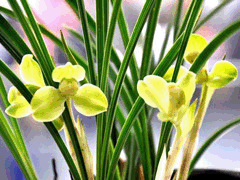
I remember one of myCymbidium faberiplants. Last year it came down from the mountain with 2 growths and 1 new shoot, and had a flower bud. At the beginning of this year, it did not send up new shoots, but it had one flower bud, and the flower form was quite good. After the flowering period ended, thisCymbidium faberidesperately sent up shoots, and by September 25 it had already grown to 14 shoots. When I went home this National Day, I saw theorchid grasswas too crowded, so I bought orchid pots and started repotting. I found it had added 1 new shoot, and I felt there was still another new shoot or flower bud, and not a single leaf had any scorched or crossed appearance. I am very satisfied.
Processing and screening of lazy man's soil:
Bring 3 sieves up the mountain, respectively large, medium and small, and screen in an orderly manner according to particle size, then put it into woven bags or burlap sacks. Because mountain soil is very heavy, I hired a donkey to carry it down the mountain, and the labor cost was 200 yuan per day.
After the lazy man's soil is brought down the mountain, it needs one coarse screening to remove impurities or things like grass seeds and straw, then use a disinfecting solution (I use thiophanate type), soak for 3 to 4 days, take it out and expose it to the sun for a few days. After it is fully dry, sort it into burlap sacks for future use. This kind of lazy man's soil does not break or scatter, always maintains a granular state, and is dark black. I feel quite good about it myself.
Potting with lazy man's soil:
My method is: after pruning theorchid grass, clean and disinfect theorchid grass, and dry it in the shade until the root system is somewhat shriveled and the surface color turns white-gray as the limit (fresh roots are afraid of being broken when potted, which affects future root development). By the same principle, the flower pot is the same: wash it, soak it to remove the fire energy, take it out and begin potting the orchid grass. The lowest layer is tiles or a breathable cover bought from the market (the kind with breathable holes). The next step is to place some coarser broken brick pieces or large good lazy man's soil, then add a certain amount of medium-coarse lazy man's soil. First lightly pat the pot wall so that the growing medium enters every gap, then place the orchid grass in, and add a large amount of lazy man's soil, placing it around the orchid grass respectively (to stabilize the orchid plant), but do not let the lazy man's soil enter the leaf grooves of the orchid plant. Hold the orchid grass with one hand, and with the other hand grab small-grade lazy man's soil to fill half of the orchid pot, then fill with medium-coarse grade lazy man's soil, and finally fill firmly with large-grade lazy man's soil, to about 2 cm from the pot rim. At the beginning, do not add lazy man's soil, lightly tap around the orchid pot so that the lazy man's soil fully clings to the orchid grass and orchid pot. At the same time, slightly lift the orchid plant, and lightly tap the orchid pot with your hand. After this, lightly press the pot surface, and the potting work is complete.
Soaking the orchid pot after potting the orchid grass:
For newly potted orchid plants, it is best to use the soaking method, as this makes it easy to fully absorb water. At the moment the orchid pot is placed in, you will hear a sizzling sound. After soaking in the water tank for about 20 minutes, take out the orchid pot, and it can enter a semi-shaded state for quiet cultivation, but it is necessary to maintain ventilation and breathability, as well as a certain amount of light (avoid direct sunlight). After one week of quiet cultivation, move it into the orchid room, orchid chamber or greenhouse, and switch to regular cultivation.