Orchid watering has its subtleties: master the four-look method
The four looks of orchid watering
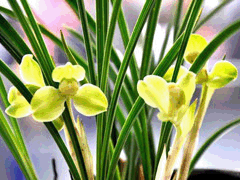 Some orchid lovers like to ask this question, "orchidwatering is mostly best done once?" This question cannot be answered simply. Becauseorchidwatering is a rather meticulous task. Since ancient times there has been the saying "dry orchids, wet chrysanthemums," but it is not that the drier the better. Plants all need water to grow,orchidsare no exception.
To grow orchids well, the growing medium is the foundation, the environment is the condition, and watering is the key. Orchid watering is both simple and not simple; you must carefully observe the orchid plants, frequently check the potting medium, and pay attention to changes in season and climate, and so on. It must be determined by the specific situation. What should you look at?
One, look at the growing medium: for householdorchid growing, the growing medium is generally not mixed all at once. Because the materials used differ, their water-retention capacity varies greatly, and their moisture retention differs. A medium with large particles that does not absorb water lets water run straight through to the bottom of the pot as soon as you water the surface; with this kind of medium you must water more frequently. If you use pond mud or leaf mold, its water retention is good, and one watering can last several more days. If you use "xian soil" (spent mushroom compost), its water retention is not as good as leaf mold. You must decide based on the coarseness of the medium and its water retention.
Two, look at theCymbidium goeringiipot: orchid pots differ in material, and their water retention differs greatly. For example, unglazed sandy clay pots have very good permeability, so you must water frequently. Purple clay pots have somewhat poorer permeability, but both are better than porcelain orchid pots. If you use porcelain orchid pots or plastic orchid pots, you must water less. Next, you must also look at the size of the orchid pot: a large orchid pot retains moisture for a longer time, while a small one dries quickly, so the number of waterings also differs.
Three, look at the climate: because the seasons differ, the temperature changes considerably, so the amount of water given to orchids also differs. In spring the orchid begins to grow and sprout, so watering should gradually be increased; if there is not enough water, the sprouting of new shoots will be affected. But just after winter, it is not suitable to suddenly increase the water volume; it should be increased gradually. In summer the climate is hot and the temperature rises, the orchid plants transpire heavily, and the potting medium dries quickly, so you must water frequently. In autumn the orchid plants are growing again, and water must also be ensured. But July and August are precisely the critical period for flower bud formation, so water should be appropriately controlled; otherwise there will be many leaf buds and few flower buds. In winter, watering frequency should gradually be reduced; when the temperature falls below 5°C, you should not water at all. The climates of northern and southern China differ greatly, so it must be judged specifically. No matter the season, you must also consider sunny days, cloudy days, and rainy or snowy days, and treat each different climate specifically. "Linghai Lanyan" proposed "six cases to avoid, four cases to increase, five cases to decrease," and although these refer to the Lingnan region of Guangdong, they can also serve as a reference.
Four, look at theCymbidium goeringiiplants: where there are many and they are growing vigorously, they transpire more water, so you should water frequently; where there are few plants and they are weak, the water requirement is small, so water less; diseased plants should also be watered less. Do not water before repotting. Next, you must also consider the habits of the variety; different orchid species need different amounts of water. For example,Cymbidium sinenseand Dendrobium require somewhat higher humidity;Cymbidium goeringiiand Cymbidium faberi require relatively lower humidity; Taiwanese orchids are semi-epiphytic orchids and can be watered less.
For orchid watering, three methods are generally used: spraying, pouring, and soaking. If the temperature is high and the air is dry, on sunny days, to lower the temperature and increase humidity, you can spray the leaf surfaces; if you do not need to increase humidity, you can pour directly into the potting medium with a kettle; if you are away on a trip or busy, have not watered for a long time, and the potting medium is too dry, then you need to use the soaking method. Place the orchid pot in a basin of water and let it soak slowly, but observe it at all times. As soon as the surface is wet, take it out immediately; it should not be soaked for a long time. A thoroughly dried medium lets water run straight through as soon as you water it; it looks as if it has been watered through, but in fact the medium in the pot is still dry and does not easily absorb enough water. As for the specific time of watering, morning and evening are both fine. From the perspective of when plants transpire, morning watering is best. Morning watering can also control the height of orchid leaves.
In short: do not water when not dry; when you do water, it must be just right, and by all means avoid giving half a watering. The potting medium should be dry but not parched, moist but not wet.
Contact address: Zhijin County No. 2 Middle School, Guizhou Province An Qichang
Postcode: 552100 Telephone: 0857-7625573