What are the planting tools and precautions for spring sword orchid (Cymbidium tortisepalum) seedlings?
Planting tools and precautions for spring sword orchid seedlings
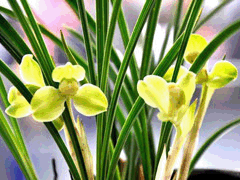 1. Planting in nutrient bags: For those planted in nutrient bags, use scissors to cut several additional holes in the bottom and sides of the bag on top of the existing ventilation holes, then place medium-coarse broken bricks, tiles or other drainage materials at the bottom of the pot to make up about one quarter of the orchid pot height as a drainage layer, then plant seedlings of the same type three plants per clump (because orchids like to grow in groups) (leave a 0.5-0.6 cm space between plants to encourage new shoots), with a plant spacing of 3 cm, 4-5 clumps per pot, and cover one third of the orchid crown with the substrate;
2. Pot planting: For those planted in other pots, be sure to use pots with good ventilation, and the larger the pot the better (preferably more than 30 cm in diameter). The drainage layer is the same as the method above. On the drainage layer, place a 2 cm layer of 50% crushed charcoal and 50% rice husk, then add the substrate and plant, 2-3 plants per clump, with a plant spacing of 3-4 cm, and cover one fifth of the orchid crown with the substrate or simply until the orchid roots are no longer visible;
3. Ground planting: For ground planting, water the bed thoroughly 2 days before planting, plant about 5 plants per clump when planting, with a plant spacing of 5-10 cm and a row spacing of 20 cm. Shallow drainage ditches should be left between rows (2 cm below the orchid crown surface soil is sufficient; too deep is not good for moisture retention), and the culture soil should cover one half of the orchid crown.
For those planted in orchid pots, the soak-pot watering method should be used after planting. For those planted in nutrient bags or in the ground, a watering can may be used, but watering cans bought on the market must be modified before use. The method is to remove the spray head and replace it with a 30-50 cm rubber tube with a diameter of 0.5 cm, so as to avoid water accumulation that causes seedling collapse when watering. Potted plants should be placed in a cool place for about 20 days after soaking (watering).
Because potted orchid seedlings are indoorsorchidswithout dew for care, it is best to adopt an outdoor cultivation method. If conditions do not allow, it is best to move the orchid pots outdoors at night. If it is an open-air balcony, it is best to set up a dual-purpose movable canopy that can both shade and block rain.
Newly planted orchid seedling management should pay attention to several aspects. First, for daily watering, it is best to use spraying or the soak-pot method; second, understand that spring sword orchid's humidity requirements for the substrate are not as high asChinese cymbidium (Cymbidium sinense)requires, so the watering interval can be extended by one day; third, appropriate rain exposure is beneficial to orchid seedling growth, but do not expose them to rain for consecutive days; fourth, for outdoor planting, a dual-purpose movable canopy for shading and rain protection must be built; fifth, for potted plants, after the orchid seedlings have been planted for 2 months, spray 700-800 times diluted orchid fungus king twice a month (except in hot weather), and do not fertilize ground-planted orchid seedlings; sixth, after the orchid seedlings are planted and have recovered, if new roots grow out exposed, promptly sprinkle some crushed humus soil or add sphagnum moss.
Whether planted in nutrient bags or orchid pots, several points should be noted: First, if all three plants in a clump produce new shoots, do not transplant them if they are not crowded; if crowded, they must be moved to a tall pot the following year. For the first pot change, adopt the method of planting multiple varieties together in one pot. A 15 cm diameter orchid pot can hold three varieties, with the substrate and method the same as above. The second transplanting should be carried out when each variety reaches four consecutive-generation plants, and at this time transplanting should be treated as mature seedlings. Second, when one of the three varieties per clump reaches four consecutive-generation plants, the variety with more plants must be moved to a tall pot for planting, and it may be planted one variety per pot, initially managed as a mature seedling. Third, weak seedlings should all be transplanted for the first time only after three consecutive-generation plants. The substrate used for the first transplanting should preferably be the substrate for dragon-root seedlings. Fourth, for ground-planted seedlings, whether strong or weak, the first transplanting should be carried out after two consecutive-generation plants; when transplanting, a single variety may be treated as one clump, with plant spacing and row spacing of 10 cm.
Guangxi Qin Shaoping
Contact address: Guangxi Luocheng County National Tax Inspection Bureau
Tel: 13907782256