Analysis of the Characteristics of Legume Vegetables and Their Pesticide Residue Situation
Do you like eating legumes? Do you know whether they have pesticide residues? Inspections have found that the pesticide residue failure rate of legume vegetables such as green beans, peas and common beans is as high as 63%. Among the pesticide residues detected were chlorothalonil, acetamiprid, carbaryl, dimethoate and others. To enable consumers to more fully understand the pesticide residue problem in legume vegetables, this article discusses the main reasons for the failures based on the results of the 99th year (2010) legume vegetable testing by the Agricultural Testing Center of this association. So extra attention must be paid.
˙Characteristics of legume vegetable crops
Legume vegetables such as green beans, peas, common beans, sweet peas, edamame and cowpeas are "continuous harvest crops." So-called continuous harvest crops are those in which on the same plant, the mature parts and the flowering and pollination stage exist simultaneously; simply put, the harvestable parts and the not-yet-harvestable parts exist at the same time. Therefore, to ensure that no pests or diseases occur and that harvesting can continue, pesticides are sprayed continuously. If farmers are not careful, a situation of spraying today and harvesting tomorrow can easily occur, causing the pesticide residue problem in continuous harvest crops to be more serious.
˙Statistical results of legume vegetable pesticide residues from the Agricultural Testing Center
In the 99th year (2010), the Agricultural Testing Center tested a total of 94 legume vegetable samples, of which 11 were organic vegetables, 73 were commercially available, and another 10 came from farmers under the guidance of certification bodies. The organic vegetable brands and the guided legume vegetables had no pesticide residues; of the 73 commercially available samples, 57 were non-compliant, as shown in Table 1. These results show that the food safety of legume vegetables from organic brands and under certification guidance is high; relatively, the commercially available portion, because its source is uncertain, carries a higher risk of pesticide residues.
Table 1. Results of legume vegetable pesticide residue testing by the Agricultural Testing Center in the 99th year (2010)

˙Discussion of the reasons for pesticide residue non-compliance
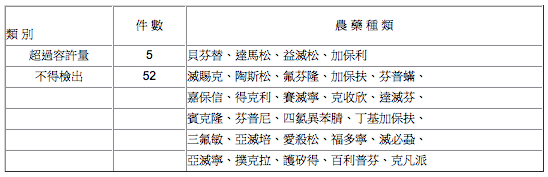
There are two categories in the definition of pesticide residue non-compliance. One is that the concentration of the detected pesticide exceeds the safety tolerance set by the Department of Health of the Executive Yuan; the other is that the detected pesticide is a pesticide that must not be detected. So-called pesticides that must not be detected are those legally registered and licensed, but approved for use only on other specified crops besides this crop. Among the 57 non-compliant legume vegetable samples in pesticide residues at this center, a total of 5 were due to pesticides exceeding the safety tolerance, and the types of pesticides detected in excess included 4 kinds: benomyl, dimethoate, formothion and carbaryl; a total of 52 were non-compliant because they were pesticides that must not be detected, and the types of pesticides detected included 24 kinds in total, including chlorpyrifos, carbaryl and acetamiprid, with detailed results shown in Table 2. These 24 pesticides that must not be detected cannot be used on legume vegetable crops.
From the above results, it can be seen that the main reason for the non-compliance of legume vegetables in pesticide residues is the application of pesticides that must not be detected, which is the main cause of the high non-compliance rate.
Table 2. Types of pesticides detected in non-compliant legume vegetables
Eat with greater peace of mind
Samples for pesticide residue testing are not subjected to pre-eating treatments such as washing, peeling or shelling. If such treatments are carried out, the vast majority of pesticide residues can be reduced before cooking. Therefore, it is recommended to increase the number of times legume vegetables are washed before eating and to purchase products from guided and certified brands, which will let us eat with greater peace of mind.