How Do Orchids Grow? A Detailed Explanation of Orchid Growth Habits
Orchid Growth Habits
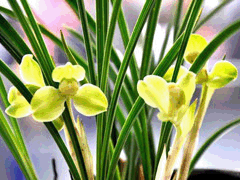 Epiphytic Orchids
In tropical regionsorchidshave the greatest number of species, and the vast majority of them are aerial plants, or more precisely, epiphytes. They grow on tree trunks, but do not absorb nutrients from the trees; some species grow attached to rocks or cliffs. These epiphyticorchidsuse their thick, sturdy root systems to attach to the surfaces of tree trunks and rocks, with most or all of their roots exposed to the air. The exposed rock supplies very few nutrients to the plants, which proves that theseorchidsare not parasitic plants.
The water and nutrients these epiphytic orchids need come from rainwater and the inorganic salts contained in it, and nighttime dew and fog can also serve as sources of water. Any tiny debris, such as fallen leaves, shed bark or even dead insects, that falls around the orchid roots and rots can serve as nutrients, and such debris is very abundant under the tropical forest canopy. Commonlycultivatedepiphytic orchid species include Cattleya, Vanda, Phalaenopsis, Dendrobium, and Cymbidium hookerianum.
Terrestrial Orchids
This category of orchids includes almost all orchid species native to cold and temperate regions. In tropical and subtropical regions, many orchids also belong to the terrestrial group. They have green leaves, and their root systems grow in soil mixed with fallen leaves, humus and sand and gravel, absorbing water and inorganic salt nutrients from the soil, much like common garden flowers. Terrestrial orchidflowers'root systems more or less clearly have filamentous root hairs, whereas the roots of epiphytic orchids do not have root hairs. Commonlycultivatedterrestrial orchid species are mostly Paphiopedilum,Cymbidium goeringii,、Cymbidium faberiand other Chinese orchids and Calanthe, etc.
Saprophytic Orchids
They have a special way of life, different from ordinary plants. They usually grow on decaying plant matter; for example, on rotting wood underground. Although there are only a few genera of saprophytes, they grow all over the world, especially in tropical and subtropical regions where they are more widely distributed. The famous Chinese medicinal herb Gastrodia elata is one of the saprophytic orchids. It grows underground year-round, and only sends up an inflorescence from underground when it flowers. It is now known that Gastrodia elata grows with the help of Armillaria mellea, which provides water and nutrients. Gastrodia elata has already beencultivatedon a large scale as a major product in China. Most of the Gastrodia elata on the market today comes from cultivated plants, which set a precedent for the artificialcultivationof saprophytic orchids and partly unraveled the mystery of how saprophytic orchids grow and reproduce.
It should be noted that orchidgrowthhabits are difficult to classify strictly. Because a typical epiphytic orchid may, by chance (such as a broken branch or a rotting tree), be forced to live on the ground, it then develops many roots growing into the soil like a terrestrial orchid, and all of its roots have root hairs. There are also some orchids, such as certain species of the genera Epidendrum, Oncidium and Cymbidium, that show no particular preference for epiphytic or terrestrial life, and the same species can grow into a thriving plant whether on a tree or in the soil on the ground.
In addition, there are some orchids that in the seedling stage are like true terrestrial orchids, growing in forest soil, and later develop into epiphytes growing on tree trunks. Examples include Vanda, Vanilla and Epidendrum, etc. (Lin Qingde, Mu Wei)