Foxtail Millet Cultivation Techniques: Field Management Measures and Pest and Disease Control Methods
Foxtail millet cultivation techniques and field management - do you know them?Soil selection and land preparation with basal fertilizer application,sowing and thinning,weed control and intertillage with earthing up - are you clear on all of these? And there is also pest and disease control - if you do not understand, let us take a look together.
(1) Soil selection and land preparation with basal fertilizer application
Foxtail millet is best suited to loam, sandy loam, clay loam and other soils with good structure, high organic matter content and a soft, loose texture. Foxtail millet is not suited to continuous cropping, so when planting, fallowing, rotation with green manure or legume crops should be used to build up soil fertility.
Because foxtail millet seeds are small, levelling the field and breaking up clods before sowing can avoid the problem of slightly larger clods hindering germination. If the soil is dry before land preparation, it should first be irrigated and then drained, so that the soil moisture content is kept at 15-20% humidity during the operation.
The fertilizer requirement of foxtail millet is nitrogen : phosphoric anhydride : potassium oxide at approximately 100:50:50 kg per hectare, and the basal fertilizer is applied during land preparation before sowing. If a compound fertilizer is to be used, Taiwan Fertilizer No. 5 compound fertilizer (N:P2O5:K2O = 16:8:12) may be applied, with half of 600 kg per hectare, i.e. 300 kg, as basal fertilizer, and the remaining 300 kg split into one to two top dressings.
(2) Sowing and thinning
Foxtail millet seeds have dormancy, so they should be stored properly before sowing; before sowing, they should be taken out every 2 months and sun-dried for 1-2 days before being put back into storage. The seeds used must not be too old; those more than two years old have an extremely low germination rate. Before sowing, the seeds need to be carefully selected, and half a month before sowing they should be sun-dried for 2-3 days on sunny days for later use.
In the Taiwan region, foxtail millet has two planting seasons, spring and autumn; the spring sowing period is from early to late February, and the autumn sowing period is from early to late August, with spring cropping generally being more common. The sowing rate is 8-10 kg per hectare. Before sowing, shallow furrows are opened at a row spacing of 30 cm, the seed is sown in drills, and then covered with soil.
About 20 days after sowing, when foxtail millet has 5-6 leaves, thinning is carried out. The method of retaining seedlings in foxtail millet is to thin to a plant spacing of about 10 cm, keeping 1-2 seedlings, so that the number of plants per hectare is about 330,000.
(3) Weed control and intertillage with earthing up
Weed control: Using pre-emergence herbicides to control weeds before sowing foxtail millet can save labour. After the seeds are covered with soil, spray the pre-emergence herbicide 50% linuron wettable powder, diluted 1,000 times, at 1 kg per hectare, or 21% bensulfuron-methyl wettable powder, diluted 4,000 times, at 400 g per hectare; these have the least effect on foxtail millet germination and effectively suppress weed growth. Then at the booting stage, 44% bentazon solution diluted 200 times, at 3 litres per hectare, can suppress weed growth throughout the whole period without affecting the yield and quality of foxtail millet.
Intertillage with earthing up: Carrying out intertillage with earthing up during the growing period is also one of the ways to control weeds. Intertillage can regulate soil aeration and moisture conditions, promote the activity of aerobic microorganisms, strengthen the decomposition of organic matter, and also prevent lodging. Foxtail millet can be intertilled at the seedling stage, jointing stage and booting stage. At the seedling stage, intertillage is carried out at the same time as thinning; at the jointing stage, the second intertillage is carried out, along with irrigation and fertilization, generally to a depth of 7-10 cm. At the booting stage, intertillage should not be too deep so as to avoid damaging the root system, generally 5 cm is appropriate, and the height of earthing up should mainly cover the basal nodes where aerial roots emerge.
(4) Application of top dressing
During the growth period of foxtail millet, the absorption of the three major fertilizer elements is greater in spring cropping. There are obvious differences in fertilizer absorption at different growth stages, with the greatest fertilizer requirement from booting to heading, and nutrient absorption gradually decreasing after heading. For the first top dressing of foxtail millet, nitrogen and potassium fertilizers are mixed and applied at half the rate each per hectare; if Taiwan Fertilizer No. 5 compound fertilizer is used instead, 150 kg per hectare is applied 30 days after sowing. The second top dressing is applied around 50 days after sowing.
(5) Irrigation and drainage
During the growth period of foxtail millet, the number of irrigations is 1-3 times, and irrigation is given only when the climate is dry; moderate drought at the seedling stage is beneficial to growth. Foxtail millet has a relatively large water requirement around the jointing stage and from the booting stage to the heading stage. If there is no suitable rainfall at the milk-ripe and maturity stages, irrigation should be carried out; after entering the milk-ripe and maturity stages, if there is no suitable rainfall, irrigation is also needed, though the water requirement at this time is not great. If heavy rain and water accumulation occur at the seedling stage, it will affect seedling growth; at the flowering stage it will affect pollination, leading to incomplete pollination and the formation of empty grains; at the milk-ripe and maturity stages it often leads to lodging of the plants and causes pests and diseases, so drainage ditches should be opened.
■ Diseases, insect pests, bird damage and their prevention
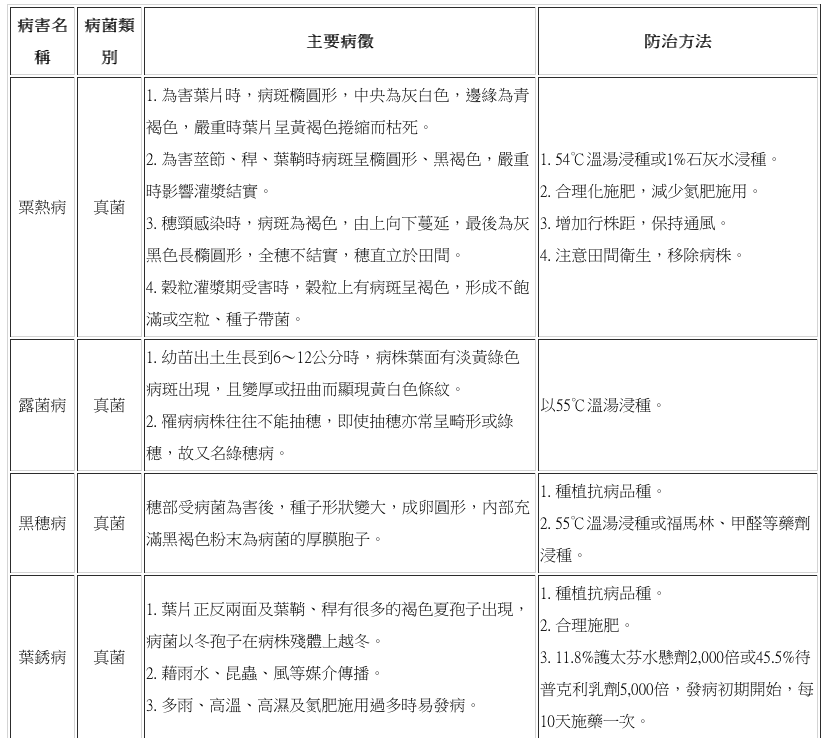
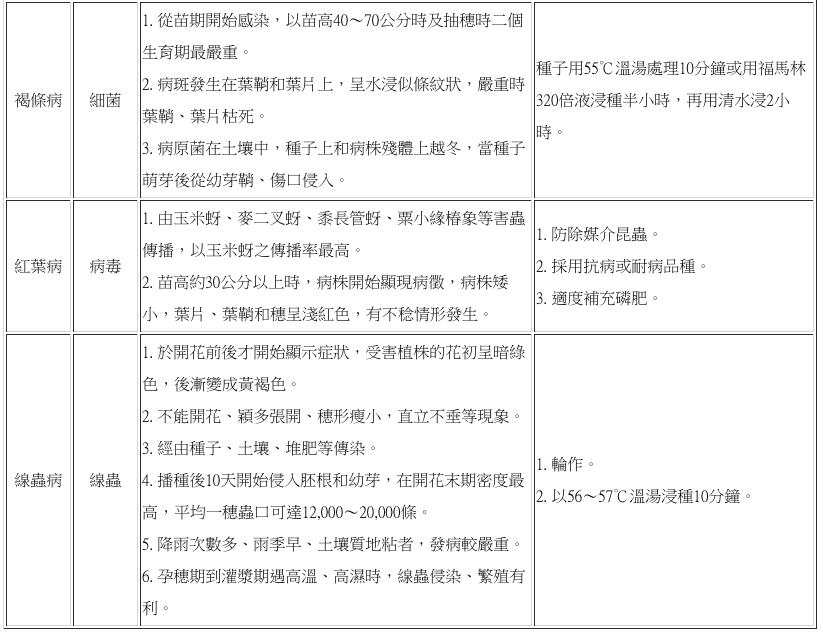
(1) Diseases: The main diseases of foxtail millet number eight, including those caused by fungi, bacteria, viruses and nematodes; their main symptoms and control methods are shown in the table below.
Disease control should vary according to different regions and different types, but according to the actual degree of occurrence in the field, the control principles are as follows:
Rotation: There should preferably be more than half a year of fallow or rotation; the downy mildew pathogen can survive for three years, so if this disease occurs in a foxtail millet field, when replanting it is best to have an interval of more than three years.
Select disease-resistant or disease-tolerant varieties: Although the Taiwan region does not yet have variety disease testing materials available for application, varieties can be retained from observation or obtained through consultation.
Seed treatment: Pathogens can be controlled through seed treatment procedures such as hot water soaking and seed dressing.
Adjust the sowing period: When the soil temperature is lower, the time for seedlings to emerge is prolonged, increasing the chance of pathogen invasion in the soil; adjusting to sow when the temperature is slightly higher can reduce disease occurrence.
Strengthen field management: Through measures such as intertillage, weeding, fertilization and irrigation, certain diseased plants can be removed and sources of infection reduced; also, through good management, cultivating healthy plants can increase disease resistance or tolerance.
Chemical control: Applying chemical control according to different categories of disease can achieve rapid and reliable results, but the principles of appropriate timing, appropriate pesticide and appropriate dosage must be observed.
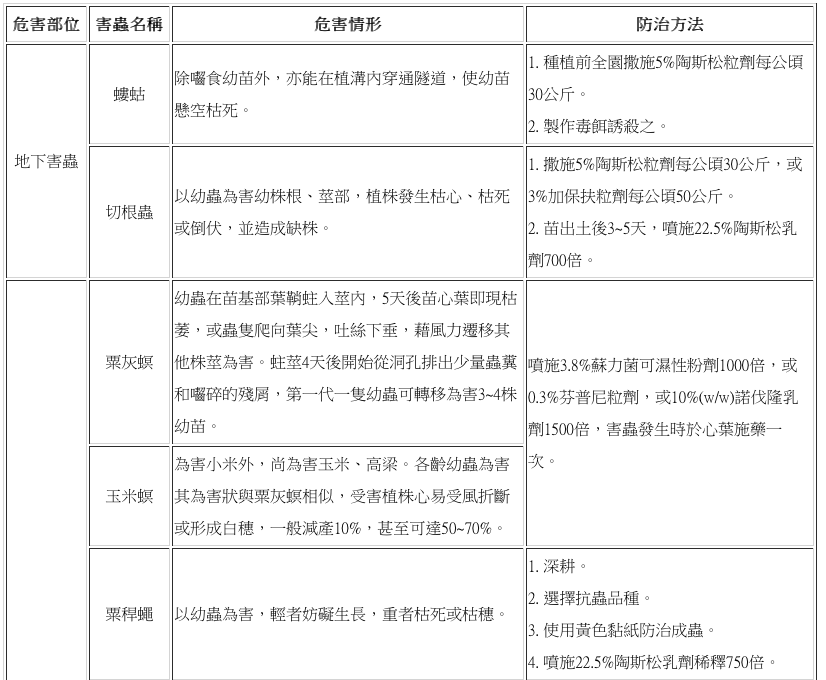
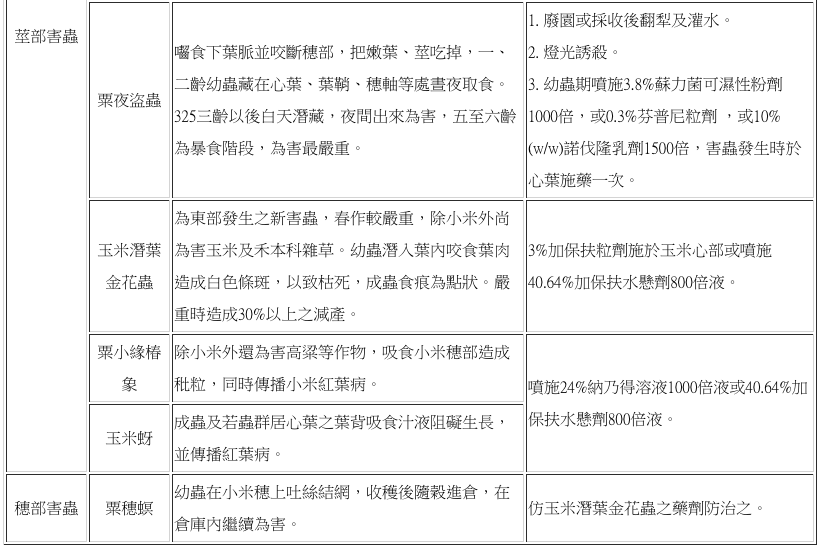
(2) Insect pests: According to the different parts of the foxtail millet plant damaged by pests, they are divided into underground pests, stem pests and ear pests; their degree of damage and control methods are described in the table below.