Agricultural drones have wide applications, excelling at spraying, fertilizing and disaster surveying
Nowadays drones are being used more and more widely, and they are also used in agriculture. Let's take a look together.
Unmanned aerial vehicles are seen as a promising new capable assistant for the future development of agriculture. Not only has the Civil Aeronautics Administration been busy drafting regulations, under which anything above 250 grams will in future require real-name registration, but all sectors are also actively investing in developing agricultural and other uses of drones. The Agricultural Research Institute of the Council of Agriculture, Executive Yuan, has set up a drone team and is currently building experimental data; in future it is expected to establish a set of operating manuals for farmers to refer to.
Using drones to reduce pesticide drift: climate and operating parameters are key
The Agricultural Research Institute of the Council of Agriculture, Executive Yuan, today held the "Symposium on Realizing Smart Agriculture Technology with UAVs," attracting about 100-plus practitioners and experts from industry, government and academia to discuss the current status and future of drone use in Taiwan, China.
Kuo Hung-yu, head of the Chemistry Division at the Agricultural Research Institute, pointed out that the nozzle specifications for drone pesticide application must change with different crops and environments. "Sometimes the droplets sprayed out are too small; although they are very fine, because the sunlight is strong, the pesticide droplets may evaporate before they even land on the leaf surface, so they are not necessarily suitable."
"The first thing to carry out is meteorological observation," said Huang Wen-da, associate professor in the Department of Agronomy at National Taiwan University. The use of drones for pesticide spraying is strongly constrained by environmental factors, and one must pay attention to whether the wind speed at 1.5 meters above the land surface is below 3 m/sec before it is suitable to carry out. In addition, during spraying, do not raise or lower the body of the machine at will, so as not to cause pesticide drift.
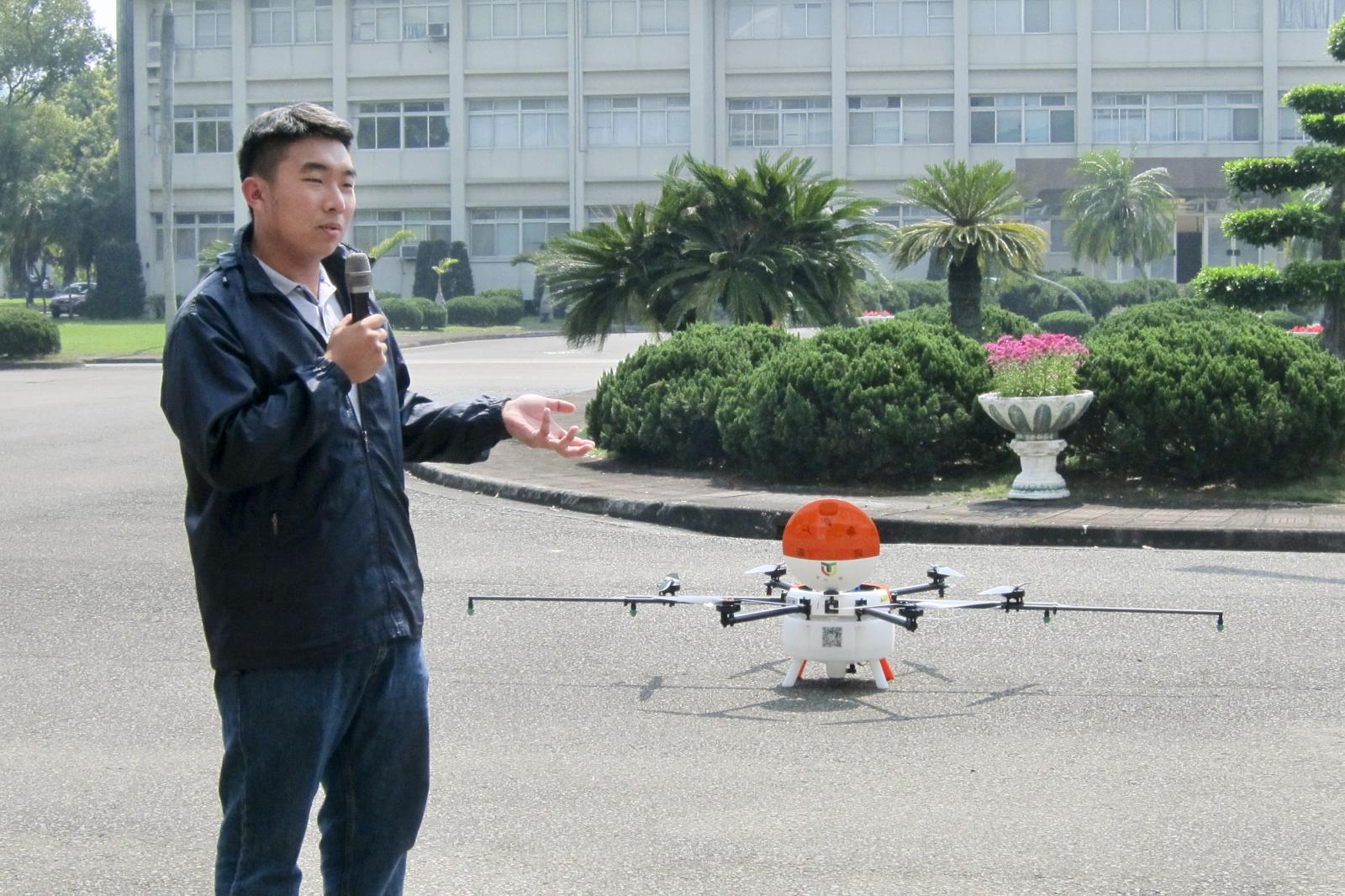
Kuo Hung-yu explained that besides nozzle specifications, the flight altitude during pesticide application also affects the results. "Previously, when spraying celery and cauliflower, the wind speed of the drone was very strong. We originally flew lower wanting to spray the pesticide, but the wind it beat down instead broke all the plants." Kuo Hung-yu said the drone team at the Agricultural Research Institute is currently building experimental data, and in future it is expected to establish a set of operating manuals for farmers to refer to.
The Agricultural Research Institute today held the "Symposium on Realizing Smart Agriculture Technology with UAVs," inviting many experts from industry, government and academia to share their experience, and also had domestic manufacturers give on-site operation demonstrations to promote professional exchange.
Drone aerial photography assists disaster surveying, greatly helping decision-making
Just how useful drones are, ask the Agriculture Department of the Chiayi County Government and you will know. Lin Liang-mao, director of the Agriculture Department of the Chiayi County Government, pointed out that in recent years Chiayi County has actively used drones to assist with agricultural administration work within its jurisdiction, greatly improving the efficiency and accuracy of decision-making.
"We fly once before the disaster and once after the disaster, then use overlay maps to compare, and the accuracy is very high." Lin Liang-mao said that things like rice lodging and damage to facilities can all be investigated with the help of aerial photography drones, and can be determined very quickly. Using drone aerial photography to assist with surveys of agricultural natural disasters not only reduces the loss of time and manpower, but through image interpretation technology it can also quickly and relatively objectively understand the degree of disaster damage, and can even shorten the time for farmers to resume cultivation. In addition, Chiayi County also uses drone aerial photography for agricultural statistics, helping to grasp agricultural production conditions; even shallow-sea oyster farming can be clearly surveyed.
"Our biggest domestic problem is stuck on the legal basis and administrative barriers," Lin Liang-mao said. In fact, drone hardware technology is no longer a problem, and it has developed quite maturely internationally. Taiwan, China, has very good software, and combined together it can make drones a very useful innovative tool. Lin Liang-mao stressed that for a new tool to be usable, what is most needed is a legal basis; official regulations and administrative barriers must quickly catch up so that drone applications can be promoted, creating an industry environment and producing real benefits.
In recent years the Chiayi County Government has actively used unmanned aerial photography drones for agricultural statistics, cooperating with professional laboratories to interpret images, which is very helpful for determining agricultural conditions. The picture shows image analysis of rice lodging in Xikou, Chiayi. (Image provided by the Agriculture Department of the Chiayi County Government)
Drones paired with artificial intelligence learning for truly "precise" pesticide application
Feng Hai-tung, director-general of the Bureau of Animal and Plant Health Inspection and Quarantine, said that although the trend of civilian use of drones is growing more vigorous, the bureau most hopes that domestic manufacturers can quickly make various models become standardized, improving the current situation in which there are all kinds of models and specifications. "Use a specially suitable unit for whatever purpose, and only then will the work be efficient." Feng Hai-tung pointed out that Japan already has very professional classification for the standardization of drones, and he hopes the domestic sector can also learn in that direction.
This year, research and development will be invested in drone artificial intelligence precision pesticide application. "We hope that during flight it can automatically detect diseased plants, and then apply pesticide specifically to the diseased plants, rather than spraying everything." Fan Yu-han believes that drones can carry artificial intelligence learning, and should not be used only to apply pesticide to target farmland; developing intelligent recognition is what can let technology provide greater assistance.