What is the shape and taste of foxtail millet, and how long is its growth period?
Do you know foxtail millet? Do you know what foxtail milletis like in morphology? When is its growth period? Let's take a look together.
Foxtail millet is a type of millet. Foxtail millet originated in China and evolved from green foxtail (chromosome number 2n=18), and they cross easily with one another. In common folk usage, the currently cultivated foxtail millet (Foxtail millet) is generally called foxtail millet. The indigenous peoples of Taiwan, China have a long history of cultivating foxtail millet; it is their oldest food crop and is also regarded as their most sacred crop, possessing religious importance. All farming rituals are related to foxtail millet, and millet wine is an indispensable offering in the harvest festivals of every ethnic group.
■ Taitung foxtail millet industry and variety selection and breeding
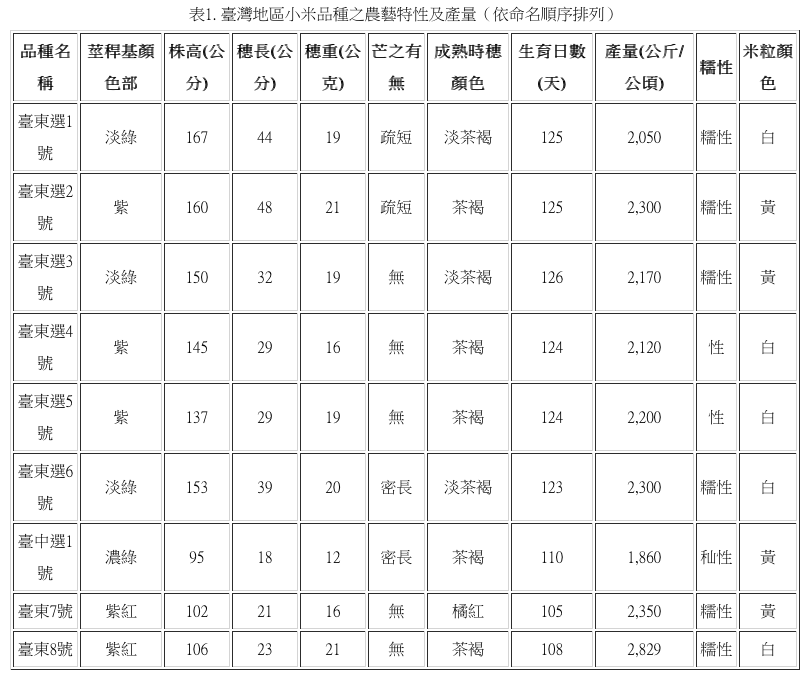
Because foxtail millet varieties in Taiwan, China have been cultivated for a very long time, most have become mixed and degraded, and most have been handed down through generations of indigenous peoples in various places. Therefore, this station began foxtail millet variety improvement work in the 46th year of the Republic of China, and after nearly ten years of selection, elimination, and trial cultivation, in the 54th year of the Republic of China it selected and named 6 excellent varieties, Taitung Selection No. 1 to No. 6, which increased yield by 31.9~46.9% compared with the original mountain varieties. In the 59th year of the Republic of China, the Taichung District Agricultural Improvement Station also introduced, selected, bred, and named Taichung Selection No. 1. In the 82nd year of the Republic of China, another excellent line was selected and bred and named Taitung No. 7. In addition, after many years of breeding at this station, the new line TTS-8508 passed review at the foxtail millet naming review meeting on October 31, 97th year of the Republic of China and was named "Foxtail Millet - Taitung No. 8". Foxtail Millet - Taitung No. 8 belongs to the short-spike type line, is dwarf, tolerant of dense planting, and has the characteristics of high grain harvest and stable yield. The grain color is refined white, the grain quality is glutinous, and the taste is also quite good; moreover, its autumn crop growth period is earlier maturing than other varieties, making harvest convenient; its yield is higher than the control variety Taitung No. 7.
The relevant traits of the current foxtail millet varieties in Taiwan, China are detailed in Table 1
Morphology and growth period
(1) Morphology
Root: The foxtail millet root is a fibrous root system, composed of primary roots and secondary roots. The primary roots emerge after the seed germinates. During the seedling stage, water and nutrients are mainly supplied by the primary roots. When conditions are good at the 4-leaf stage, secondary roots can form, and the root system expands rapidly, able to penetrate 150 cm into the soil, with an expansion radius of about 40 cm.
Stem: The stem is erect, about 60~150 cm long, cylindrical, with 10~25 nodes. Several internodes at the base are extremely short, and tillers can grow from this area, which is called the tillering node.
Leaf: One leaf per node, divided into leaf blade, ligule, leaf cushion, and other parts, with no auricles. The leaf blade is 25~65 cm long and 2~4 cm wide, long lanceolate. As the plant grows, the lower leaves gradually lose function, and usually 12~15 leaves are maintained during the peak growth period. The leaf sheaths and leaf cushions of many varieties appear purple in varying degrees because they contain anthocyanins, which can be used to identify varieties.
Spike: It is a terminal spike inflorescence, conical in shape. The spike is 10~30 cm long, with branches borne on the rachis, arranged in even-numbered opposite pairs. Each spike has about 70~150 primary branches, commonly called spikelets. The spikelet has 2 glumes and contains two flowers. The lower floret degenerates, and the pistil of the upper complete flower has a feathery stigma, three stamens, and after fertilization produces one grain. Each spike has 3,000~10,000 spikelets. The glumes and bristles of some varieties appear purple in varying degrees, which can be used for variety identification.
Grain: The grain of foxtail millet is a caryopsis, about 1.5~2.5 mm long, 1.4~2 mm wide, and 0.9~1.5 mm thick, with a 1000-grain weight of 1.5~2.5 g. After the grain matures, the glumes have different colors such as white, yellow, red, and black. After hulling, foxtail millet has colors such as yellow, white, and green.
(2) Growth period
The number of growth days of foxtail millet differs according to variety. Those with 110 days or fewer are early-maturing varieties, 111~125 days are medium-maturing varieties, and 126 days or more are late-maturing varieties. Most foxtail millet varieties in Taiwan, China are medium-maturing varieties.
Seedling stage: From germination to the growth of permanent roots (secondary roots). After the seed germinates, one new leaf can grow out in 1~5 days. When the seedling has 3~4 leaves, permanent roots can form if the soil is moist.
Jointing stage: From the growth of permanent roots to the beginning of stem elongation, generally starting at the 10-leaf stage. During this period the root system grows vigorously and the plant is most drought-resistant, so soil aeration should be maintained at this time.
Booting stage: From stem jointing to young spike differentiation. For general varieties, it begins 3~7 days after the plant begins to elongate. At this time, root, stem, and leaf growth is most vigorous, and water and fertilizer requirements surge, so sufficient irrigation and fertilization should be provided to help reproductive growth.
Heading stage: After young spike differentiation, the heading stage begins in 20~25 days. From the beginning of emergence of the top spike to full emergence takes 3~5 days. After emergence, the spikelets flower in 3~4 days. At this time, cloudy rain and drought are unfavorable.
Grain formation stage: The order of grain filling is from the top of the spike to the base, and from flowering to maturity takes 40~45 days. During this period the plant is neither drought-resistant nor waterlogging-tolerant, so moderate water and nutrients should be provided before the heading stage, and pests and diseases should be carefully prevented.