What causes plant pests and diseases? Tracing the origins of IPM crop production management techniques
IPM is not about setting absolute methods, but about finding the most optimized approach. Let's take a look together below.
Cruciferous crops in their growth pattern often develop serious pests and diseases only near harvest time. Taking broccoli as an example, the head is covered by outer leaves, and pests easily hide within, leading to poor control effectiveness; this causes farmers to apply pesticides at the wrong time or too frequently, making pest and disease management even more difficult.
According to the pesticide monitoring and testing results for agricultural products sold in markets and packing houses published by the Food and Drug Administration of the Ministry of Health and Welfare from 2014 to 2016, continuously harvested crops and cruciferous crops had the highest non-compliance rates.
The first 6 years went fairly smoothly, but in the 7th year the situation gradually worsened. There were once 3 to 4 cases of pesticide exceedance within a single month, and they were repeat violations. At that time, because the farmers' cultivation and pesticide use could not be traced, we had no choice but to absorb the fines ourselves. It was hard to speak of the bitterness then, and at the same time I began to think that agricultural products must be managed starting from the source, the farmers' end, in order to be safely delivered to the consumer end, rather than relying on back-end spot checks as the gatekeeping.
IPM is not about setting absolute methods, but about finding the most optimized approach
Afterward, Huang Chien-yi and Yang Su-chin actively participated in agricultural training courses held by the Yunlin County Government, including organic specialty classes and production-marker traceability counselor classes. It was also at this time that they began to encounter Integrated Pest Management (IPM), and thus came to know Yang Hsiu-chu, who was then a researcher at the Agricultural Chemicals and Toxic Substances Research Institute of the Council of Agriculture, Executive Yuan.
Nongwei Fruit and Vegetable Store currently focuses on small cucumbers as its main product, supplied by more than 20 farmers together. All small cucumbers are cultivated in facilities. Through the guidance of Huang Chien-yi and Yang Su-chin, the farmers gradually adopted IPM, making this a model example of complete IPM implementation at present. Yang Su-chin said that when she first began implementing IPM, she was only a counselor who had attended the specialty class, and each farmer's problems were different, so she did not fully understand everything.
After farmers busily harvest cabbage and broccoli, they use a rotary tiller to work the crop residues into the soil as base fertilizer, emphasizing fertilizer management. This is also one of the quite important IPM planning measures during the crop seedling stage. (Photo / Hsu Chung-ping)
There was once a farmer growing broccoli in the open field whose product, when listed, tested positive for pesticide exceedance. Yang Su-chin immediately reviewed the farmer's pesticide records and went to the site to inspect, but found nothing unusual, so she sought help from Yang Hsiu-chu. After an on-site investigation, it turned out that pest and disease control in a neighboring rice paddy had caused pesticide drift, contaminating the two rows of broccoli closest to the neighboring field.
Yang Hsiu-chu reminded the farmer to first maintain good neighborly relations. When the neighboring field sprays pesticides, conduct a test of the pesticide drift distance by placing paper kitchen towels at fixed distances and observing the wetting condition of the towels to determine the drift distance. Afterward, whenever the neighboring field sprays pesticides, it is recommended to cover crops within the drift distance with non-woven fabric. Since non-woven fabric can absorb pesticides, while using plastic sheeting may cause rebound and make pesticide drift more serious. The farmer followed Yang Hsiu-chu's suggestions, and the same problem never occurred again.
Another farmer adopted IPM to grow small cucumbers, but severe pests and diseases occurred and the fruit quality was poor, causing that season to end in a disastrous loss. Huang Chien-yi and Yang Su-chin immediately asked Yang Hsiu-chu to go and inspect. It turned out that after the farmer implemented IPM for one season, he found that the fruit quality was very good but the yield had not increased, so he left more fruiting branches while still maintaining one heart and one bud, which resulted in poor nutrition for the plants and weakened resistance.
Yang Hsiu-chu explained that the goal of IPM is not to provide one optimal method for all crops, but to give the most optimized method in response to different situations. When cultivation conditions differ, IPM must be adjusted accordingly and is not unchanging. Yang Su-chin said that fortunately Yang Hsiu-chu provided a complete consultation network. When farmers encountered problems that were difficult to solve, she went directly to the site of the problem to diagnose it and gave the farmers the most suitable management prescription, bringing them tremendous encouragement and confidence.
The problem of downy mildew in small cucumbers can be addressed through pre-planting disinfection, combined with pesticide control during the growing period. Since it is a continuously harvested crop, phosphorous acid can be used during the harvest period to avoid pesticide residues. (Photo / Hsu Yu-ping)
However, not all farmers are willing to adopt IPM. As soon as a problem occurs, they go directly to the pesticide store to buy pesticides. When the disease is severe, they apply pesticides twice a week, with as many as 10-plus products at a time. To improve this situation, Yang Su-chin holds farm observation visits from time to time, allowing farmers to see practices different from their own farms, such as how to prevent pesticide drift contamination from neighboring fields and how to control pesticides in continuously harvested crops. Farmers can directly feel the difference in crop quality and farm health.
Yang Su-chin recounted that there was once a novice farmer who initially grew small cucumbers using conventional farming methods. Whenever pests or diseases appeared, he would spray pesticides. Although the yield was not bad, the fruit was short and small. She communicated with the farmer several times without success; the farmer felt his technique was very good and his income was not low, so there was no need to adjust. It was not until he began observing other farms that he discovered his pesticide use was as much as 2 to 3 times higher, and that other farms' small cucumbers were good and long, reaching 23 to 24 cm, with the skin covered in bloom. In contrast, his own small cucumbers were short and covered in pesticide spots. Only then was the farmer truly convinced and willing to try using IPM.
Most farmers gradually discovered that using IPM together with production-marker traceability can indeed reduce the frequency and amount of pesticide use, while also making quality better and better and greatly reducing management costs, so they naturally became willing to change their management model. Yang Su-chin said this is also a consideration of mutual benefit. When crop quality improves and income becomes stable, farmers invest more on their own initiative, and the consumer end can also obtain better agricultural products.
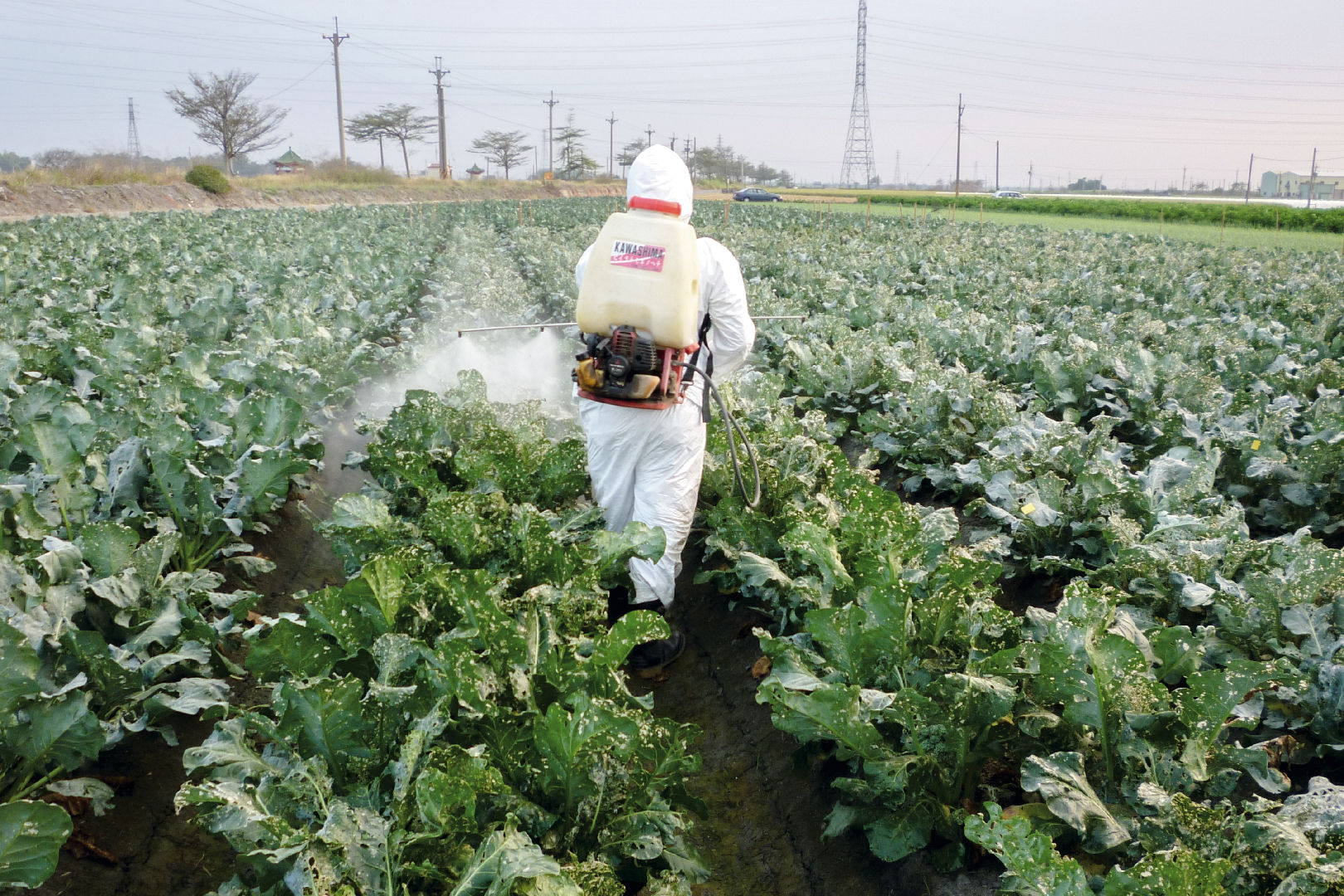
If pests and diseases occur only in the later stages of cultivation and pesticides must be sprayed to improve the situation, some small details must also be noted. For example, the pests of cruciferous crops often hide on the underside of leaves or within the wrapper leaves. When applying pesticides, attention must be paid to the spraying angle, and the pesticide must be sprayed on the leaf undersides or wrapper leaves so that the pesticide reaches and eliminates the pests. (Photo / Hsieh Pei-ying)
Building a sound production and marketing chain starts with caring for farmers' health
Although integration on the farmers' end has been completed, Yang Su-chin still set out 3 gatekeeping stages for each other. The 1st stage is "complying with contract farming regulations," cooperating with the guidance of Nongwei Fruit and Vegetable Store, using pesticides correctly and safely, and keeping complete cultivation records; the 2nd stage is "pesticide store gatekeeping." To avoid the risk of farmers secretly spraying pesticides or buying the wrong pesticides, it is recommended that farmers make purchases at a few cooperating pesticide stores, and through purchase records, it is also possible to understand whether there are violations or misuse.
In addition, Yang Su-chin also invited the pesticide store owners to visit the farms together. Besides getting to know the farmers, they can also understand IPM more directly from the agricultural front lines.
The 3rd stage is "inspection by the animal and plant disease control center." Once an agricultural product undergoes spot-check testing and a violation occurs, in addition to having to bear the consequences jointly, they must also face stricter inspections and guidance going forward. Yang Su-chin said that in this process, she stands on the front line with the farmers, facing things together and growing together. This is the commitment of a counselor to the farmers.
Huang Chien-yi and Yang Su-chin have been implementing IPM for more than 4 years. After obtaining production-marker traceability certification, they felt that social responsibility was gradually increasing, and they deeply realized that it is not only consumers' health that is health; true health begins with caring for farmers' health.
Through IPM, farmers use pesticides correctly, starting by reducing the frequency and amount of pesticide use. Farmers reduce their exposure to danger, the burden on the ecological environment is also lowered, and the various pesticide residues in agricultural products are far below the allowable values. This is a truly healthy production and marketing chain.
The use of IPM is a complete series of countermeasures, from problem diagnosis and prescription use to monitoring and prevention, providing effective and good protection throughout the crop growth process, and enabling farmers to clearly understand their own cultivation environment and crop growth status, combined with the correct concept of pesticide use, rather than spraying large amounts of pesticides to clean up after pests and diseases appear. Through IPM, more farmers, when pests and diseases occur, can explore the causes from more perspectives and be given the most suitable solutions.
Through long-term guidance and communication of concepts, farmers can truly understand the spirit of IPM and put it into practice, conveying correct cultivation concepts. Furthermore, combining IPM with production-marker traceability can also make the vegetable and fruit cultivation process in Taiwan, China more transparent, allowing consumers to purchase with peace of mind.