Detailed Guide to Vegetable Greenhouse Construction Methods and Benefits
Based onexperts' experience sharing, this article separately introduces the common Lee Ba type greenhouses, as well as smart flower production facilities that incorporate technology and operate on an enterprise scale, and reminds farmers how to assess their needs, profitability, and other key points, so as to build the ideal greenhouse that suits them.
To stabilize harvests, many farmers have invested in protected agriculture, but the construction quality of these facilities varies greatly, and their typhoon resistance is often insufficient. After a single typhoon, losses can actually become even more serious. Therefore, promoting structurally reinforced greenhouse cultivation of crops has become an urgent priority. Taiwan is located in a subtropical region and is rich in diverse vegetables and fruits, but in recent years the frequency of extreme weather has increased. Typhoons are frequent in summer and autumn, and cold damage often occurs in winter, seriously affecting farmers' harvests. For this reason, the government must spend huge amounts on natural disaster relief.
For sustainable greenhouse management, sturdiness, durability, safety, and profitability should be considered
"Improving profitability and achieving sustainable operation are the primary considerations when building a greenhouse," said Wang Shih-hsien, director of the Tainan District Agricultural Research and Extension Station. Wanting to be profitable involves the crops being cultivated, and farmers can observe from downstream channels whether the prices of protected-cultivation crops meet demand; through crop rotation, for example, many greenhouses in Chiayi County grow small-fruit tomatoes in winter and Meino melons or green manure in summer, which not only sustains soil use but also improves crop quality.
The Crop Environment Section of the Tainan District Agricultural Research and Extension Station suggests that, from the farmer's perspective, one should first decide what crop to grow, and whether open-field cultivation or greenhouse/net-house cultivation yields higher output and value. How long will it take to recover the cost? If it already grows well in the open field, why is a greenhouse still needed? Then evaluate and consider from angles such as pest and disease prevention, rain protection, wind resistance, bird prevention, and microclimate modification. However, greenhouses also have disadvantages. For example, in summer, temperature and humidity are usually higher, and the day-night temperature difference is large. Without proper environmental control, pests and diseases easily breed.
To save money, some farmers often choose to build lower-cost simple plastic-film greenhouses. The Crop Environment Section of the Tainan District Agricultural Research and Extension Station said that when farmers use simple plastic-film greenhouses to grow small-fruit tomatoes, quality is almost always up to a certain standard, but the structure of simple greenhouses is relatively fragile. When a typhoon comes, the risk of damage or being blown down is greater. Since these are high-value crops, it is still advisable to use a structurally reinforced greenhouse with a proper foundation.
Last year, Typhoon Megi severely damaged agricultural areas in central and southern Taiwan. Lin Liang-mao, director of the Agriculture Department of the Chiayi County Government, observed that in earlier times, to allow workers and machinery inside greenhouses to operate smoothly, farmers would enlarge the span of simple plastic-film greenhouses.
"In the past there were no problems, but after they started enlarging and raising them, they became lantern-like structures, big and good-looking, yet unable to withstand typhoons. When a typhoon came, many greenhouses 'went weak in the legs,' crops and property were damaged, and there were even cases of people being crushed to death." Lin Liang-mao believes that the strength of some simple plastic-film greenhouses is seriously insufficient, and what is needed in recent years is structurally reinforced greenhouses that can resist natural disasters and protect farmers' safety.
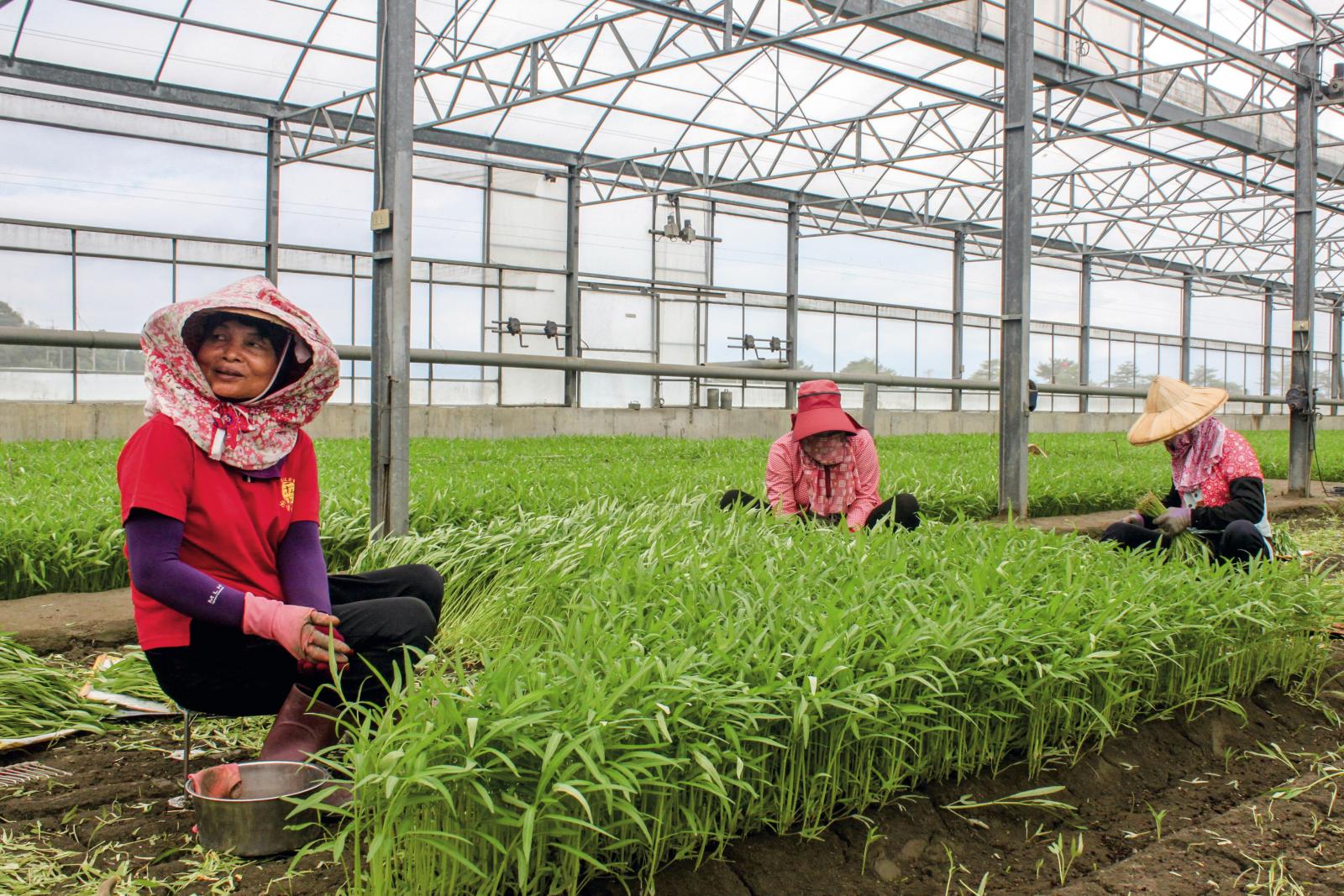
Lin Chun-sheng's Lee Ba type greenhouse grows water spinach, and the raised-height design keeps the interior ventilated, giving employees a comfortable working environment.
Protected agriculture stabilizes harvests, and short-term leafy vegetables can also be profitable
Traditional thinking holds that only high-value crops grown in greenhouses can be profitable, but Wang Shih-hsien feels this is not necessarily true. Although the same crop can be grown in the open field and in protected facilities, facilities can provide stable harvests year-round and better quality, creating an opportunity for profit.
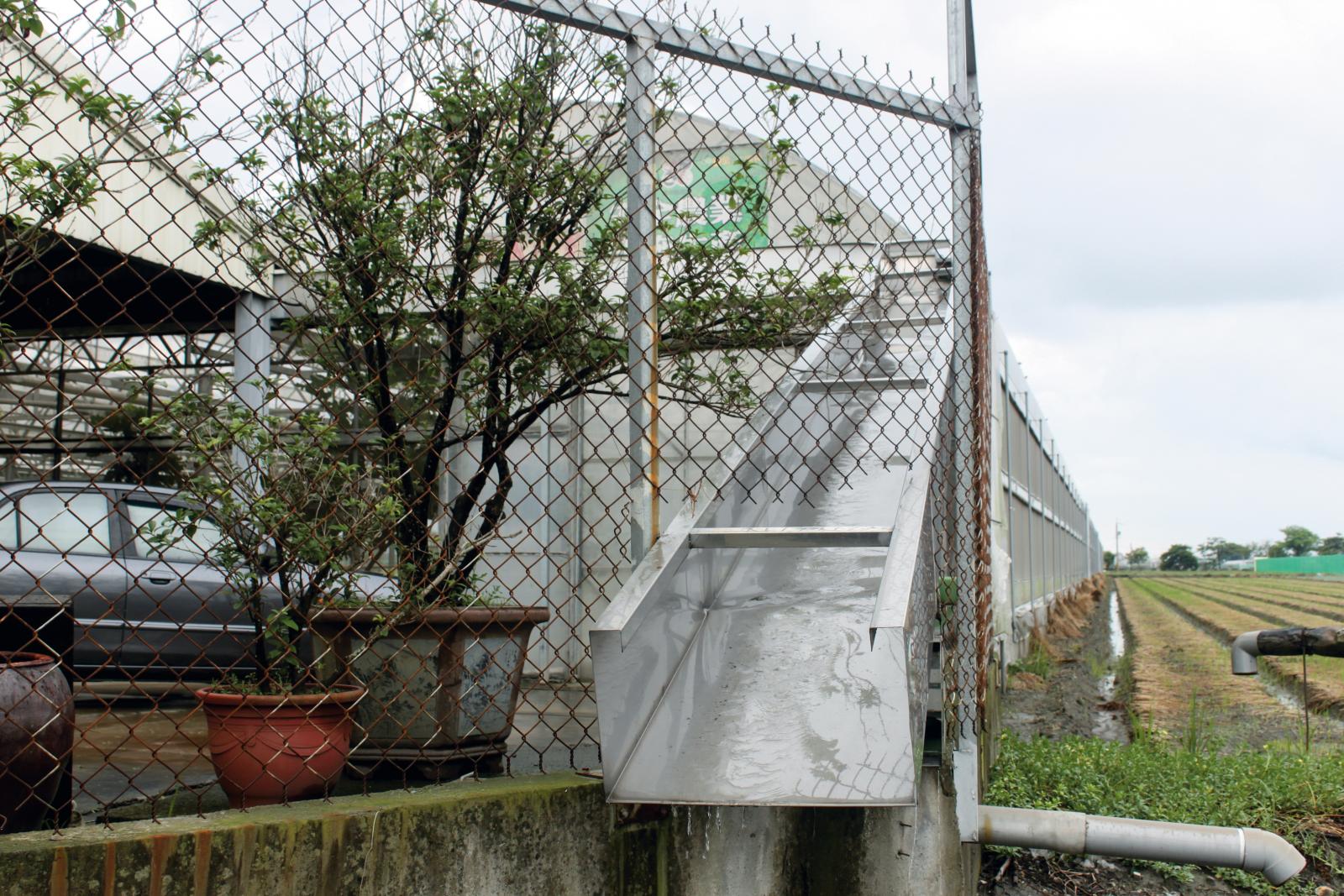
Futian Agricultural Products in Citong Township, Yunlin County, is a good example. Its head, Lin Chun-sheng, built a Lee Ba type greenhouse on 5 fen of land. On the day of the interview it was raining, and the greenhouse roof has drainage channels that collect rainwater and discharge it into ditches. In addition, the large day-night temperature difference makes condensation likely. Lin Chun-sheng worried that water droplets falling from above would injure the vegetable leaves, so the greenhouse uses anti-drip agricultural plastic film and directs roof condensation to flow into the drainage channels.
From the outside, Lin Chun-sheng's Lee Ba type greenhouse roof is a multi-span structure combining an arched type with a single-slope type. Lin Chun-sheng said that placing the arched roof on the outermost side provides wind resistance, and because ventilation in the middle of multi-span greenhouses is usually poorer, a single-slope roof is used in the middle to increase air convection and ventilation.
What Lin Chun-sheng grows in his greenhouse is not some especially high-value crop, but water spinach. He said that in summer, the farm-gate price of greenhouse water spinach is 2 yuan more per kilogram than open-field cultivation, and 5 yuan more in winter. If a wind disaster occurs and the market lacks vegetables, greenhouse water spinach can be 12 yuan higher than open-field. A greenhouse costs on average NT$1.2 million to NT$1.4 million per fen to build, and with proper management, the cost can be recovered in about 4 to 5 years.
Looking around the greenhouse, besides noticing that the interior uses a raised-height design, black shade nets hang from the beams, and every other post has a socket installed so electric fans can be plugged in. This is Lin Chun-sheng's thoughtful design to keep workers comfortable. Most people think that although a raised greenhouse is well ventilated, it also carries a greater risk of tilting under strong winds. However, Lin Chun-sheng's greenhouse uses integrally formed hot-dip galvanized steel pipes, which have strong wind resistance, so there is no need to worry even if it is raised.
The local farmland has a high groundwater level, and water easily accumulates when it rains. For crops inside the greenhouse, waterproofing is the first priority. The lower side walls of Lin Chun-sheng's greenhouse are made of cement, and drainage ditches have also been dug. When it rains, they become like a moat, and the water is then pumped dry with a pump motor.
In addition, growing the same crop on the same piece of land for a long time can easily cause imbalanced development of soil and crops, accumulate pests and diseases, and over time create continuous cropping obstacles. Lin Chun-sheng also has a solution: installing steam hoses in the greenhouse and using steam to disinfect the soil. Overall, the indoor and outdoor design is full of ingenuity everywhere.
Water spinach farmer Lin Chun-sheng's greenhouse roof has drainage channels that can collect rainwater and discharge it into ditches.
Wang Shih-hsien affirmed Lin Chun-sheng's Lee Ba type greenhouse design and management. He said that although water spinach is not a high-value crop, it can be harvested 14 times a year in the facility, giving a high turnover rate. "In early June this year there were continuous heavy rains. Others had no vegetables, but he had vegetables. With greenhouse cultivation, one can achieve this kind of model."
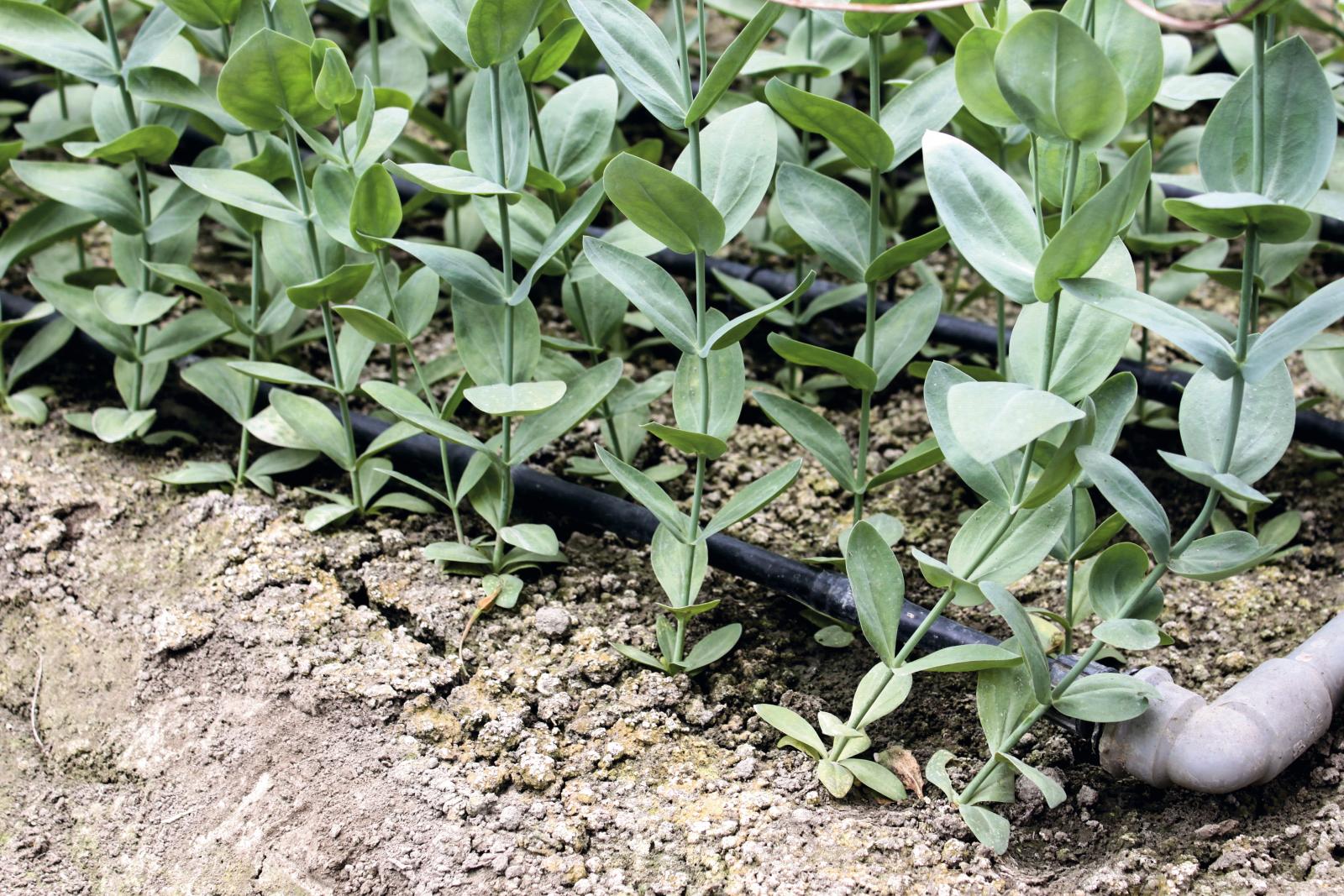
Combining greenhouses with drip irrigation systems saves both water and labor
Also in Yunlin County, the Huwei Flower Special Zone has multiple Lee Ba type greenhouses built in earlier years on 4.07 hectares of land. This area was once a famous protected production zone for summer vegetables and winter flowers, growing heat-tolerant small-fruit tomato varieties in summer and chrysanthemums in winter. Later, as export orders for lisianthus increased, it gradually switched to year-round lisianthus cultivation.
Although the local greenhouses were built in 2002 and their appearance is already somewhat old, they have still withstood several typhoons and remain standing firm. Tsai Wu-chi, director of the promotion department of the Huwei Township Farmers' Association, said that Huwei's greenhouses used hot-dip galvanized H-beams very early on, which do not easily rust in the soil environment.
The greenhouse interior uses a raised-height design and is equipped with internal circulation fans and manually operated skylights to increase ventilation; the indoor span is 11 m, and the utilization rate of the work-line layout can reach 82%, much higher than the roughly 70% utilization rate of ordinary greenhouses.
In terms of irrigation, because groundwater in the Yunlin-Chiayi-Tainan area has high iron content and easily clogs pipes, the Huwei Flower Special Zone first treats extracted groundwater through a reverse osmosis (RO) system and uses drip irrigation equipment to supply water evenly to each lisianthus plant. Wang Shih-hsien said that, apart from leafy vegetables, delicate agriculture should generally all use drip irrigation systems, saving both water and labor.
If galvanized pipes are not treated for rust prevention, rusted areas are prone to breaking after long-term exposure to wind and rain and soaking in water. (Photo / Wang Wen-hao)
Integrally formed galvanized pipes should be used to avoid water accumulation, rust, and bending at joints, and screws also need rust prevention treatment. (Photo / Wang Wen-hao)
Bringing in technology, smart facilities can achieve enterprise scale
If farmers have the means and take a long-term view, then in addition to building structurally reinforced greenhouses, they can also consider investing in more advanced technology and environmental control systems.
At Mingxing Orchids in the Taiwan Orchid Biotechnology Park in Houbi District, Tainan City, driving past the perimeter of the site reveals impressive multi-span greenhouses; upon entering the "fan-free water-wall green energy greenhouse," the elaborate design and computer control system are even more astonishing. These ideas all come from an industry maverick——Lin Ming-hsing, chairman of Mingxing Orchid Garden.
Lin Ming-hsing practices orchid stem-inhibition cultivation, focusing on large seedlings for overseas markets, with exports spanning 5 continents, including the United States, Canada, Japan, France, South Africa, and the Dominican Republic. From September to April of the following year, low temperatures promote the emergence of flower stems in Phalaenopsis, that is, the transition from seedling plants to flowering plants. Therefore, how to control temperature to inhibit flower stems becomes the key.
Usually, orchid production in summer relies on fan-and-pad water walls to circulate cold air inside the greenhouse and achieve cooling; in winter it relies on fuel oil, gas, or electricity for heating. Both heating and cooling are necessary for the orchid industry. However, with energy costs rising recently, how to effectively control costs has become very important. Lin Ming-hsing referenced the Nordic principle of using the constant underground temperature of nature and developed a raised-height fan-free water-wall green energy greenhouse.
The Huwei Flower Special Zone in Yunlin County began using drip irrigation systems very early, saving both water and labor.
Lin Ming-hsing showed his smartphone, which contains a computer coding system he developed that can precisely control the microclimate inside the greenhouse, including temperature, humidity, wind direction, wind speed, boiler operation status, and the opening and closing direction of skylights. With one device in hand, even when abroad, he can know the cultivation conditions in the park.
Thanks to this system, the previous winter heating cost of about NT$900,000 per month was reduced. By observing the wind-chill effect of the northeast monsoon and fine-tuning parameters, he saved more than NT$400,000. Lin Ming-hsing said that operators usually identify the center point of the greenhouse as the temperature standard. In fact, the temperature at every point in the greenhouse is different. If heating is based entirely on the center temperature, then in winter when sunlight comes in at a slant, the surrounding areas are already warmer yet continue to be heated, wasting energy. "My heating system is targeted. Whichever point is insufficient gets supplemented."
The fan-free water-wall green energy greenhouse is so vast that from the entrance no end can be seen. The floor is made of gleaming tiles, and small bicycles are provided for employees to ride while patrolling the park. Inside the greenhouse, irrigation is carried out through 2 automatic watering machines developed by Lin Ming-hsing, which can save the labor of 7 people and also achieve water savings. Lin Ming-hsing did not use a fan-and-pad water wall because the greenhouse interior uses a raised-height design; if a fan-and-pad water wall were added and pulled higher, the temperature layers would change too much and consume electricity. However, because there is no water wall bringing humid air into the interior, not only is humidity reduced, but pests and diseases are also reduced. He also uses Japanese-made 360-degree rotating turbid-flow fans to achieve all-around circulating ventilation and constant-temperature effects.
Wang Shih-hsien said that farmers themselves should be clearest about what kind of greenhouse they want to build and what functions it needs. For example, the higher the precision of Lin Ming-hsing's greenhouse control, the better the effect and the more labor saved; but the higher the precision, the more energy it consumes relatively. Therefore, Lin Ming-hsing emphasizes making good use of energy to save costs, and this can only be achieved with a comprehensive understanding of plant physiology and technological application.
Lin Ming-hsing developed the fan-free water-wall green energy greenhouse to develop orchid stem-inhibition cultivation. (Photo / Wang Wen-hao)
Through computer smart system control, temperature control can be made more precise. (Photo / Wang Wen-hao)
Make good use of technology to improve management efficiency and stop depending on the weather
Yunlin flower farmer Chen Kuo-ming, head of Jingpin Horticulture Co., Ltd., also believes that only by investing in advanced automated equipment, finding energy-saving methods, and improving efficiency is there a chance to profit and reduce overall costs. "Some people think that farming should save costs and reduce investment in equipment. This is wrong. If you want to increase profits, only something under controllable conditions can be called an industry."
Chen Kuo-ming has achieved success in lisianthus cultivation. In addition to 1.7 hectares of greenhouses for cut flowers, his farm also has a seedling greenhouse that uses an environmental control system for cooling and dehumidification. Entering it in summer, a refreshing coolness greets you.
Lisianthus seedlings require temperatures of 25 to 27 degrees Celsius during the day and 16 degrees Celsius at night. To overcome high temperatures that cause lisianthus to go dormant, early flower farmers mostly transported them to Alishan or near Qingjing Farm in Nantou for seedling cultivation. At first, low-temperature seedling cultivation in the mountains worked fairly well, but natural conditions are not always stable. For example, winters may be too cold and require heating, high humidity in the mountains can easily interfere, or seedlings can only be raised in certain seasons, while transportation costs are another expense.
Now that flatland greenhouses have environmental control equipment, they can be adjusted to the environment lisianthus likes, and flowers can be supplied year-round. Chen Kuo-ming said that imported seedlings cost NT$3 to NT$4.5 each, while cultivating them in Taiwan with cooling rooms costs only NT$2.6 to NT$3 each, making costs lower and relatively more competitive.
To reduce heat sources entering the greenhouse cooling room, Chen Kuo-ming added not only shade nets on top but also double-layer inflated plastic film for insulation.
"If you want to lower operating costs, you must save energy and improve efficiency." Chen Kuo-ming said that the cooling room of his seedling facility uses a heat pump (a device that transfers heat energy) to make ice water. The ice water enters the greenhouse to circulate, then carries the heat source out of the greenhouse, which helps cool the interior and saves more energy than oil heating.
He especially reminds people not to underestimate the sun, since light is also a heat source. To reduce heat sources entering the greenhouse and creating a burden on the air conditioning, the greenhouse roof is equipped with 1 layer of external shading and double-layer inflated plastic film. The external shading blocks light, and the double-layer inflated plastic film can provide insulation similar to a thermos. An ordinary greenhouse has only 1 layer of plastic film for wind and rain protection, while Chen Kuo-ming's greenhouse has an extra layer of plastic film for insulation, which can be said to indirectly save on electricity costs in the cheapest way.
"In the past, agriculture depended on the weather; now it depends on equipment to make money." Chen Kuo-ming said that agriculture is a profession, and farmers must think carefully before investing in equipment, including what crops to grow, whether output value and yield are competitive, how much layout space there is, how much efficiency the equipment can improve, how good the insulation effect is, how to save the most energy, and whether overall operating costs can be reduced.
He suggests that farmers should enhance their own professional knowledge, advance steadily step by step, and constantly observe how operators domestically and internationally do things. If they can learn from others' mistakes, they can avoid some unnecessary detours. In the future, he also hopes that after production capacity increases, he can purchase better equipment so that employees can enjoy a comfortable and friendly working environment and young people can be attracted to agriculture.