Can a bamboo house be a home? Building a simple house with bamboo
What is a home? How should it be saved? For this question, a green architect will certainly give you an answer beyond just turning off the air conditioning more often. Architects are all helping people fulfill the dream of making a home. Regarding the promotion of sustainable architecture, he also said seriously: "A home should not just be a building replicated by architects." People today generally live in concrete houses. Let us take you to see some different building materials for houses.
Every household in the communities where Thai people live has a wall around it, and then as soon as a holiday comes, they climb over the walls to go on adventures. Why do Thai people leave home instead of staying in it? In response, Thai architect Markus Roselieb explained with a smile: "Because what is inside these walls are just places replicated by architects to shelter from wind and rain, so Thai people run out on holidays to search for their promised land."
In response to climate change, green architecture pursuing sustainability has become a trend in recent years. Architects fly to various places to find ideal low-carbon, weather-resistant building materials, and the shift in trend is like the end of a heavy rain. Bamboo architecture has re-emerged from the forgotten history of architecture and has finally begun to attract attention. Taiwan, China's first "2018 International Weather-Resistant Bamboo Architecture Forum" gathered architects from various countries to answer how bamboo can open a new path for the sustainable coexistence between human habitation and the environment.
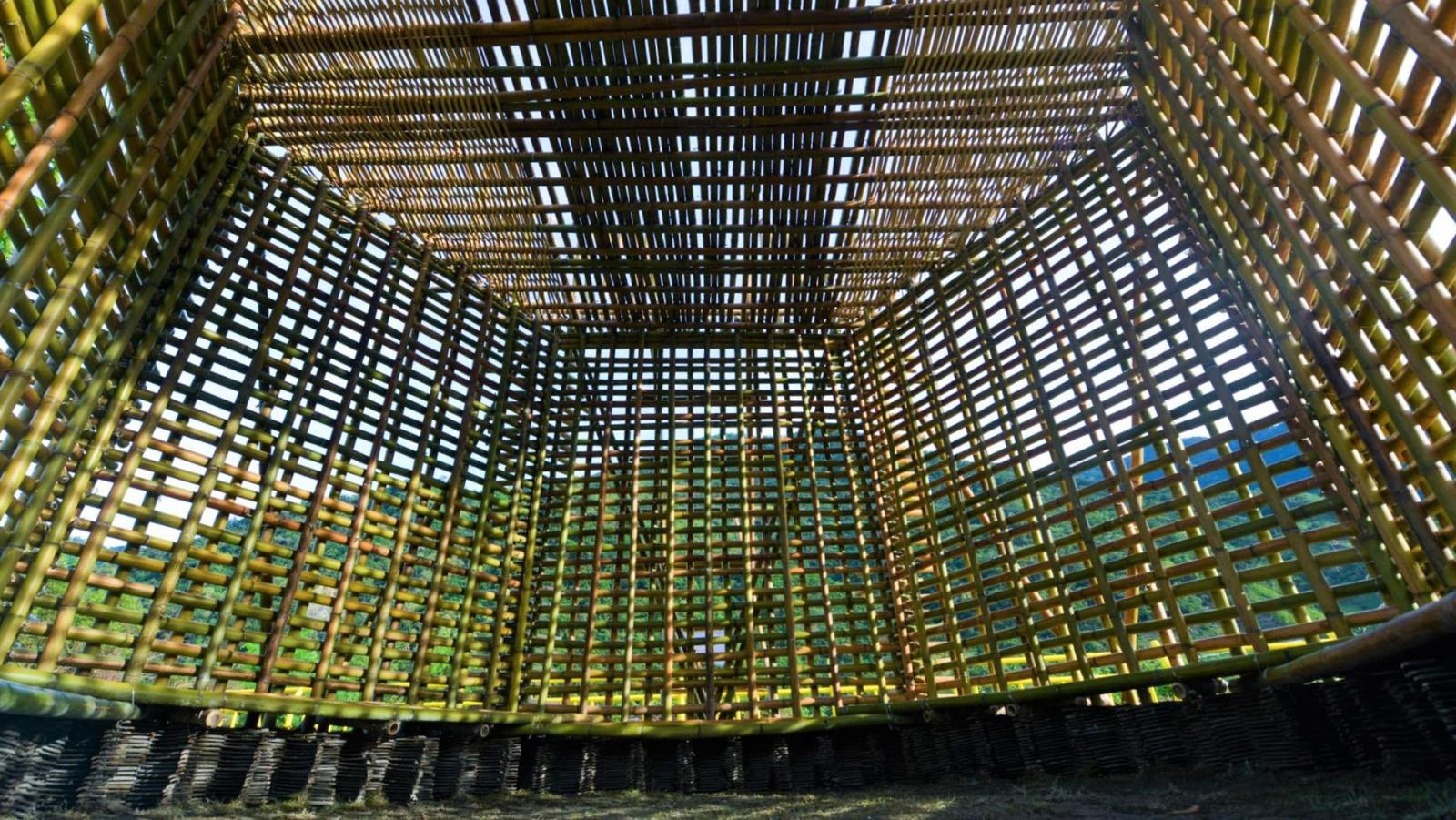
Bamboo is not enough to make a home because people fear being seen as poor
Even though bamboo architecture has already been proven by the technology of Taiwan, China, Singapore and other countries to be affordable, sturdy and highly malleable, the road to using it as sustainable housing for people around the world is still rugged. Compared with reinforced concrete, bamboo is also naturally associated with being backward. Even an internationally renowned green architect, Markus Roselieb, founder of CLC firm, still has to face people's prejudice against building materials.
"As a new building material, architects have to present a considerable amount of data and research to prove that bamboo meets building and safety codes and can withstand earthquakes and shaking before anyone is willing to build with it; but after it has been proven and built, even in social housing, poor people will still go and live in the house next door made of concrete and steel bars, because they are afraid of being seen as poor."
The bamboo gymnasium that Markus Roselieb created for Thailand's international green primary school Panyaden School won the World Architecture News Awards 2018 in 2018. However, he still shared bluntly that building a bamboo architecture school locally in Thailand is quite difficult. People hold prejudices that bamboo is not advanced and not civilized, especially in buildings for education and government units, where people prefer the cold concrete buildings of cities in their stereotypes, and therefore refuse to use natural building materials.
"It always takes until it is built for the client to feel reassured and happy enough to invite relatives and friends to visit the home; it always takes until it is built for government units to believe that bamboo architecture also meets safety codes and can also withstand earthquakes and shaking, and only then do they grant us building permits." Markus Roselieb said this.
Even an internationally renowned green architect, Markus Roselieb, founder of CLC firm, still has to face people's prejudice against building materials. (Photo / Lin Suyu)
Facing many prejudices against bamboo architecture, Markus Roselieb emphasized that this is the result of cutting off nature and tradition when we imagine civilization. We believe civilization must keep its distance from nature and can even dominate nature, yet only after the pollution of civilization do we think of nature. Sustainable bamboo, amid this contradiction, is either dominated by environmental issues because of its renewable characteristics, or confined to the countryside because of its traditional image. But in the sustainable development of bamboo architecture, what should be affirmed and recognized is the building material and construction method as a whole, not just one part of its function.
He believes that for bamboo to be widely used as a building material, greater emphasis must be placed on its architectural capabilities such as function and aesthetics, so that it directly competes with mainstream reinforced concrete. In addition, to break the association between bamboo architecture and disadvantaged rural areas, bamboo architecture should start from cities and overturn the impression of poverty, so that people are willing to recognize and value bamboo architecture.
When we are liberated from labor, the concept of sustainability is also replaced along with it
If sustainable architecture is meant to preserve the home and family, how should we view the passive giving of the natural environment?
Cross-media artist Lahizi Dalifu (Amis) used the Amis concept of "home" to explore the cultural meaning of sustainable architecture in Taiwan, China. Starting from the relationship between clothing and the body in tribal life, he described clothing as the home of the body. A piece of traditional clothing takes time and effort in the handmade process from gathering and drying to weaving, so every piece of clothing is an indigenous person's entire life. Indigenous people and these creations are one and inseparable.
"If you feel that creations have nothing to do with you at all, then you are even less able to talk about nature." Lahizi Dalifu interpreted the Amis cultural meaning of "standing" by saying that taking from nature enables people to "stand" and live on the land. Home is the system that enables the collective to stand. To constitute a home, the members standing within it and the environment standing outside it yet constituting it are all connected—— home, people and nature are one organism, and only by spending time going deep into nature to find materials and building a home with one's own hands can the concept and knowledge of home be carried on.
Home, people and nature are one organism. Only by spending time going deep into nature can the concept and knowledge of home be carried on. (Image provided by / Lahizi Dalifu)
"Being liberated from labor may seem easy and beautiful, but the organic connection between people and natural resources is also broken; however, such an imagination of life finds it hard to accept living scenes composed of bamboo, wood and rattan and care for nature."
Weaving craft creator Varig Tinaway said that not only bamboo, but Taiwan, China's traditional architecture also uses natural resources such as slate, rattan and reeds, and the crafting techniques developed according to the characteristics of the materials, such as weaving and stacking, are by no means inferior. He shared with a smile that the traditional indigenous slate house is a spatial structure formed by planar stacking, the same concept as 3D printing, and after combining it with weaving techniques, it can also use lighter materials such as bamboo strips to form a stable three-dimensional building through hexagonal stacking.
Returning to sustainable architecture, Varig Tinaway believes that the sustainability in traditional indigenous architecture does not mean that the home must remain unshakable after it is built, but that even if it is blown down a little by a typhoon and shifted a little, people can still pick up the wreckage and take materials from nature again, reinforcing and stabilizing it time after time; this process of personal labor is what makes us familiar with the ways of using natural resources, and treasure and pass on this "home" that includes both environment and culture.
"Responding to the modern from tradition, the material itself has not changed," said Lahizi Dalifu. "Of course we hope culture can continue to be passed on, but the high labor and time cost of natural material education is considered inefficient, and that is what makes the distance between people and materials grow."
Chen Yuping, director of the Space Mother Tongue Foundation, moderated the roundtable discussion.
Just as Chen Yuping, curator of this "2018 International Weather-Resistant Bamboo Architecture Forum" and director of the Space Mother Tongue Foundation, said in his final conclusion: "For the sake of promotion, we easily reduce these issues to the possibilities and functions of the material itself. Even aesthetics becomes a symbolization and functionalization of culture and tradition; the reduction of connections between people, materials and architecture is all imposed and forcibly projected."
"This is the loss of people's organic imagination of the unity of environment and culture under changing lifestyles, and it is also the challenge for sustainable design in the future."