What is the whole process of how bees collect nectar?
With the rise of the health-preservation trend, eating natural honey has become a global craze, but people know only a little about honey and bee ecology. Wu Shuhui, an assistant researcher in the Botanical Garden Division of the Taiwan Forestry Research Institute who is in charge of curation, said that many people love eating honey but do not know where honey comes from. In fact, there are many sources of honey all around our daily lives, and it is hoped that through the exhibition, people will know where the food in their mouths comes from and how bees collect nectar.
Longan honey and lychee honey are nothing rare. Have you ever seen mangrove honey or paperbark honey? The Taipei Botanical Garden of the Taiwan Forestry Research Institute has cooperated with several beekeepers to collect more than ten kinds of honey from different seasons and from all over Taiwan, many of them from plants commonly seen around us. For example, the honey from the roadside tree paperbark is, just as its name suggests, thick and white, while the honey from the coastal plant mangrove is dark brown…. "Buzz•Forest: The Sweet Betrothal Gift of the Forest" is now on display at Nanmencho 323 in the Taipei Botanical Garden, inviting the public to spend a sweet New Year.
Roadside trees and coastal plants can all be sources of nectar
Walking into the exhibition site of "Buzz•Forest: The Sweet Betrothal Gift of the Forest", what greets you are more than ten kinds of honey suspended in midair in transparent test tubes. The labels read mangrove honey, paperbark honey, Formosan trema honey…and so on, plants familiar to the public, whose traces can be seen in parks, along roadside trees, on suburban hills, and by the sea.
Honey from different seasons, places, and plants shows different colors and tastes, and also reflects the influence of seasonal changes on bee ecology. For example, the paperbark planted in the botanical garden produces honey that is not amber-colored but thick and white, with sediment clearly visible when placed in a test tube; Pujiang honey is especially eye-catching, showing dark coffee color with a faint fragrance; in winter, when few plants bloom, the "Formosan trema" commonly seen on low hills and the introduced largeflower tickclover become a few of the bees' choices.
Seeing the turning of the seasons through pollen colors
In addition to honey, the exhibition site also specially displays the pollen colors of the same area in different seasons, as well as the changes in largeflower tickclover pollen from October 29 to December 3, with bright and colorful hues ranging from yellow, orange to red, brown, and so on, reflecting environmental differences in different areas.
Largeflower tickclover pollen has different colors in different seasons, showing environmental differences.
For example, the Dongshan Work Station of the Forestry Bureau collected pollen within a three-kilometer radius on six days, including May 21, 24, and 31, and June 14 and 28. Careful observation reveals that the pollen color on May 31 was especially dark. Wu Shuhui explained that this may have been when acacia was blooming; acacia pollen is darker in color, and the bees were attracted by acacia flowers to collect nectar.
The exhibition site also specially heats the pollen so that the public can personally smell the scent of largeflower tickclover pollen. Through vision and smell, visitors can experience changes in the environment and seasons and analyze bee ecology. In the future, a honey-tasting event is also planned.
During visits, many people often ask: How is this nectar collected? Do the staff take it directly from the flowers? Wu Shuhui said with a smile that there is no need to pick flowers directly. When bees collect nectar, their legs get covered with pollen; simply scraping the bees' legs lightly allows the pollen to be collected naturally.
An exhibition that began with a bee-sting incident
The exhibition "Buzz•Forest: The Sweet Betrothal Gift of the Forest", in addition to hoping the public will understand the mysteries of the forest and know the sources of honey, has another important purpose: to get to know the bees around us.
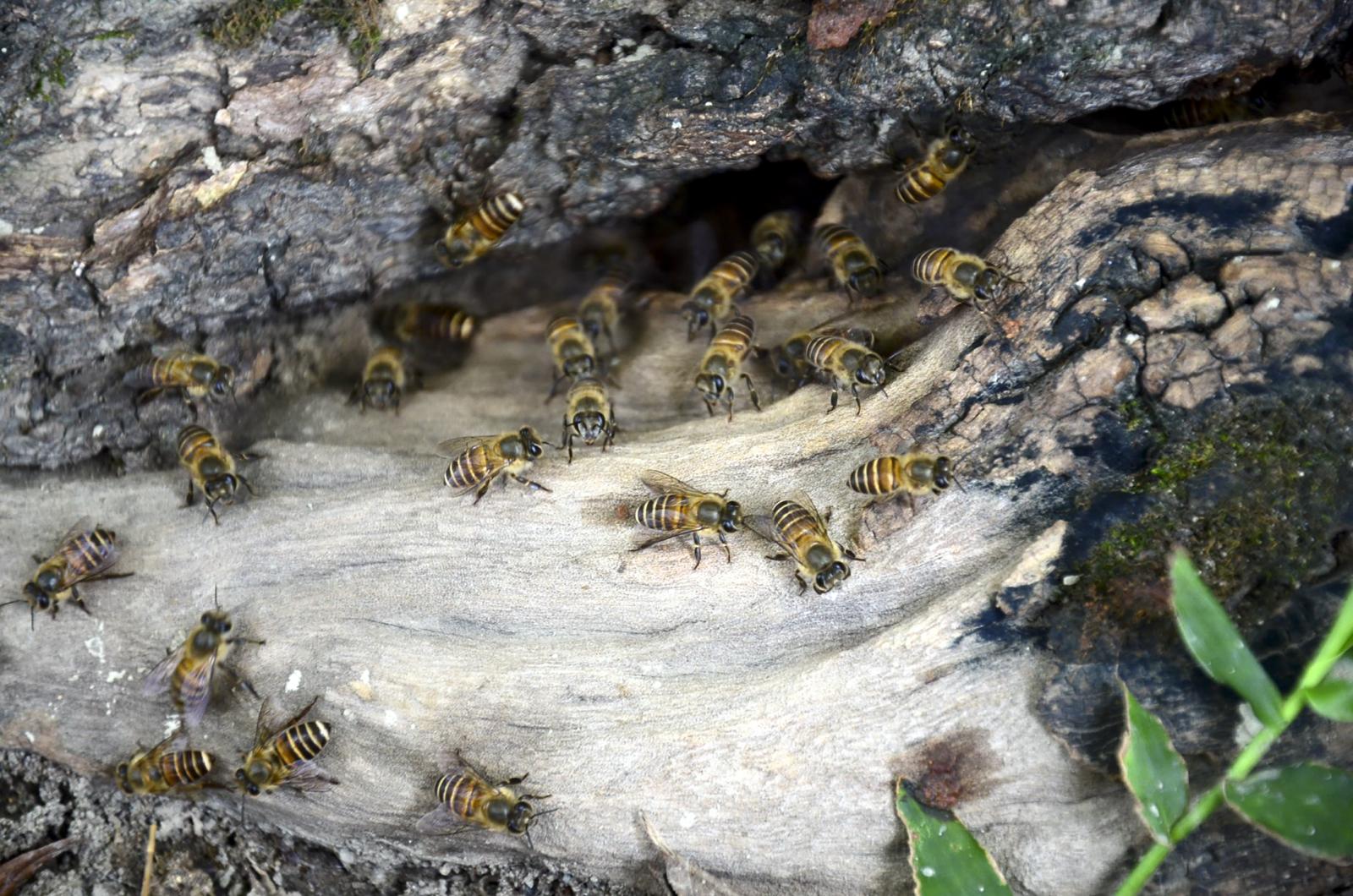
At the base of an old camphor tree outside the botanical garden wall, local residents complained that there was a beehive that might endanger pedestrians. (Image provided by the Taiwan Forestry Research Institute)
In early September of this year, at the base of an old camphor tree outside the botanical garden wall, local residents complained that there was a beehive that might endanger pedestrians, and the fire department was notified to remove it.
But in fact, this colony of bees had long coexisted peacefully with the public; it was only because MRT construction narrowed the sidewalk, bringing people closer to the bees when walking, that complaints arose. Later, after coordination with the MRT bureau, the construction road closure location was changed and explanatory signs were made, and the dispute was smoothly settled.
Wu Shuhui said that this colony of bees is the "Oriental honeybee", commonly known as the native bee. The Oriental honeybee is gentle by nature and will not sting people at will, and it is also very common in cities. Some parents even bring their children near the beehive in the botanical garden to explain ecology, hoping that through the exhibition and notices, people's understanding of the creatures around them will be enhanced.