Latest news on African swine fever: carcass of a pot-bellied pig found in Taipei city today
The Taipei City Government already set up a "city-level inter-agency prevention and response task force" on the 4th. As the African swine fever epidemic has drawn intense public attention, the Animal Protection Office urged that people should not panic if they find a sick pig, and that once a pig owner is found to have arbitrarily dumped a carcass, they will instead be fined in accordance with the law, with the result being even more of a loss than a gain.
At around 11 a.m. on the 7th, a Taipei City cleaning crew found the carcass of a pot-bellied pig weighing about 300 kg on an empty lot in Lane 632, Section 3, Heping East Road, Daan District. Because the pig carcass was slightly bloated and had red patches on its abdomen, epidemic prevention personnel from the Taipei City Animal Protection Office rushed to the scene to take samples and send them to the Animal Health Research Institute for testing, while also carrying out environmental disinfection. The test results are expected to be released on the 10th.
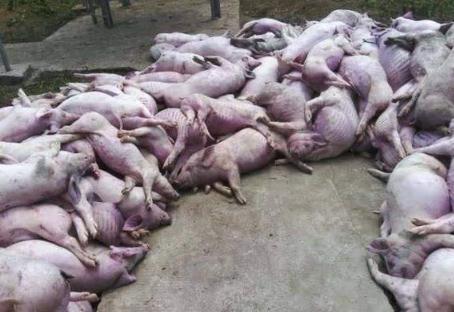
The Animal Protection Office is currently reviewing relevant video recordings to track down the identity of the owner. Once it is determined which person illegally dumped the animal carcass, a fine may be imposed under the "Statute for Prevention and Control of Infectious Animal Diseases" or the "Waste Disposal Act", with a maximum fine of 1 million yuan.
Do not panic if a pig falls ill; in Taipei City call 1999
Lien Yun-ching, head of the Epidemic Prevention and Inspection Section of the Taipei City Animal Protection Office, said that after receiving the cleaning crew's report in the morning, she went with personnel from the Department of Environmental Protection to the scene to understand the situation. It is understood that the dead pig was suspected to have been kept by a homeless person. The pig carcass at the scene was slightly bloated and showed red patches on its abdomen, and it was estimated to have been dead for some time. After epidemic prevention personnel arrived at the scene, they immediately set up a cordon, and the police department dispatched officers to help control the entry and exit of personnel and investigate the owner's identity.
Lien Yun-ching said that although the on-site veterinarian judged that the appearance of pooled blood in the pig carcass's abdomen did not look like a clinical symptom of African swine fever, and was more like the phenomenon of red blood cells and blood pooling in the body after an animal's death, the pig carcass was still properly packaged and sent to the Animal Health Research Institute for dissection and testing, while environmental disinfection of on-site personnel and vehicles was also carried out to prevent the possibility of the virus spreading.
The Animal Protection Office also completed a preliminary epidemic investigation at the same time. Within 3 km of the site, only the livestock farm of the Agricultural Experiment Station affiliated with National Taiwan University's College of Bioresources and Agriculture keeps about 50 pigs, and no abnormal situation has been reported there so far. In the future, it will also closely monitor whether there is any suspicious epidemic at that farm, to ensure the biosafety of pig farmers in Taipei City.