How to Identify Panama Disease in Bananas: A Detailed Guide to Symptom Recognition
The bananas commonly seen in supermarkets are also prone to the disease known as "Panama disease," which has earned the nickname of banana cancer. Panama disease has no cure, severely impacting banana farmers' income and also affecting the stability of supply for Taiwan bananas sold to Japan. At one point, Taiwan's banana planting area dropped from 50,000 hectares to 9,000 hectares. Let's take a look below.
Panama Disease Reshuffled the History of International Banana Trade, with Taiwan's First Case Appearing 51 Years Ago
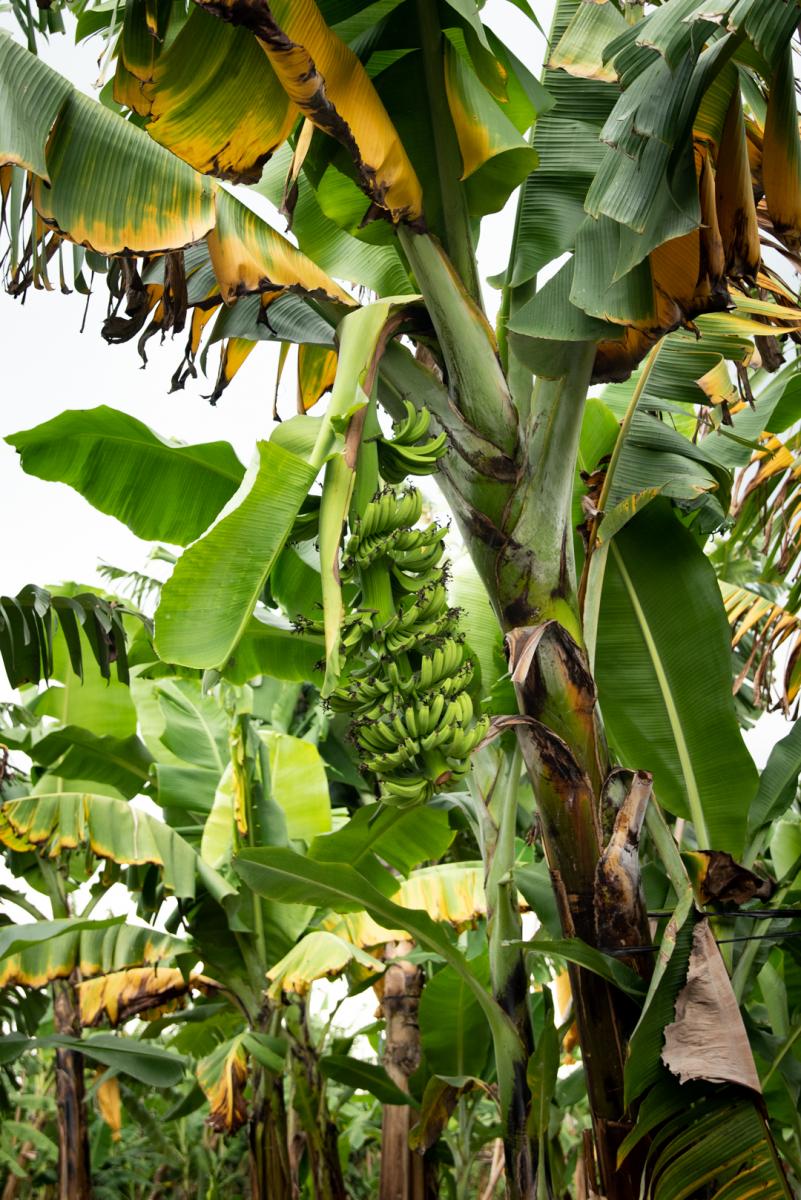
In the height of summer in July, driving to Pingtung County and Kaohsiung City, Taiwan's main banana-producing areas, you will find that amid the lush green banana plantations, a few banana trees have yellowing leaves, some with softened, drooping leaf stalks, and in severe cases even entire plants withering. This is what is commonly called the banana cancer, "Panama disease."
Banana Panama disease, also known as Panama disease, is a soil-borne fungal disease. It prefers acidic soil environments and can survive in soil for decades without a host. This disease still has no cure, so once a banana plantation is infected with Panama disease, it is like sounding the alarm for cancer, and the land must be abandoned for 30 to 40 years before bananas can possibly be planted again.
Bananas can be infected with Panama disease at any stage of infection. If infection before heading does not cause death, the fruit will become short and small, with a distorted shape.
Banana Panama disease is ravaging the globe, and the world's major banana-producing regions, including the Philippines, India, Indonesia, Vietnam, China, and Central and South America, have almost none been spared. In the 1950s, it destroyed the main international export variety Gros Michel, causing Central and South America, which primarily grew Gros Michel at the time, to switch to Cavendish, the same main variety group as Taiwan's bananas, opening a new chapter in the history of international banana trade.
Taiwan first discovered Panama disease in 1967 in a banana plantation in Jiadong Township, Pingtung County. At that time, Taiwan's bananas were in their golden age of export to Japan, with a banana planting area of up to 50,000 hectares. According to trade statistics from Japan's Ministry of Finance, that year Taiwan's banana exports were approximately 394,000 metric tons, with a market share in Japan as high as 82%. After that, Taiwan's banana industry plummeted. Externally, it faced competition in the Japanese market from producing countries such as Ecuador and the Philippines; internally, the spread of Panama disease severely impacted banana farmers' livelihoods.
Persisting in Soil, Spreading with Water, Making Prevention Impossible
About 8 years ago, Yu Chih-jung, a banana farmer who first sold bananas into President Chain Store's 7-Eleven stores across Taiwan through Dole Food Company's distribution system, currently grows 40 hectares of banana plantations in Pingtung County. As a third-generation banana farmer, he recalled that 40 to 50 years ago, his father's banana cultivation was squeezed from both inside and outside, and he exclaimed that it was simply unbearable.
"At that time, farmers' disease prevention concepts were poor, and Panama disease kept spreading. Farmers became afraid to grow it. When my grandfather grew bananas, there were originally 10 hectares. After the plantation began to get the disease in the later period, my father took over and switched to growing wax apples, miscellaneous grains, or adopted rice rotation. The banana cultivation area was roughly maintained at only 1 to 2 hectares. At that time, we didn't even calculate our own labor costs. I remember one year was very severe; my father only earned 50,000 yuan per hectare, but the cultivation cost was 700,000 to 800,000 yuan. It was truly so miserable that we couldn't even recover the capital."
Bananas can be harvested year-round, but the Kaohsiung-Pingtung area mainly produces spring and summer bananas.
Kuo Wen-ming, founder of the Kaohsiung City Qishan Fruit and Vegetable Marketing Cooperative, who has long served as a guarantor for exporting Taiwan bananas to Japan, witnessed Panama disease in his family's banana plantation when he was just over 10 years old. He said that in severe cases, the infection rate in banana plantations reached as high as 70%. Simply put, out of 10 banana trees, 7 were infected. Over the decades, some banana farmers in the Qishan area switched to other crops, while others opened up new land to grow bananas.
But Panama disease spreads too quickly. The pathogen can spread with river water, irrigation water, and farm tools. In addition, early farmers would pull out diseased plants and discard them by the fields or beside ditches, which invisibly increased the speed of Panama disease transmission. According to 1988 data from the Taiwan Banana Research Institute, after diseased plants were found in Jiadong Township, Pingtung County in 1967, over the following 6 years Panama disease spread all the way from Jiadong Township to Linbian Township, Nanzhou Township, and other areas. In 1973, it affected banana-producing areas such as Qishan District and Meinong District in Kaohsiung City. After 1980, banana-producing areas in Nantou County, Hualien County, Taitung County, and others also fell one by one. By then, no banana-producing area in Taiwan was spared.
Because Panama disease was ravaging Taiwan, combined with Japan's year-by-year declining purchases of Taiwan bananas, under this double squeeze, Taiwan's banana cultivation area kept declining from 50,000 hectares in 1967, and at one point in 1977 only 9,000 hectares remained.
Origins Are Disputed, and the Time and Probability of Onset Cannot Be Predicted
In the years when Panama disease began to spread, various experimental improvement units and plant pathology experts were all searching for causes and solutions, and among them the Taiwan Banana Research Institute was the most dedicated. Director Chao Chih-ping said that before 1967, Panama disease did not infect the Cavendish variety group, which is Taiwan's main cultivated variety, the North Banana. So at first, all sectors were not quite willing to conclude it was Panama disease, until Su Hong-ji, professor emeritus in the Department of Plant Pathology and Microbiology at National Taiwan University, provided scientific evidence, and international experts took the pathogen back to the United States for inoculation, only then was it confirmed to be a new type of Panama disease, called "Panama disease tropical race 4 (TR4 for short)."
Just as the pathogenicity produced by different types of avian influenza continues to evolve, TR4 can infect not only Gros Michel and Latundan bananas, which Panama disease race 1 can infect, and South Cavendish bananas, which Panama disease race 2 can infect, but also Taiwan's North Banana.
But how exactly did Panama disease spread to Taiwan? There is still no standard answer to this day. Chao Chih-ping said that Taiwan's bananas were introduced from the Fujian Province area of China 280 years ago, and Fujian's bananas came from Malaysia, Indonesia, and other countries. The current mainstream international inference is that the pathogen may have come in together with banana planting material early on, and only after Taiwan began large-scale intensive cultivation of the single variety North Banana did the pathogen continue to evolve under selection pressure.
Chiang Shih-chao, former director of the Physiology and Biochemistry Division at the Taiwan Banana Research Institute, said that TR4 is very tough because it can produce chlamydospores to survive adverse conditions such as cold and flooding. So even if farmers switch to aquatic crops such as rice or taro and then return to planting bananas, there is still a chance of infection with Panama disease.
Chiang Shih-chao, former director of the Physiology and Biochemistry Division at the Taiwan Banana Research Institute, conducted long-term research on soil management in banana plantations affected by Panama disease, and found that organic farming management practices can greatly reduce the infection rate of banana Panama disease.
What is even more paradoxical is that the density of Panama disease pathogens in the soil is not necessarily correlated with the infection rate. In short, a lower pathogen density does not mean a lower infection rate in that banana plantation. "You cannot predict whether it will develop the disease or when it will develop it. You only know after bananas begin to show symptoms. This is entirely a matter of probability," said Chiang Shih-chao.
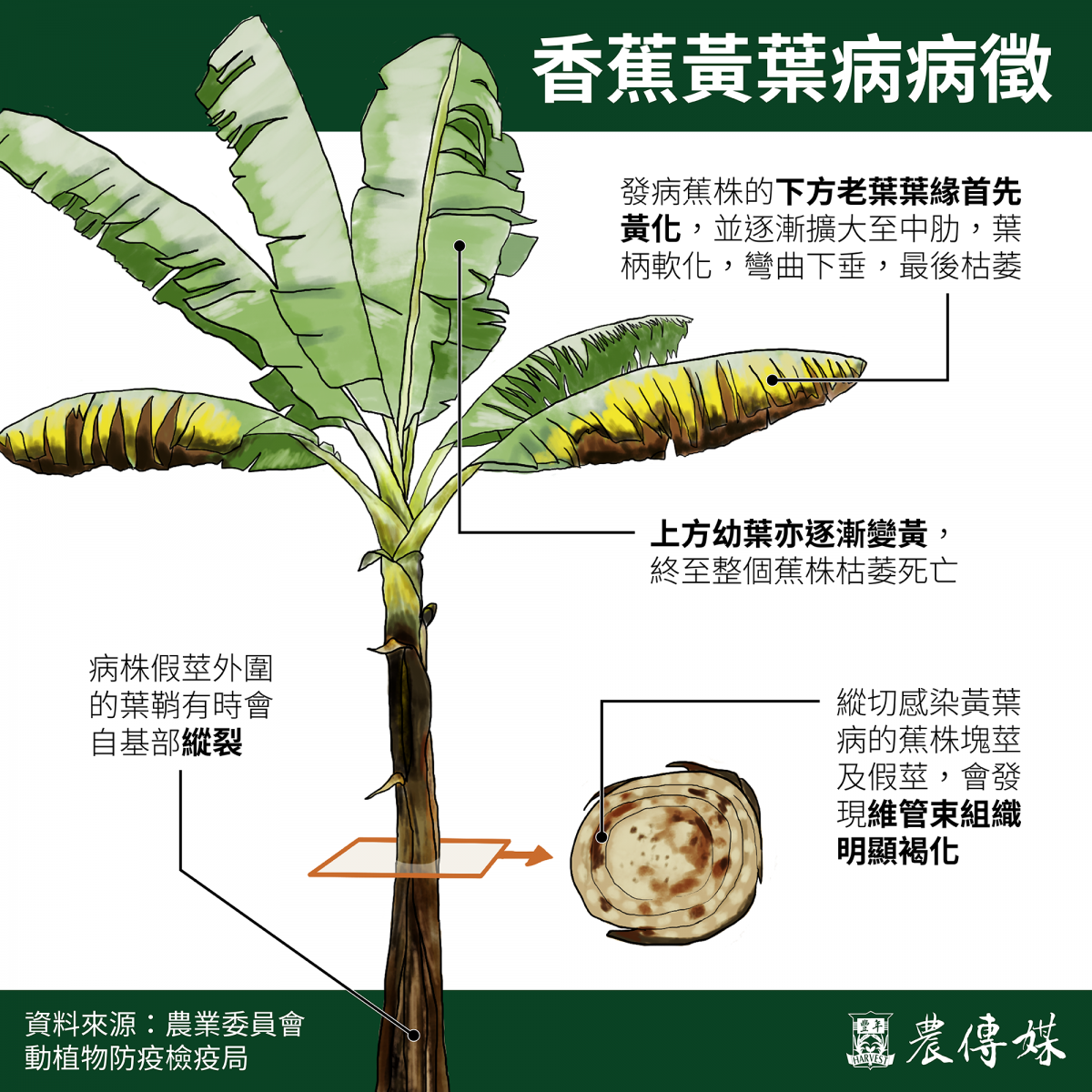
Chiang Shih-chao explained that Panama disease invades starting from the banana roots, destroying vascular bundle tissue and affecting the transport of water and nutrients. Externally, the leaves shrink and turn yellow, and when the banana pseudostem is cut open, the inside is found to have browned. Bananas can be infected with Panama disease at different growth stages. If the infection does not cause death, the fruit produced will be short and small, with a distorted shape, and because the flavor is poor, it loses commercial value.