How to control the spiraling whitefly? A complete analysis of whitefly control methods
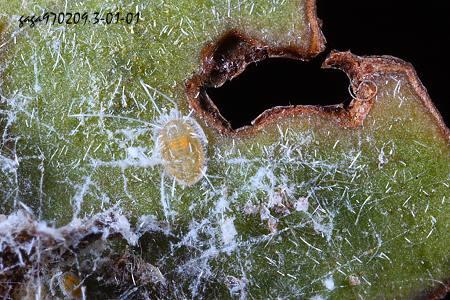
There are two methods for controlling the spiraling whitefly: one is physical control, and the other is biological control. What are the natural enemies of the spiraling whitefly? Let's take a look.
1. Physical control
In the field, at a water flow rate of 12.5 liters per minute, treating the underside of guava leaves once every 2 days for a total of 4 consecutive weeks showed that the water-spraying treatment alone achieved control rates of 86 and 79% against spiraling whitefly adults and nymphs, respectively.
2. Biological control
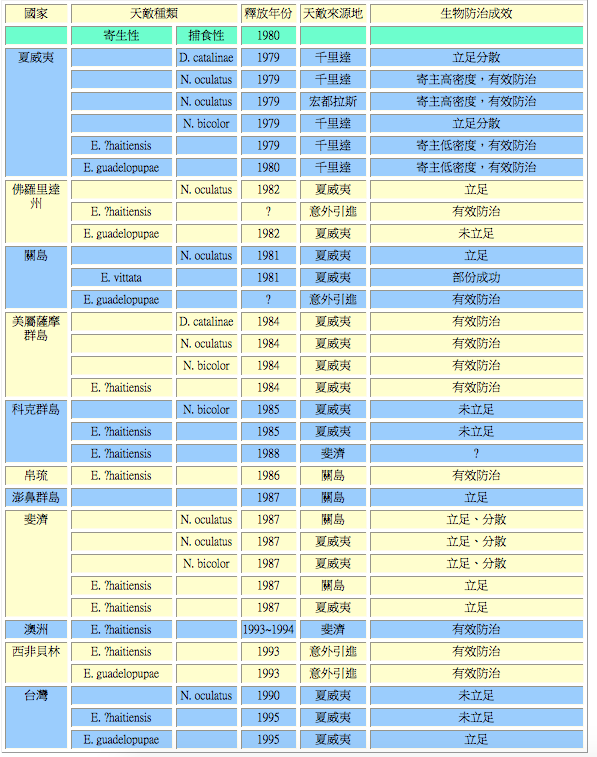
A total of 49 species of natural enemies of the spiraling whitefly have been recorded, including 41 species of predatory natural enemies and 8 species of parasitic natural enemies (Table 1). However, among these natural enemies, only three ladybird beetles (Delphastus catalinae, Nephaspis oculatus and Nephaspis bicolor) and three parasitic wasps (Encarsia haitiensis, Encarsia guadeloupae and Euderomphale vittata) have utilization value, and among them the parasitic wasps are especially valued for their ability to suppress the spiraling whitefly (Table 2).
The spiraling whitefly is an omnivorous pest of vegetables, fruit trees, food crops, ornamental plants, street trees and forests. In terms of control, although chemical control and physical control can both achieve effective control of this insect, because of its wide and scattered host range and the actual effectiveness of biological control of this insect worldwide, biological control has become the most suitable control method for the spiraling whitefly. In the Taiwan region of China, although the parasitic wasps of the spiraling whitefly have been mass-reared and released for biological control (57,032 and 66,929 individuals of Encarsia haitiensis and Encarsia guadeloupae, respectively), their effectiveness in suppressing the spiraling whitefly has not been significant. The reason may be that Encarsia haitiensis, after being released in small numbers (40-120 individuals) or accidentally introduced in Hawaii, the Pacific Islands, Australia's Torres Strait and Benin in West Africa, can quickly become established and disperse, but in Florida and Taiwan this wasp cannot become established. In addition, although Hawaii, the Pacific Islands, Australia's Torres Strait and Benin in West Africa emphasize the suppressive effect of Encarsia haitiensis on the spiraling whitefly, the decline in spiraling whitefly density in Hawaii and Benin in West Africa should also involve other important biological and abiotic factors besides the parasitic wasps. In the Taiwan region, the population density of the spiraling whitefly mainly shows seasonal fluctuations, and the effect of Encarsia guadeloupae is not great.
In addition, based on the author's field surveys from 1997 to 1999, it was found that there are four reasons why it is unfavorable for the parasitoids of the spiraling whitefly to be released or become established in the Taiwan region of China:
1. The habitat environment is unstable.
When the host plant is of no economic importance, such as roadside Indian almond, Acalypha wilkesiana and poinsettia, once infested they are heavily pruned or even cut down. When the host plant is of economic importance, such as guava, once infested farmers apply chemical control, and at the same time, in the Taiwan region of China, the host plants that the spiraling whitefly prefers, such as Indian almond, have a habit of shedding leaves in late winter and early spring, so that the synchrony between the occurrence of the host and the parasitic wasps is difficult to match.
2. The peak occurrence period of the spiraling whitefly is limited to autumn, and the insect instars are quite uniform.
Because the population density of the spiraling whitefly shows a sudden surge in autumn, if the parasitic wasps are released by the general inoculative release method, their effectiveness is not easily seen. But if the parasitic wasps are released by the inundative release method, it is also limited by the rearing cost of the parasitic wasps and the omnivorous characteristics of the host, making it difficult to implement.
3. Plum rain and typhoons.
The release of parasitic wasps of the spiraling whitefly is not only affected by the density of the spiraling whitefly, but also by the plum rain between May and June and typhoons between July and September.
4. High summer temperatures are unsuitable for the survival of Encarsia haitiensis.
Field surveys showed that Encarsia haitiensis was recovered only one month after the parasitic wasp release in 1996 and in December 1997 at Zengwen Reservoir, Chiayi Institute of Technology and the Agricultural Research Institute, after which no trace of it was seen again. The reason may be related to temperature. For example, at 15 degrees, the fecundity of Encarsia haitiensis and Encarsia guadeloupae was only 3 and 2 eggs respectively; at 20-25 degrees, the fecundity of the two wasps was 158-165 and 108-157 eggs respectively; at 30 degrees, the fecundity of the two wasps was 16 and 118 eggs respectively (Chien Ching-chin and Chang Shu-chen, unpublished data). In central and southern Taiwan, China, winter temperatures occasionally drop below 15 degrees unless a cold wave arrives, but daytime summer temperatures often exceed 30 degrees, so it is inferred that high summer temperatures may be the main reason why this wasp cannot become established in the Taiwan region of China. However, whether this argument is consistent with the performance of Encarsia haitiensis in other regions remains to be explored.
Table 1. Natural enemies of the spiraling whitefly
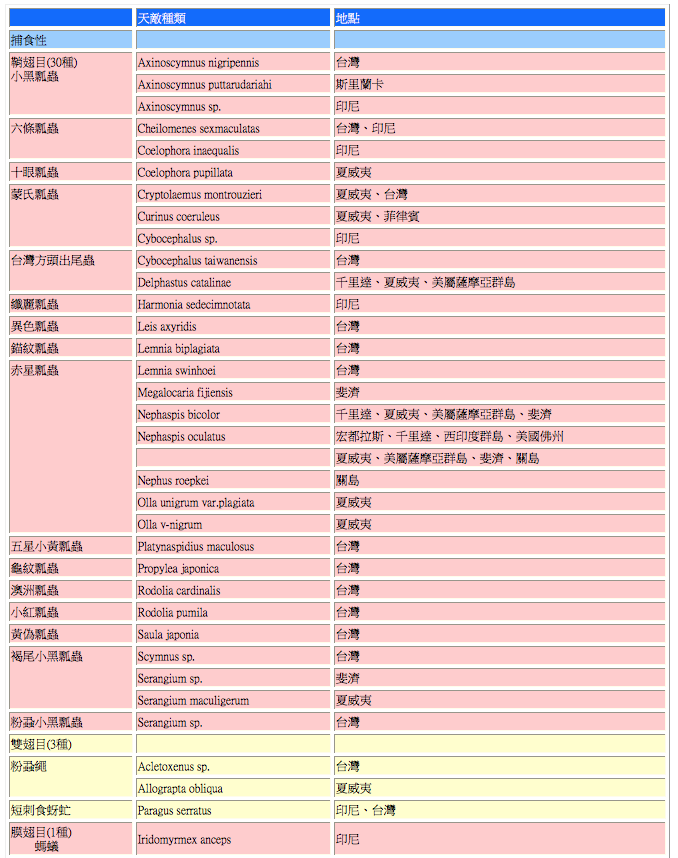
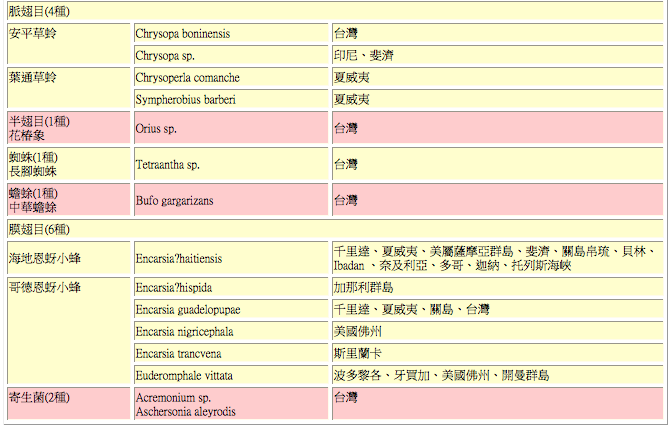
Table 2. Biological control of the spiraling whitefly worldwide