The spiraling whitefly is one of the whitefly species; what kinds of damage does it cause?
The spiraling whitefly is an important pest newly invading Hainan, with characteristics such as diverse transmission methods, a wide range of host species and a fast reproduction rate. So would you like to learn about its morphology, life history and damage? This is very helpful for controlling the spiraling whitefly.
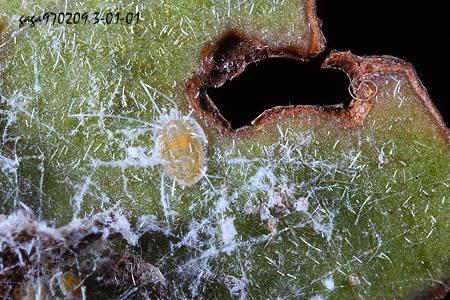
Morphology of the spiraling whitefly (Figures 1-4)
Egg: about 0.29*0.11mm in size, elongated oval, with a smooth surface, and one end of the egg bears a stalk-like structure. The egg is semi-transparent and colorless.
Nymph: there are four instars in total. The sizes of the instars are 0.28*0.12, 0.48*0.26, 0.67*0.49 and 1.06*0.88mm. At the time of molting in each instar, they are transparent, colorless and flat, but as they develop they gradually become semi-transparent with a raised dorsal surface. The body shape of each instar is similar, but with the degree of development it changes from slender to oval. The first-instar nymph has clearly segmented antennae and functional legs, while the antennae and legs of nymphs in the other instars are degenerated. The first to third instar nymphs secrete a small amount of short waxy powder, and only at the fourth instar does the amount of secreted waxy powder increase greatly, and the flocculent filaments can reach 8mm in length.
Adult: the body lengths of females and males are 1.97 and 2.10mm respectively. At the time of emergence the wings are transparent, and after a few hours the wing surface is covered with white powder. The tip of the male abdomen has pincer-like claspers for mating.
Life history of the spiraling whitefly
Males emerge earlier than females, with the peak emergence period at 6~8 a.m. The female-to-male sex ratio is 1.5:1. Mating occurs in the afternoon; the male first spreads both wings and flaps them rapidly up and down to attract the female to approach, and then mating takes place. The peak migration flight period of adults is at 5~7 a.m., but when the temperature is low or the sky is overcast their activity time is delayed. Generally speaking, males have weaker migratory flight ability than females and mostly remain on the leaves of the original host plant. The maturity of eggs in the female's ovaries is related to age; only after the third day of age do females begin to spiral upward in migration from the original host plant one after another, in order to find tender leaves of new host plants to lay eggs. Females lay eggs on the underside of leaves; the eggs are scattered in a distinctive spiral pattern, accompanied by white waxy powder. The number of eggs in each egg circle varies from 11~53. The egg has a small stalk that is inserted upright into the leaf stoma. At 25 degrees C, the lifespans of females and males are 15 and 12 days respectively; unmated females produce males through parthenogenesis, and the total number of eggs laid in a lifetime is 65.2. There are four nymphal instars in total, and only the first-instar nymph is capable of movement. After hatching, the nymphs crawl together to nearby leaf veins and then settle down to feed. The developmental period and survival rate of one generation depend on temperature; on common bean at 25 degrees C, completing one generation takes 26.5 days, with a survival rate of 91.9%. Among these, the egg stage and the first to fourth instar nymphal stages require 7.0 and 5.1, 3.4, 4.4, 5.5 days respectively; the survival rates are 100 and 98.2, 100, 97.3, 96.2% respectively. The suitable temperature range for adult activity is 12.3~32.3 degrees C. The occurrence of the spiraling whitefly and the number of host plant species it damages are both seasonal; in Taiwan, China the spiraling whitefly occurs abundantly in autumn (October to December), followed by spring and winter, and is rare in summer; the number of host plant species damaged by the spiraling whitefly is also greatest in autumn, followed by spring and winter, and lowest in summer. Because females prefer to lay eggs on new leaves, applying nitrogen fertilizer and pruning branches can often promote an increase in the population density of the spiraling whitefly. However, heavy rain and low temperature reduce the population density of this insect.
Damage caused by the spiraling whitefly
There are five ways in which the spiraling whitefly harms humans and plants, described as follows:
1. Nymphs and adults directly suck the sap of host plants on the underside of leaves with their stylets; when this insect occurs severely it can cause host leaves to drop prematurely, but it will not yet kill the host plant.
2. The large amount of white waxy powder and flocculent filaments secreted by nymphs not only affects the appearance of host plants, but their secretions are also scattered by the wind and are repulsive.
Even in Hawaii, although it has not been proven that the adults or their secretions, or both, can cause allergies and dermatitis, people are greatly frightened and complain endlessly about them.
3. The honeydew secreted by nymphs induces sooty mold, which not only affects the photosynthesis of host plants but also affects the appearance of the plants and attracts insects such as ants and flies.
4. It was once suspected of being able to transmit coconut lethal yellow disease, but it has now been proven that this insect does not have this vector capability.
5. It not only affects the yield of food crops, economic fruit trees and so on, but also poses a potential threat to the export quarantine of ornamental plants. In Taiwan, China, whether for 1~2 or 4~5-year-old guava, if damaged by the spiraling whitefly for 4 months, the fruit yield loss is as high as 73~80%, but if 90% methomyl WP (methomyl WP) at 1,800 times is applied once every 7 and 14 days, the fruit yield loss sharply decreases to 0 and 6~7%.
Dispersal methods of the spiraling whitefly
In addition to migration by the adults themselves, the spiraling whitefly can also be carried and spread by infested plants, other animals, or means of transport (cars, boats), etc. For example, in Hawaii plants along the main roads, at stations and in parking lots are severely damaged. However, it has still not been proven that this insect can disperse over long distances by upper air currents.
Economic importance of the spiraling whitefly: The spiraling whitefly is an omnivorous pest of vegetables, fruit trees, food crops, ornamental plants, street trees and forests, etc. In Hawaii its host plants exceed 27 families and more than 100 species, including avocado, banana, breadfruit, chili pepper, citrus, coconut, frangipani, guava, leucaena, macadamia, mango, papaya and rose, etc. In Africa, if the spiraling whitefly is not controlled, it becomes an important pest of agriculture and forests. For example, in fruit trees it includes banana, papaya, guava, citrus, avocado, coconut and mango; in forests it includes Acacia sp., Eucalyptus sp. and Terminalia sp.; and among food crops there is cassava. In Taiwan, China, the host plants of this insect are as many as 65 families and 156 species, among which guava, poinsettia, Terminalia, mulberry, Acalypha, papaya, chili pepper, eggplant, hibiscus, painted euphorbia, sugar apple, maple, goji, Bauhinia, dahlia, rhododendron, jasmine, canna and cherry, etc. are more severely damaged.