How to Make Sugar-Vinegar Solution: Formula Ratios and Functions Explained
Sugar-vinegar solution: Spraying sugar-vinegar on leaves can prevent and control pests, diseases and frost damage. After spraying vinegar solution on crop leaves, it increases leaf acidity, which in turn inhibits or kills pests and diseases that cannot tolerate acidic conditions, achieving control. According to observational research, bacterial diseases, viral diseases and aphids in crops are suited to reproducing and growing under neutral or alkaline conditions. Let's take a look below.
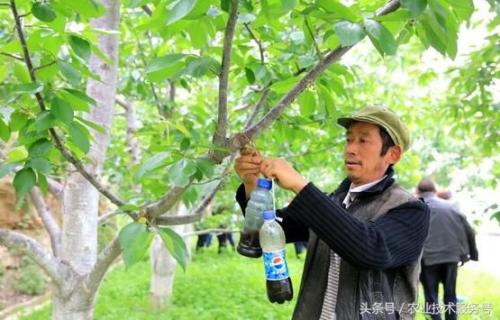
A. Functions of Sugar-Vinegar Solution
Sugar-vinegar solution is also a type of non-pesticide control method. It is mainly made by mixing effective microorganisms (including dozens of active microbial groups with different functions, such as yeasts, lactic acid bacteria, actinomycetes, photosynthetic bacteria and nitrogen-fixing bacteria) with sugars (carbon source), proteins (nitrogen source), brewed vinegar, rice wine and other ingredients as raw materials in appropriate proportions and fermenting them. It can be used as a natural pesticide, causing insects to die of indigestion or to leave upon smelling its odor, thereby achieving a repellent effect. For example, if it is diluted into a 500-fold solution and sprayed on red spider mites, the effect on inchworm larvae can be seen in 1 to 2 days, and when applied to diamondback moth larvae, the effect is seen in 4 days. Because it contains no pesticide ingredients, it is harmless to humans and livestock, and insects will not develop resistance to it, so it can be used continuously over the long term. To improve its effect, a nutrient agent or natural plant extracts such as garlic, chili pepper, houttuynia, mugwort, neem, mint and lemongrass can be added. Because it contains nutrients needed for plant growth and various organic acids and monosaccharides, it can regulate crop growth, enhance photosynthetic capacity, improve fruit sweetness and quality, and has the effect of preventing continuous cropping obstacles and inhibiting pests and diseases. In addition, when used to remove foul odors from poultry and livestock operations, purify water quality and ferment compost, it has an enhancing effect.
B. Preparation Method of Sugar-Vinegar Solution
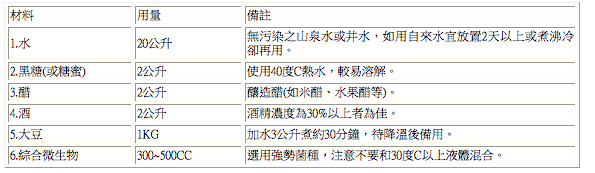
1. Materials
Manufacturing Procedure
1. Pour brown sugar (or molasses) into 40 degree C hot water and stir to dissolve it, then add vinegar, wine and soybean broth, and finally add the effective microorganisms (note that the liquid temperature at this point should not exceed 30 degrees C, so that the microorganisms are not killed by heat), and stir and mix evenly until it foams. Then pour it into a container (do not use a glass bottle), tighten the lid or bucket opening, cover with gauze, tie it securely with string, and place it in a cool, dark place (do not store it long-term in a refrigerator below 5 degrees C).
2. Afterward, stir it once each morning and evening every day until the liquid surface foams, in order to promote fermentation.
3. Due to temperature conditions, after a period of time (about 15-30 days after steeping) gas will be produced and the container will swell. At this point, the lid should be loosened slightly to let the gas escape, then tightened again.
4. The quality of the finished sugar-vinegar solution is judged by whether it has a pungent sour-sweet smell.
5. After the sugar-vinegar solution is made, its usable shelf life at room temperature (20-30 degrees C) is about 6 months.
How to Use
1. Because effective microbial groups are afraid of strong light, it is best to use it on cloudy days, before 9 a.m., after 3 p.m., or during light rain.
2. For foliar spraying, use a 500-1000 fold dilution; for soil drenching, use a 300-500 fold solution.
3. Sugar-vinegar solution is mainly used to prevent the occurrence of pests and diseases and to strengthen the cuticle layer of the leaf protective membrane, preventing the invasion of disease-causing bacteria.
4. To promote crop growth, nutrient agents such as amino acids, fish essence, humic acid and seaweed extract can be added; to increase sweetness, potassium humate, natural phosphorus, calcium and magnesium can be added; to prevent and control pests and diseases, garlic, chili pepper, houttuynia and Bacillus thuringiensis can be added.