Uses of Wood Vinegar in Agriculture: Wood Vinegar Uses and How to Use Wood Vinegar
Production and Use of Wood Vinegar: What are the agricultural uses of wood vinegar? Do you know the uses of wood vinegar and how to use it? Let's take a look below.
Uses of Wood Vinegar
The main component of wood vinegar is vinegar, and in addition there are more than one hundred other components, some beneficial and some harmful. Its effects are roughly similar to those of vinegar, but greater than vinegar, mainly because the effects differ according to the type of nutrient or natural pesticide added. When mixed with black sugar enzyme liquid before use, it becomes sugar wood vinegar.
1. General uses:
(1) Pharmaceutical raw material.
(2) Feed additive.
(3) Solvent for acetone, lime acetate, etc.
(4) Deodorant.
(5) Mordant.
(6) Wood preservative.
(7) Food preservative.
(8) Sewage purifying agent.
2. Agricultural uses:
(1) Enhance the vigor of crop roots and leaves, slow aging, reduce fruit acidity, extend fruit storage time, and improve flavor.
(2) Control some pests and diseases in soil and on leaves, and promote the reproduction of beneficial soil microorganisms.
(3) Increase the effectiveness of pesticides.
(4) Accelerate the fermentation speed of compost.
(5) Eliminate the odor of livestock and poultry manure and urine.
(6) Add to feed to improve meat quality.
Production of Wood Vinegar
1. Wood vinegar production methods:
(1) Charcoal kiln method: Use various miscellaneous tree branches, unused branches pruned from orchards, etc., smoldered in a charcoal kiln to produce smoke, which is naturally air-cooled and condensed into liquid. The quality is relatively good, but conifers with high resin content, beefwood (Casuarina equisetifolia), and discarded furniture containing paint must not be used.
(2) Rice husk furnace method: The production method is simple and convenient. The main raw material can be rice husk or bagasse. First, fill the furnace with rice husk, then place a ball of waste paper in the center of the upper part and ignite it. After the rice husk catches fire, the liquid flows to the outlet below the chimney and into a collection bucket, becoming crude wood vinegar. A furnace made from a gasoline drum can hold about 20 kg of rice husk. Usually after about one day, the rice husk is largely burned up. When liquid no longer comes out, open the lid, pour out the remaining part, and spray water to extinguish the fire, producing charred charcoal. If the burning time is too long, the residue all becomes rice husk ash, and no charred charcoal can be collected.
(3) Mixed method: A method of smoldering and dry distillation with a small amount of branches and rice husk placed together.
2. Refining of crude wood vinegar:
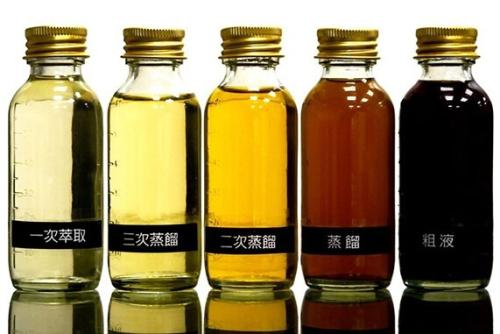
Freshly made wood vinegar is crude wood vinegar. It should be left standing for more than six months to allow it to settle into three layers. The top layer is light oil, which should be removed as much as possible. Then pour out the middle layer, which is the crude wood vinegar, and the remaining bottom layer is tar. After the crude wood vinegar has stood for six months, first filter it, then pour in 3-4% charcoal powder or 2% activated carbon, mix thoroughly, leave it for one day, and then filter it again to obtain clear, golden-yellow or yellow-brown refined wood vinegar. The remaining light oil, tar, and used charcoal or activated carbon can also be collected separately after mixing, to be used as soil improvement material or as a coating material for fruit trees to control pests and diseases.
3. Criteria for identifying wood vinegar:
(1) A brown to tea-brown transparent liquid, without sediment.
(2) pH 2.5-3.0.
(3) Baume specific gravity 1.5-3.0.
(4) Resin and tar content 1% or less.
Use of Wood Vinegar
1. Application to soil
(1) Control nematodes and bacterial wilt: Use at 10-30 times dilution in open ground, and at 30-50 times dilution in holes dug at the inner edge of the tree canopy.
(2) Drenching the soil during the growing period: Use at 100-200 times dilution, drenching to a depth of 50 cm.
(3) Use after absorption by charcoal chips: Use at 50-30 times dilution, allow the charcoal chips to fully absorb it, then apply to the soil or mix with compost before use.
(4) Use after adding to compost: Use at 100 times dilution.
2. Spraying on leaf surfaces:
For foliar spraying of sugar wood vinegar, rice can use black sugar enzyme and wood vinegar each at 300 times dilution, sprayed starting from the middle stage. General crops including vegetables, flowers, and fruit trees use about 600 times dilution. Sensitive crops such as watermelon, muskmelon, cucumber, loofah, Anoectochilus formosanus, papaya, and pomelo during the young fruit stage use about 800-1000 times dilution. For pears, avoid using high-concentration wood vinegar before bagging to prevent damage to the fruit skin. When using wood vinegar on onions and garlic, the leaf tips tend to die back, so do not use it. Before flowering, to suppress excessive growth, promote flower bud differentiation, and increase fruit set rate, monocalcium phosphate, monopotassium phosphate, boric acid, cytokinins, etc. may be added as appropriate for spraying. During the young fruit stage, fish extract, amino acids, seaweed extract, milk powder, comprehensive microorganisms, or trace elements, etc. may be added as appropriate to promote fruit enlargement, but by the middle and late stages, nitrogenous materials such as fish extract and amino acids should be discontinued, and instead monocalcium phosphate, monopotassium phosphate, calcium lactate, magnesium phosphate, manganese sulfate, etc. should be used to increase sugar content while reducing fruit acidity. If pests or diseases are present, garlic, chili, tobacco leaves, Houttuynia cordata, neem (Melia azedarach), absinthe, citronella, mint, etc. may be soaked in appropriate amounts and sprayed together. Other materials such as seaweed extract, citronella oil, peppermint oil, neem oil, summer oil, comprehensive beneficial microorganisms, Bacillus thuringiensis, etc. may all be added as appropriate to increase effectiveness. As for alkaline materials such as lime sulfur mixture, lime Bordeaux mixture, arsenic agents, and soaps, these must not be used.
3. Deodorizing livestock manure and urine: Use at 50 times dilution and drench until thoroughly wet throughout.
4. Adding to livestock feed:
Add 1% to rice bran or rapeseed meal for use as feed, which can enhance meat color, reduce moisture, and prevent mastitis. However, wood vinegar for feed use should be left standing for at least one year and must undergo distillation and other special treatments before use.