Orchid Environmental Factors: The Effect of Humidity on Orchid Growth
Orchid Environmental Factors: Humidity
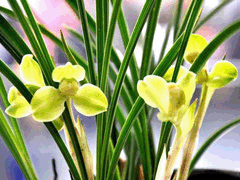 Since the reasonable regulation and balance of humidity with temperature and light is essential for photosynthesis, a relatively high humidity must be maintained during the daytime, especially during the growing season. As mentioned above, most terrestrial orchids, including the terrestrial Chinese orchid types, absorb carbon dioxide and water during the daytime and release carbon dioxide and water at night, so humidity should be reduced at night, and no misting should be done after dusk. However, most thick-leaved epiphytic orchids, such as Dendrobium and Cattleya, have stomata that open at night, so maintaining moderate humidity at night does no harm. But generally speaking, when the temperature drops,orchidshave a lower requirement for humidity, and when humidity is low they can better tolerate low temperatures. In northern greenhouses, if the heating system fails in winter, by no means should misting or watering be done.
Orchidsmostly grow in the humid environments of the tropics and subtropics, and generally require relatively high air humidity. In tropical rainforest areas, summer humidity is generally 70%-90%, and in China's subtropical regions it also reaches 60%-80%, but in winter it can drop to 40%-50%. Therefore,cultivatingorchidsrequires summer humidity of no less than 70%, while for special species such asCymbidium sinenseit is required to reach 90%; but during the winter dormant period it can be reduced to 50%, with nighttime 10%-20% lower than daytime. The general rules for humidity requirements are: high in the growing season, low in the dormant season; high during the day, low at night; high for tropical orchids, low for temperate orchids; high for epiphytic orchids, low for terrestrial orchids; high at high temperatures, low at low temperatures; high on clear days, low on cloudy and rainy days. But humidity regulation should be based on specific conditions and treated differently. For example, orchids growing in the Hengduan Mountains of western China often experience a longer dry period in winter; at this time, although there is fog, they still have slightly lower humidity requirements in winter than orchids from other regions.
The main methods of regulating humidity rely on sprinkling water on the ground, spraying water into the air, and increasing the area of water storage containers; reducing humidity can be achieved by ventilation.
Sprinkling water on the ground is beneficial to orchid growth. It is best that the greenhouse floor not be made of cement, or at least not entirely of cement, because after sprinkling, the soil floor releases nutrients from the soil during evaporation, which can be absorbed by the orchids. The ground should be kept moist, dry corners should be sprinkled, and the shelves, surrounding glass, and partition walls can also be sprinkled, which both increases humidity and avoids contact with the orchids. But the entire ground must not be allowed to accumulate standing water. Next is spraying water into the air (that is, misting). If the greenhouse floor is sandy, spray more; if clay, spray less; spray more in summer, less in winter. The degree should be such that the air remains moist while the plant's leaves, flowers, growing points, and roots do not retain water. Usually on hot days, 3-4 times a day, once on cloudy days, and at most once in winter. It is best to spray after the sun comes out in the morning and when the sun is high in the afternoon; do not spray at dusk or at night, and even more so do not let the plants retain water going into the night. In addition, the water temperature for spraying is best close to room temperature; avoid water temperature that is too high or too low. Only when the room temperature is too high may cold water be used to cool it down. Placing a certain number of water storage containers in the greenhouse can not only increase greenhouse humidity but also be used to water the flowers. This is especially needed in northern greenhouses. Algae and other aquatic plants and fish can be raised in the water storage containers, which can both improve water quality and increase nutrient content. Water storage containers include water tanks, water vats, water pools, water trays, and so on; the form is not restricted, and measures should be adapted to local conditions. (Chen Xinqi, Ji Zhanhe)