How to repot Chinese orchids? A detailed guide to repotting methods
Repotting methods for Chinese orchids
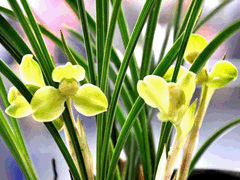 There are about two periods a year for repotting (transplanting or dividing) Chinese orchids. One is from late March to April, and the other is October, when growth has ended. However, forCymbidium goeringiithat have already produced flower buds, try to avoid transplanting them in autumn. This is because the buds that have grown often drop off due to transplanting. Conversely, from March to April, when growth is about to begin, damage caused by transplanting is not often seen. As for largeorchidplants that need dividing, the work should be done immediately after flowering.
Chinese orchids do not need to be transplanted and repotted every year. Counting from the year of planting, they will only grow vigorously in the second or third year, and at the same time, the number of buds available for division increases greatly. If at this time you divide them as quickly as possible for the purpose of exchange or sale, that is naturally understandable. But if it is purely a hobby grown for pleasure, then in order to appreciate its exquisite elegance, it is still best to grow it into a large plant as much as possible.
Therefore, under careful planting and care, by the third or fourth year, when you feel the pot is too small and no longer sufficient, that is the time to carry out division.
Orchidroots greatly need air. Their thick, long roots have highly developed water-storage tissue. Once they have absorbed water, even under temporarily dry conditions with a shortage of water, they will not wither from lack of water. Therefore, the primary requirement when choosing agrowingmedium is a material with good drainage and good aeration.
For general cultivation of Chinese orchids, soil that meets the above conditions can be used. For example, Shilin sand or Yangmingshan humus soil. However, at present, orchid growers in TaiwanGrowing orchidsmostly use materials such as tree-fern fiber, sphagnum moss, vermiculite, expanded clay pellets, red brick, bark, and charcoal. Strictly speaking, becausegrowingenvironments and types differ, the required materials also differ. But generally, any material with good ventilation and good drainage can be used.
When transplanting, take the original plant out of the pot. First remove the old soil, then wash the roots and the dirt on the leaf surfaces with water. Sphagnum moss attached to them or decayed roots must also be completely removed.
When dividing, try to avoid dividing them too small. It is best to use three buds as one unit; if divided too small, growth will stall, making the plant's recovery slower.
Throughout the entire cleaning process, avoid touching the new buds and try to hold the old stem portion.
Generally, using an orchid pot with a smaller mouth and greater depth is more helpful for the development of Chinese orchids.
In order to prevent pests from entering the bottom of the pot and to prevent the loss of thegrowingmedium, bamboo can be cut crosswise into pieces and arranged at the bottom of the pot. Cover it with orchid bricks or charcoal until the bamboo is completely covered. Preparation done in this way can be considered quite complete.
Hold the old pseudobulb of the plant to be planted with your left hand and place it in the pot. Decide the front and back positions and the height for planting, and then proceed with planting. At the same time, leave a little space in the direction of new bud growth. It is best to leave broader room for new bud growth, so that the following year you can enjoy fully opened flowers.
After deciding the position, use small tweezers or chopsticks to arrange the roots evenly on all sides, but try not to touch the white part at the front tips of the roots.
After the position is decided, hold the plant firmly with your left hand to secure it; gently place soybean-sized granular soil or other planting material between the roots. When putting in the granular soil, the roots will move, so when about one third of the pot depth has been filled, adjust the position of the roots again.
Then continue putting in soybean-sized granular soil until the roots are completely covered. At this point, confirm whether the plant is placed upright, and tap the bottom of the pot lightly on the work surface so that the soil particles or planting material settle completely. Usually gaps form between the roots, so use bamboo chopsticks to carefully fill the spaces with soil particles or planting material. Finally, cover the pseudobulbs with red-bean-sized granular soil, and make the center of the pot slightly mounded higher. If soil is used for cultivation, before putting it in, you must first use a sieve to remove the fine powdery particles.
For a plant that has already been planted, place the pot into a bucket so that the water can reach as deep as the upper rim of the pot, but be careful to avoid the loss of soil particles or planting material. Leave the pot in the water for about five minutes so that the soil particles or planting material absorb water completely, then take the pot out, and the dirty water will drip out from the bottom of the pot.
This dirty water is caused by fine dust attached to the soil particles or other planting materials. Such fine dust adhering near the roots greatly obstructs air movement around theorchidroots, so it must be filtered out and the water changed repeatedly until there is no more dirty water in the bucket.
One week after repotting, place it on a shelf where sunlight does not shine directly and strong winds cannot reach it, so that it can slowly adapt to the growing environment. (You Chongkui)