What are the types of whitefly pests and their damage symptoms?
Which whiteflies are commonly seen? What kind of damage do whiteflies bring to agricultural products? Let's take a look together below and get to know them first.
The silverleaf whitefly belongs to the order Homoptera, family Aleyrodidae. Since it invaded the main island of Taiwan, China in the 78th year of the Republic of China, the variety of crops it damages has grown ever greater, and the severity of the damage has also become more and more serious. Its economic importance has surged dramatically; after holding sway for 14 years, it has transformed into a super pest. It has omnivorous feeding habits; horticultural crops such as vegetables and flowers all suffer from it, and it damages more than 700 crop species. This insect is small in size with short generations, and can produce more than a dozen generations a year. It reproduces quickly and also has strong resistance to pesticides.
Depending on the crop, its damage symptoms and habitat habits each have their own characteristics. At present, the crops with damage potential and the targets are constantly setting new records. In addition to feeding on crop nutrients, it is also an important vector insect for many viral diseases. Especially in the two cropping seasons of spring and autumn, when Taiwan, China is at the peak production period for horticultural crops, vegetables, flowers and miscellaneous grains, with abundant food and suitable weather conditions, farmland is often abandoned because of outbreaks of the silverleaf whitefly.
Common whiteflies
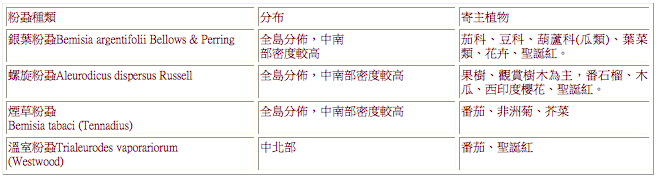
At present, the more common whiteflies in Taiwan, China are the silverleaf whitefly, the spiraling whitefly, the tobacco whitefly and the greenhouse whitefly, 4 species in all. Whiteflies are small insects; the adults are yellow with clearly two pairs of white wings. The spiraling whitefly is the largest in body size, and the adult body secretes white cotton-like waxy powder on the underside of leaves. The silverleaf whitefly and the tobacco whitefly are similar in body size; the silverleaf whitefly comes from the B biotype of the tobacco whitefly, and because it was found on poinsettia it is also called the poinsettia biotype. Its white wings are slender, and at rest they stand at a 45-degree angle to the leaf surface. The greenhouse whitefly is also similar in body size, with slightly broader and rounder wings that are parallel to the leaf surface at rest. The greenhouse whitefly is an insect of relatively colder zones, inhabiting the temperature-controlled net houses of central and northern Taiwan, China. The tobacco whitefly, silverleaf whitefly and spiraling whitefly are all distributed throughout the province, with density increasing the further south one goes. Especially in central and southern areas, where warm winters and long-term drought are common, the damage often reaches its peak. They are distributed in the plains and low-altitude mountain areas; as for the crops damaged, the spiraling whitefly mainly attacks woody plants and is occasionally found on tall-stemmed crops such as papaya; the silverleaf whitefly, tobacco whitefly and greenhouse whitefly mainly damage shorter and herbaceous plants, vegetables, miscellaneous grains, flowers, weeds and so on, such as tomato, cucurbits or legumes. Among them, the silverleaf whitefly has the highest density, causes the most serious damage, and is the hardest to control.
Host plants
The silverleaf whitefly is good at migrating and has a broad range of hosts. According to survey records, it can currently damage more than 700 crop species, and the variety of crops it damages and the severity continue to increase. Among horticultural crops, those of the Solanaceae, Fabaceae, Cucurbitaceae, leafy vegetables, flowers and so on, none can escape except grass-family crops. The more seriously affected ones include tomato, muskmelon, edamame, cauliflower, Chinese kale, cabbage, radish, eggplant, lavender, lemongrass, poinsettia, Malabar chestnut and African daisy.
Table 1. Distribution and main host plants of common whiteflies in Taiwan, China at present
Living habits and damage characteristics
A female can lay as many as 200 to 400 eggs in her lifetime. The eggs are oblong, initially white and gradually turning brown, and are scattered on the underside of tender leaves. The newly hatched nymphs are irregular, crystal-clear yellow, flattened ovals. The nymphs have four instars in all; the first instar has legs and seeks a suitable host, while after the second instar the legs degenerate and it attaches firmly to the underside of middle-aged and older leaves, piercing and sucking the plant's nutrients with its piercing-sucking mouthparts. After emergence, the adults fly to the underside tissues of tender new leaves on new shoots to lay eggs. The adult body is yellow with two pairs of obvious white wings; the body is delicate and its flying ability is poor. Generally, when disturbed, it hovers briefly at the upper part of the plant or around it and then still returns to the underside of the original leaf to rest and cause damage. Its body is light and thin, and it generally spreads by wind. In addition to directly piercing and sucking nutrients, both adults and nymphs transmit viral diseases, causing leaves to wrinkle, turn yellow and fall early, and they secrete large amounts of honeydew that induces sooty mold, affecting photosynthesis, weakening the plant body and hindering the normal growth of crops. Both adults and nymphs like to gather in groups on the underside of leaves, are photophobic, have overlapping generations, and live a gregarious life; whiteflies are almost never seen on the leaf surface. Because they vector tomato leaf curl disease and the viral diseases of muskmelon, leading to the abandonment of entire fields, this is nothing new. Edamame loses its original flavor because of their damage, and radish roots are damaged to the point that their weight is reduced by 1/3 and they lose their original pungent taste. Meteorological factors: aside from the many kinds of food whiteflies prefer, they are also extremely sensitive to climate change. 25.28°C is the optimum development temperature. Density is high when it is dry and warm, while cold, heat, high humidity, heavy rain and strong wind are mostly unfavorable to the reproduction of their population. They occur year-round in Taiwan, China, with density gradually rising from autumn to the turn of spring and summer the following year. Every year from September to May of the following year, before the plum rain arrives, is the peak period. Especially in early season and late spring, when food is abundant and the climate is suitable, if management is even slightly careless, the density often becomes uncontrollable in no time.