Occurrence of the bamboo mirid bug on crops and its control methods
The bamboo mirid bug is a pest you surely know about. So how do you control it and eliminate its harm to agriculture? Let's take a look below.
Currently, chemical control can still effectively control the bamboo mirid bug, but because it is not suitable to apply pesticides during the continuous bamboo shoot harvesting period (April to October), and because at this time the bamboo clumps are gradually growing larger with dense branches and leaves, which not only provides a good living environment for the bamboo mirid bug but also makes spraying quite difficult. Therefore, the appropriate timing for control should be before April, after farmers clear the plantation and retain the mother culms, when the bamboo clumps are smaller and sparser, making pesticide application convenient. Moreover, at this time the population density of the bamboo mirid bug is at its low point, so the population can be suppressed early, providing a good growing environment for the bamboo and an opportunity for parasitic wasps to exert their parasitic effect, thereby reducing the damage of the bamboo mirid bug during the shoot harvesting period.
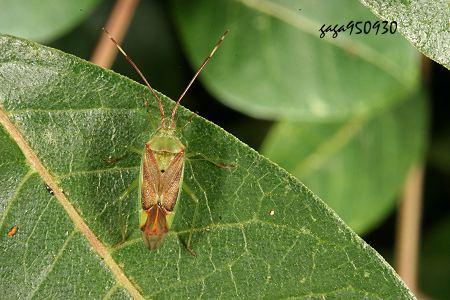
Ecology of the bamboo mirid bug
The bamboo mirid bug has a slender body, with legs and antennae also very long, and its appearance closely resembles a mosquito, so it is commonly called the "bamboo mosquito." The eggs are elongated oval, about 1mm long, milky white and transparent, laid on the leaf margin near the leaf tip on the surface of tender leaves, arranged in a row. The number of eggs in an egg mass can range from 3 to 52, mostly 7-14, with egg masses composed of 13 eggs being the most common. Near hatching they turn pale pink. The egg stage is about 4 days. The nymph is emerald green and resembles the adult. The nymph stage is about 18 days. The adult is about 6-8mm long, green or earthy yellow in color. The female is larger than the male, and its ovipositor is quite long, reaching up to half its body length and extending beyond the wing tips, while the male's abdomen is completely covered by the wings. The average lifespan of the adult is about 16-19 days. Both nymphs and adults inhabit the underside of leaves, piercing and sucking sap to survive, causing damage to the leaf mesophyll tissue and forming neat white square feeding marks.
Population fluctuations of the bamboo mirid bug
Using yellow sticky paper to investigate population fluctuations of the bamboo mirid bug in bamboo forests in Guanmiao Township, Tainan County, it was found that there are two peaks in a year. The first peak is in January, with an average of 133.6 insects caught per two-sided sticky paper. This peak may be due to winter drought combined with a warm winter, causing the density to begin rising at the end of the previous year, then gradually decline, and rise again after April. The second peak appears in July, with an average of 182.3 insects caught per two-sided sticky paper. Because April-May is the beginning of the bamboo shoot harvesting period, farmers no longer apply pesticides, and the plants gradually become taller with dense branches and leaves, providing more food sources and habitat, so the density of the bamboo mirid bug gradually begins to rise and reaches a peak in July. Starting in August, typhoons and heavy rains occur successively, causing the population density to drop rapidly. From this population change pattern, it can be seen that the best timing for control is in February-March, when the density of the bamboo mirid bug is still low, and farmers are also clearing the plantation and retaining mother culms at this time, when the bamboo clumps are smaller and sparser, making pesticide application more suitable, so the population can be suppressed early.
Control methods for the bamboo mirid bug
1. Physical control
Physical control uses the bamboo mirid bug's color preference for trapping and killing. Based on field tests of the bamboo mirid bug's response to four colors of sticky paper currently on the market (yellow, green, blue, white), the results showed that yellow had the strongest attraction effect, followed by green, blue, and white. Because yellow sticky paper has a relatively high cost, it is less suitable for direct use in control. However, the attracting effect of yellow can be used for density monitoring of the bamboo mirid bug, to understand its field fluctuation patterns and to determine the timing for pesticide control.
2. Biological control
Upon examining the eggs of the bamboo mirid bug, it was found that some were parasitized by a black egg wasp, preliminarily identified as Telenomus sp. Normal eggs of the bamboo mirid bug are pink, but after being parasitized by the black egg wasp they appear black with a metallic sheen (as shown in the figure). Each egg contains only one parasitic wasp. After parasitism, the eggshell hardens and darkens, and the adult bites through the cocoon shell to emerge. From egg masses collected in the field, the average parasitism rate of bamboo mirid bug eggs was calculated to be 33%.
Bamboo belongs to the grass family (Poaceae), subfamily Bambusoideae, and is a perennial evergreen plant. Starting each year in March to April, the underground rhizome grows tender shoots and bamboo shoots, which are edible. Currently, the national cultivation area is about 30,000 hectares. Within the jurisdiction of the Tainan station, it is mainly distributed in Yunlin, Chiayi, Tainan and other counties, with a planting area of about 16,000 hectares, accounting for more than 50% of the national production area. In recent years, farmers within the jurisdiction of this station have increased their income by growing green bamboo (Bambusa oldhamii) shoots, with an average unit price of about 30 yuan per kilogram, so farmers are all willing to continue planting. After joining the WTO, green bamboo shoots will have even greater export potential. At the same time, this year (92nd year of the Republic of China) a bamboo shoot industry alliance was established to integrate the bamboo shoot industry and create the best value. Common pests of bamboo include the bamboo mirid bug (Mecistoscelis scirtetoides), bamboo leaf aphid (Astegopteryx bambusifoliae), bamboo stem aphid (Pseudoregma bambusicola), bamboo leaf roller (Coclebotys coclesalis), long-horned stink bug (Notobius meleagris), Taiwan palm weevil (Rhynchophorus longimanus), and fruit flies of the family Tephritidae such as the six-striped fruit fly (Acrotaeniostola sexvittata), yellow-spotted fruit fly (Acroceratitis plumosa) and banded-belly fruit fly (Gastrozona fasciventris), among others. Among these, the bamboo mirid bug causes the most severe damage to green bamboo and ma bamboo (Dandrocalamus latiflorus), with feeding marks exceeding two-thirds of the leaf area. Farmers do not have sufficient knowledge of the pests, their control techniques are poor, and they fail to suppress them in time, causing bamboo leaves to be damaged, with large amounts turning yellow and drying up, seriously affecting yield and quality. To provide bamboo farmers with effective, economical and safe control measures, the Tainan station regularly monitors the population dynamics of the bamboo mirid bug and investigates appropriate control timing and techniques, providing reference for farmers to apply.