Ecological Habits, Damage and Control Methods of the Striped Flea Beetle
The striped flea beetle is an ancient pest of cruciferous vegetables. Farmers are no strangers to it, but they do not understand its ecology and the metamorphosis of its life cycle, because the adults live on the leaves above ground, while the eggs, larvae and pupae all live in the soil. Most farmers only control the adults and
The striped flea beetle is an ancient pest of cruciferous vegetables. Farmers are no strangers to it, but they do not understand its ecology and the metamorphosis of its life cycle, because the adults live on the leaves above ground, while the eggs, larvae and pupae all live in the soil. Most farmers only control the adults and neglect the larvae and pupae in the soil.So how should the ecology and control of the striped flea beetle be handled?
In spring and summer, population densities often remain high, and protected cultivation offers no escape either. Cruciferous vegetables should not be grown continuously; changing cultivation practices, combined with field management and attention to field sanitation, soaking the soil before planting, deep plowing or sun exposure to kill soil-dwelling eggs, larvae and pupae, and using fences to stop the invasion of external pest sources, plug-tray planting or using yellow sticky traps to capture adults can all reduce field populations.
In spring and summer, population densities often remain high, and protected cultivation offers no escape either. Cruciferous vegetables should not be grown continuously; changing cultivation practices, combined with field management and attention to field sanitation, soaking the soil before planting, deep plowing or sun exposure to kill soil-dwelling eggs, larvae and pupae, and using fences to stop the invasion of external pest sources, plug-tray planting or using yellow sticky traps to capture adults can all reduce field populations.
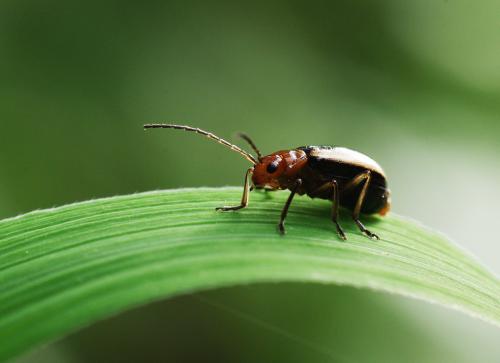
The striped flea beetle is a small beetle of the order Coleoptera, with a glossy black sheen, named for the slightly wavy golden-yellow longitudinal stripe in the center of each wing cover. It jumps like a flea, and farmers commonly call it "jumping bug." It is the most important pest of cruciferous vegetables under protected cultivation or organic cultivation during high-temperature periods. When damage is severe, it often leads to abandonment of the crop and total loss. Summer vegetables have high economic value, and whether the striped flea beetle is properly controlled often becomes the key to success or failure in cultivation.
Taxonomic Status
Order Coleoptera:(Coleoptera)
Family Chrysomelidae:(Chrysomelidae)
Scientific name:(Phyllotreta striolata(Fabricius))
English name:(Stripped flea beetle, turnip flea beetle)
Common names: vegetable jumping bug, vegetable tortoise bug, yellow tortoise bug, flea, flea beetle or hard-shelled tortoise bug.
Morphology
Adult:
The body is small and the wing covers have a glossy black sheen. Each wing cover has a slightly wavy golden-yellow longitudinal stripe. The hind-leg femora are especially enlarged, and it jumps and moves like a flea, hence the name striped flea beetle. Body length 2.4~2.7 mm.
Egg:
Elliptical, pale yellow. About 0.5 mm long.
Larva:
Body slender, white or pale yellow, head dark brown, body surface covered with fine hairs, with three pairs of thoracic legs and one pair of tiny posterior legs. Body length about 4.0~5.1 mm.
Occurrence Period
1. An important pest of cruciferous vegetables during the high-temperature spring and summer period in this province; densities are even higher during drought or when there is no water for irrigation.
2. In protected cultivation areas, it may occur year-round and cause damage, so timely control must be noted.
Living Habits
Adults chew on leaves, usually feeding from the upper epidermis and leaving the lower epidermis behind, and occasionally feeding from the lower epidermis as well. Damaged leaves first show dot-like feeding marks, and as they grow they become large holes and lose market value. Damage at the seedling stage affects plant development, and when population density is high and damage is severe, it often leads to crop abandonment.
Eggs are laid in the soil at the root zone or near the roots of the plant, scattered singly. After hatching, the larvae are soil-dwelling and burrow into the soil to feed on the roots, causing poor plant growth or loss of market value. Mature larvae pupate in the soil, and after emergence the adults crawl out of the soil surface and damage the aboveground parts, continuing their reproduction.
Life Cycle
1. Egg: about 6.0~7.1 days in winter, about 3.0~4.3 days in summer.
2. Larval stage: about 20.4 days in winter, about 10.5 days in summer.
3. Pupal stage: about 9.8 days in winter, about 4.0 days in summer.
4. Completion of one generation: about 66.9 days in winter, 32.9 days in summer.
5. Adult lifespan: about 50~60 days in winter, about 20~30 days in summer.
6. Number of eggs laid: each female can lay several tens to more than 700 eggs, averaging about 18 eggs.
Host Plants: It damages cruciferous vegetables such as radish, Chinese cabbage, qingjiang bok choy, heading Chinese cabbage, cabbage, cauliflower, mustard, heading mustard and Chinese kale.
Damage Symptoms
Damage symptoms vary with crop type. For example, when radish leaves are damaged by adults, they show dot-like feeding marks and the leaves become suberized; adults lay eggs on or around the roots, and after the eggs hatch the larvae burrow into the soil and damage the root cortex, causing strip-like sunken feeding marks that affect appearance or even render the crop unmarketable. These feeding marks often serve as entry points for pathogens, causing soft rot or black rot and seriously affecting yield and quality. Chinese cabbage seedlings may be chewed away completely, leading to crop abandonment, or the holes in the growing tip of the seedling may enlarge as the plant grows and cause loss of market value. In heading Chinese cabbage, the leaf mesophyll may be chewed away completely, leaving the plant soft and limp, seriously affecting plant growth. Cabbage, heading Chinese cabbage and heading mustard suffer more serious damage at the seedling stage and late growth stage. Adults like to gather in the growing tip and on the shaded undersides of leaves near the soil surface or in the gaps between two overlapping leaves where sunlight cannot reach. On leaves with thicker mesophyll, such as cabbage, they often damage from the upper epidermis and leave the lower epidermis.
Control Methods
1. Change cultivation: In severely damaged areas, cruciferous vegetables should not be grown continuously; instead, non-cruciferous vegetables such as amaranth and water spinach can be planted.
2. Before planting, flood the entire field to drown soil-dwelling eggs, larvae and pupae, or deep plow, turn the soil and expose it to the sun. In continuous cropping areas or areas where damage occurs, residual plants must be cleared; timely plowing followed by irrigation gives better control results.
3. Using yellow sticky traps to trap and kill adults can reduce field density; traps are best placed flat.
4. Adults are good at jumping and migrating, so the surroundings of the facility should be sealed. Using fine-mesh plastic netting or plastic boards (50 cm high) as a fence can block the invasion of adults.
5. Pay attention to field sanitation and remove residual plants, weeds and other hosts.