Is the apple snail a pest? Its harms and how to kill its eggs
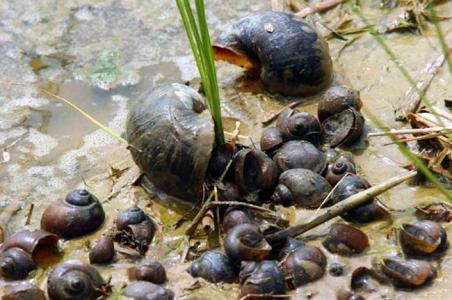
Apple snails often appear in rice paddies, but the apple snail is a pest, and it can harm the growth of rice, so how do you control it? Would you like to learn about more scientific control methods? Let's take a look below.
Because apple snails reproduce very quickly, in Taiwan, China they have almost no natural enemies, and even in Japan and China there have been major agricultural losses caused by apple snail damage. However, Chen Zhenliu, a teacher in the food processing department of National Longtan Agricultural and Industrial Vocational High School, recently discovered that using plant oil emulsion to suffocate apple snail eggs has been proven through field experiments to indeed have a killing effect. Chen Zhenliu said that this killing method will not cause secondary pollution to the environment, and after applying to the Ministry of Economic Affairs for a patent it has been approved, and she hopes to help farmers kill apple snail pests.
A film blocks the air and suffocates the eggs
Apple snails have invaded Taiwan, China for nearly thirty years, and in the fields of Taiwan, China pink apple snail eggs and dark brown apple snails can be seen everywhere. Chen Zhenliu said that because apple snails have extremely strong reproductive capacity, almost all common methods of killing apple snails use chemical pesticides. Although they can effectively kill apple snails, the residue of chemical agents not only causes environmental pollution, kills native fish and frogs and disrupts the ecological balance, but also causes great harm to the human body.
It will not cause secondary environmental pollution
Chen Zhenliu said that two years ago she emulsified plant oil and formulated it into a harmless emulsion. When she led students to spray it on apple snail egg clusters in the fields, it formed a thin film. This film blocks the air and achieves the effect of suffocating the eggs so they cannot hatch, and after repeated field experiments the results were indeed quite good.
She said that suffocating snail egg embryos is a physical control method, not pesticide control, and the plant oil emulsion is itself edible and harmless to the human body and the environment. In addition, she has also studied the use of a fruit peel preparation to control adult apple snails with considerable success, but it is still in the experimental stage.
Patent approved, mass production to benefit farmers
Chen Zhenliu said that in July of the year before last she applied to the Ministry of Economic Affairs for a patent, and the patent was approved a few days ago. After receiving the patent approval document, she discussed it with principal Zhang Yifang. Zhang Yifang suggested that she could cooperate with large private manufacturers to mass-produce it and help farmers kill apple snail pests. Although there is unlimited business opportunity, she thought that being able to help farmers without harming the environment and the human body is the ultimate goal of her research and development, and today she will publicly share this invention with farmers nationwide.
Ye Ying, deputy director of the Bureau of Animal and Plant Health Inspection and Quarantine of the Council of Agriculture, said that at present chemical agents are mostly used to control apple snails, and in recent years some farmers have also used biological control by raising fish or ducks in paddy fields to eat apple snails. As for the method of using plant oil emulsion to suffocate apple snail eggs, she had not heard of it.
In the past, the pesticide "triphenyltin acetate" was used for control, but because it is harmful to the environment, its use was announced as banned in 1997, and it was replaced with "niclosamide" and "metaldehyde". At that time farmers were not used to using them, and apple snail damage was once again caused, but now there is no such problem. The Bureau of Animal and Plant Health Inspection and Quarantine holds briefing sessions every year to teach farmers the correct way to use them.