Can you raise a baby mantis yourself? A detailed guide to mantis rearing methods
Using fruit flies to rear baby mantises - this method of rearing mantises, have you ever heard of it? If you want to learn this ecological rearing method, then let's take a look together.
Predatory natural enemies are part of the predatory food chain, such as the mantis stalking the cicada while the oriole watches from behind; the relationship among these three forms a food chain. Every natural enemy has its own natural enemies. For example, from egg to adult, the mantis has natural enemies at every stage: during the egg stage there are parasitic wasps, ants, and boring beetles; nymphs and adults have birds, nematodes, and so on. The mantis is a predatory natural enemy and can prey on pests such as aphids, flies, locusts, and moths. Newly hatched nymphs are small, about 0.6-0.8 cm, and the prey provided at this time should be equal to or smaller than the nymph's body size, such as aphids and fruit flies, so that the nymphs can catch the prey. But as the mantis grows larger, its appetite also grows, and the prey provided should be larger in size and greater in quantity.
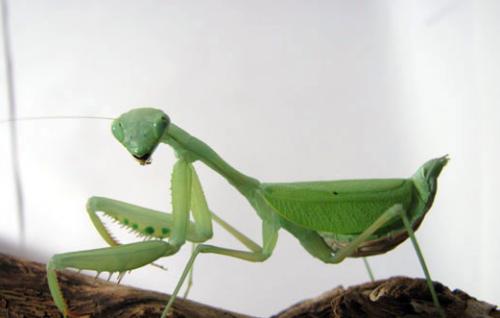
During the mantis larval stage, the prey includes small insects such as aphids or fruit flies. Aphids can be found everywhere on wild plants and on vegetables and fruits in fields; there are many species, but when the mantis feeds, it can prey on aphids regardless of species. Although aphids can be bred indoors, the number bred is hard to control, and if protective measures are not done well, secondary harm is easily caused; by contrast, fruit flies are simple to breed, and their adults can be raised on overripe melons and fruits or rotting plants, and can also be mass-reared on artificial feed.
The formula and steps for the artificial feed are as follows: first, add 5 grams of agar powder to 2 liters of water and boil, then add 120 grams of yeast powder and 140 grams of brown sugar; after adding, stir constantly. Separately, 300 grams of corn flour must first be dissolved in 1 liter of cold water before it can be added, otherwise it easily forms hard lumps that are difficult to dissolve. After the dissolved corn flour is added, stir constantly to avoid sticking to the pot; once it boils, turn off the heat and let it cool. When the temperature drops to about 80°C, pour in 18 milliliters of alcohol and stir, then pour in 18 milliliters of propionic acid and stir, and it is ready to be portioned into deep plastic trays (so that the artificial feed does not need to be replaced and topped up often). Each tray should be filled to about half, otherwise the fruit flies will crawl around the plastic tray and pupate everywhere; cotton can also be placed in the tray and around its four sides for resting and pupation. When the artificial feed has cooled to room temperature, it can be placed into the rearing box. If a very large number of fruit flies is needed, an iron frame can be used as the skeleton, with mesh netting wrapped around the four sides of the iron frame, with a mesh size of 32 mesh; then introduce stock from the wild and place the artificial feed tray by tray into the rearing box, with the temperature controlled at about 27-30°C, and they can be mass-reared. But when introducing stock from the wild, pay special attention: sometimes fruit fly parasitic wasps are introduced at the same time, making fruit fly breeding difficult.
When using natural enemies, a very large number is often needed to quickly bring pests under the economic injury level, but mass-rearing substitute food for natural enemies is not easy. The fruit fly's breeding process is simple, the space needed for rearing is small, the cost is very low, and its life cycle is short - about ten to twelve days from egg to adult - making mass-rearing easy; therefore, for rearing mantises, the fruit fly is a fairly good substitute food.