Why is Azolla an excellent green manure and feed?
Application of Azolla green manure in paddy field cultivation:We have always regarded Azolla as a polluting aquatic plant, but actually it has its benefits too. If you did not know, then take a look at this. Its usefulness in paddy field cultivation is great.
Reducing the production cost of grain crops, decreasing the application of chemical fertilizers and avoiding environmental pollution, maintaining soil fertility and the sustainable use of land - planting green manure is truly a choice that achieves both goals at once. However, paddy fields cannot carry out co-cultivation with ordinary upland green manure, so the aquatic plant Azolla has become the best paddy field crop to serve as green manure, and it does not occupy space and is easy to cultivate.
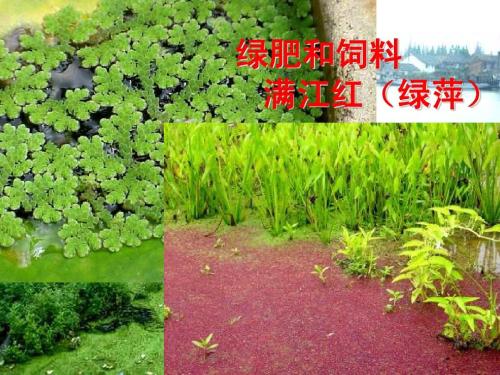
Taxonomic status, morphology and growth habits of Azolla
Azolla is a perennial aquatic fern that floats on the water surface, belonging to the family Azollaceae and the genus Azolla (Azolla), which is the only genus worldwide. The genus contains six species, namely A. caroliniana, A. filiculoides, A. mexicana, A. microphylla, A. nilotica and A. pinnata; Taiwan, China currently has one species, A. pinnata. Azolla can be seen in paddy fields, ponds, swamps and other water areas, mainly growing in subtropical and tropical regions, and the size and shape of the plants vary according to the different species and strains.
Taiwan, China currently has the species A. pinnata; the plant is triangular in shape, no more than 1 cm wide, with leaves at most 0.1 cm long. The stem bears roots and leaves, and the leaves are alternate and arranged in a pinnate pattern; each leaf is divided into upper and lower lobes. The upper lobe floats on the water surface, has assimilatory tissue and stomata, and its inner side is filled with many mucilage cavities; within the cavities lives a symbiotic bead-like nitrogen-fixing blue-green alga, Anabaena azollae. The lower lobe is membranous and submerged. Normally it mainly reproduces asexually, and when the weather is cold or too hot it produces male and female spores and carries out sexual reproduction. During low temperatures in autumn and winter, the plant's chlorophyll is destroyed and it produces red anthocyanin pigment (red anthocyanin pigment), making the water area where it is distributed present a scene of bright red, hence the name Azolla (full river red).
Environmental factors affecting the growth of Azolla
The Azolla variety A. pinnata grows best in an environment of PH 4.5 - 7.0, a temperature of 15-30 degrees Celsius, and a light intensity of 12,000 Lux; it reproduces rapidly and has extremely strong growth vigor. About 15 days after stocking and inoculation, its fresh weight can increase to 16 times the original, and after filling the water surface it can continue to proliferate by stacking in layers, reaching about 4-5 layers.
Azolla can grow in an environment without a nitrogen source. Because of the nitrogen-fixing blue-green alga Anabaena azollae in its leaves, it has a strong nitrogen-fixing ability. After the plant is incorporated into the field soil and decomposes, it can provide nitrogen and reduce the amount of chemical nitrogen fertilizer used. The most important nutrient for Azolla growth is phosphate fertilizer, followed by iron. When phosphate fertilizer is lacking, Azolla grows very poorly, the plants turn yellow, and the nitrogen content decreases. In addition, in some soils with high lime content and higher PH values, the iron content and availability of the growing environment are too low, so both the reproduction and nitrogen-fixing ability of Azolla are relatively poor, and the plants turn yellow. Excessive nitrogen fertilizer is unfavorable to Azolla growth, reduces the nitrogen-fixing ability of the blue-green alga, and promotes the growth of other weeds, which is unfavorable for weed control in paddy fields. If at the initial stage of stocking Azolla the nitrogen application rate is below 18 kg per hectare, combined with 20-40 kg of phosphate anhydride per hectare, then it will not only not affect the nitrogen-fixing ability of Azolla but will also help increase its fresh weight.
In summer, the climate has strong sunlight and high temperatures, and the water temperature is often 42 degrees Celsius, making heat damage and pest damage likely. When the water temperature is too high and the sunlight is too strong, the leaf color of Azolla changes from deep green to yellow-brown, the growth rate slows, and its covering and suppressing effect on weeds decreases. Therefore, at the initial stage of rice transplanting in the second crop, the stocked Azolla grows relatively slowly; when the rice plants tiller more vigorously and the rice leaves shade each other, the Azolla under the leaves begins to grow rapidly and vigorously, and the stocking and reproduction rate in the second month is about six times faster than in the first month. Although Azolla in first-crop paddy fields occasionally encounters low-temperature periods, its growth still remains deep green; therefore, there is no need to worry about low-temperature problems for native Azolla. Water depth also affects the growth of Azolla; if the water depth is insufficient, Azolla cannot float, and its reproduction rate will also slow down.
Field application of Azolla, fertilizer effect and weed suppression effect
The inner side of Azolla leaves has many mucilage cavities containing symbiotic nitrogen-fixing blue-green algae, so its nitrogen-fixing ability is strong. After being plowed into the soil, it can supply a large amount of nitrogen, reduce the application rate of chemical nitrogen fertilizer and save costs. It is an excellent green manure for paddy fields, does not occupy space, and is easy to cultivate.
Under suitable light and temperature it grows extremely rapidly, roughly doubling in about four days, and has strong coverage ability, with a very strong suppressive effect on paddy field weeds; it suppresses almost most paddy field weeds, and its weed control effect is similar to applying the herbicide "Mashangchu", so it can reduce the application of herbicides. Stocking Azolla in water caltrop fields or lotus fields at the initial stage of flooding and planting can also suppress the growth of weeds and Cladophora, but the application rate in water caltrop fields should be greater than in paddy fields, because water caltrop fields have no shade, and in summer with high temperatures and strong sunlight Azolla easily turns yellow-brown and its reproduction rate decreases. If there is not more Azolla stocked initially, the coverage effect on the water surface will be poorer, and the suppressive effect on Cladophora will be less noticeable.
Before rice transplanting, a small plot can be set aside in the field for Azolla reproduction. Phosphate fertilizer is the most important fertilizer for Azolla, with a suitable application rate of about 7.5-15 kg of phosphate anhydride per hectare, and no nitrogen fertilizer needs to be added. After land preparation and transplanting, the propagated Azolla can be stocked into the field. The fresh weight stocked per fen of land is about 25-30; at the initial stage of stocking the growth vigor is relatively slow, and after 30 days of stocking the coverage rate is about 30 %. When rice tillering begins to be vigorous, its growth vigor also becomes vigorous, and after 50 days its coverage rate reaches about 90 %.
Each hectare of paddy field can produce about 15,000 kg of Azolla fresh weight. After being plowed into the soil, it can supply 38 kg of nitrogen, 8 kg of phosphate anhydride and 24 kg of potassium oxide. Because these nutrient elements exist in organic form, their fertilizer effect will be slowly decomposed and released after being plowed into the soil, and their organic matter content is 50 %, which can increase the soil organic matter content.
Now you know that Azolla has this benefit too. So we should look at things from two sides, and looking at plants is the same.