New Technology for Ecological Duck Farming in Rice Paddies: An Introduction to Efficient Duck Farming Methods
Natural ecosystems are diverse, with various organisms coexisting in harmony. We can raise many animals in rice paddies to increase income. Let's take a look at how to raise ducks in the fields. Also, beneath this beautiful ecology lie troublesome problems. For organic farms, since herbicides cannot be applied, weed control becomes a chore. Let's take a look together.
■ Ducks, naturally diligent, forage row by row, walking 3 to 4 km each day. Efficiency is 100 percent.
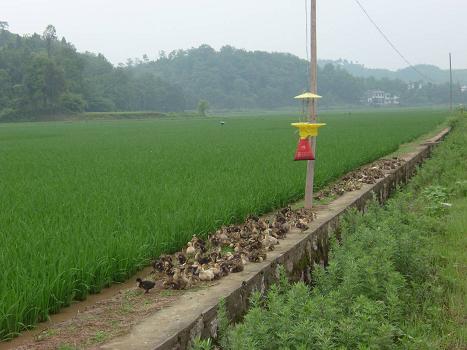
Ducks travel a path of 3-4 km each day from dawn to dusk
Last year, the author visited a Japanese university and personally witnessed farmers of the Japan Aigamo Rice Association successfully controlling weeds by raising Aigamo ducks. After returning home, I requested that Squad Leader Xiao Longcheng of Yilan Liming Farm donate 50 young white ducks, and began raising white ducks in organic rice paddies. The first crop season in Taiwan, China transplants rice seedlings very early, and the temperature is still chilly when it first turns warm. If ducklings are placed in the rice paddy too early, they are susceptible to cold. In principle, after hatching, ducklings need to be kept warm at night. During the day, they can be allowed to learn to paddle in water, and only after 15 days can they be released to forage in the rice paddy. In the second crop season, because the temperature is higher, the ducklings can be released into the field to forage one week after transplanting, once the seedlings have taken root.
The ability of ducks raised in rice paddies to control weeds lies mainly in their foraging process: as they move back and forth, they stir up the paddy water, and the muddy water prevents newly sprouted weed seedlings from receiving sunlight so they cannot grow, or prevents weed seeds from germinating. Combined with the daily trampling of their webbed feet, they can almost completely suppress weeds that sprout after transplanting.
According to observation, a flock of ducks travels a path of 3-4 km each day from dawn to dusk. Stocking 30 white ducks in a 5-hectare rice paddy can clean out golden apple snails and their egg masses completely. At this farm, raising ducks in organic rice paddies not only effectively controlled weeds but also brought an unexpected surprise: the ducks actually ate clean the golden apple snails that reproduce rapidly and leave everyone across the country and even all of Southeast Asia helpless. In the third section of this farm, an organic rice paddy of about 5 hectares, only 30 white ducks were stocked, and yet before the heading stage, no trace of any golden apple snail or egg mass could be found in the field. It is estimated that if adult ducks are not fed other feed, each duck can swallow 50-100 young snails per day.
In the past, "triphenyltin acetate" was used to control golden apple snails. Because it contains highly toxic substances and may cause cancer, it is a very toxic agent. The Council of Agriculture ordered it banned starting January 1, Year 88 of the Republic of China (1999). Although new drugs such as "niclosamide" are less toxic, they are expensive. Therefore, raising ducks to control golden apple snails is the most economical and most environmentally friendly method. In addition, ducks can also be sold for money, increasing farm household income.
Organic duck meat is firm, delicious, and low in fat. It saves money, is environmentally friendly, and can also increase income
When the rice reaches the heading stage, the ducks will begin pecking at the rice ears, and at this point they must be moved to the duck house for fattening. Because the white ducks feed on golden apple snails, they grow quickly and have already reached a body weight of 3 kg. With slight fattening, they can be sold. If fed natural feed such as oatmeal or rice bran, according to Australian organic standards, they still meet the standards for organic duck. In rice paddies where ducks are raised, because duck manure contains nutrients sufficient to fertilize the field, the nitrogen application rate should be reduced by one-third as appropriate, to avoid excessive lodging-prone overgrowth of the rice plants. Because ducks walk or peck in the field, the number of tillers of the rice plants may be slightly affected and decrease somewhat, but the rice stalks are stiff and upright, not prone to lodging, and the rice ears are plump and full, with every grain well filled.
The nutritional composition of golden apple snail meat is 10% protein and 2% fat, and every 100 grams of snail meat has only 57 calories. Organic ducks that forage on golden apple snails walk several kilometers every day, so their meat is firm. Golden apple snails are also a high-protein, low-fat feed, so the organic duck meat produced has low fat content and delicious meat quality and can be sold at a very good price. If laying ducks are raised, the duck egg yolks are rosy and even more of a top-grade product. This is worth vigorous promotion by local governments, encouraging farmers to raise ducks in rice paddies. This can not only control field weeds and golden apple snails and increase income, but also reduce pollution from agricultural chemicals and maintain the ecological environment of paddy fields. (This experiment was funded by the Council of Agriculture.)