The Benefits and Effects of Lemongrass, and an Introduction to the Lemon-Scented Plant
Lemongrass: In Taiwan, China, during the 40s to 50s of the Republic of China era (1951-1961), it was once cultivated on a large scale to extract lemongrass oil for export trade. At that time, together with peppermint oil and camphor oil, it was one of the important agricultural products that earned foreign exchange for our country. After the 57th year of the Republic of China (1968), because natural lemongrass oil could not compete with chemically synthesized products due to the development of chemical synthesis technology, lemongrass was forgotten and left to survive in the wild. Currently it is only produced in scattered amounts, commonly seen sold by vendors at tourist attractions for the purpose of repelling mosquitoes. In fact, lemongrass has extremely wide applications. Not only is lemongrass oil extracted for repelling mosquitoes, but lemongrass oil is also widely used in the international market as a fragrance ingredient in perfumes, cosmetics, soft drinks, soaps, detergents, and more, with a long history. Therefore, many people, when touching this plant that resembles silvergrass in appearance and catching its scent, cannot help but evoke a familiar smell from childhood memories, suddenly recalling that it was the scent of old-fashioned soap or laundry soap in early daily life. Fresh or dried lemongrass both have a pleasant lemon fragrance and can replace lemon for use in lemonade. Brewed with hot water as an herbal tea or medicinal herb tea, it is also very tasty. The tender stem base portion is suitable as an added flavoring for fish and meat soups. In India and Southeast Asian countries, lemongrass is an essential ingredient in home cooking, and is even used as an herb for treating colds and dispelling wind.
Lemongrass, also known as lemongrass, is a perennial evergreen herbaceous plant of the grass family Poaceae (Gramineae), genus Cymbopogon, widely cultivated in tropical and subtropical regions. The English term lemongrass mainly refers to the lemongrass species cultivated in the West Indies and Ceylon region with the scientific name Cymbopogon citratus (DC. ex Nees) Stapf. In addition, Cymbopogon flexuosus (DC.) Stapf., cultivated in the East Indies, known in its place of origin as cochin or malabar grass, is also called lemongrass. Currently the world's major producing countries include Guatemala, India, mainland China, Paraguay, the United Kingdom, Ceylon and other countries, as well as Indonesia, Africa, Central and South America and parts of South America. The estimated total cultivated area is approximately 50,000 hectares. Lemongrass products on the international market include fresh grass, dried grass, essential oil and potted plants, among other items. Statistical analysis shows that market prices are stable and demand is trending upward.
Plant Classification
The genus Cymbopogon contains approximately 50 to 60 species, and is the only genus in the grass family whose leaves contain a special aroma. The classification of lemongrass is mainly divided into five types: 1. Lemongrass, known in the essential oil market as West Indian lemongrass, scientific name: Cymbopogon citratus (DC. ex Nees) Stapf. 2. Cymbopogon flexuosus, scientific name: C. flexuosus (Nees es steud.) W, known in the essential oil market as East Indian lemongrass; 3. Ceylon citronella, scientific name: C. nardus. 4. Java citronella, scientific name: C. winterianus. 5. Palmarosa and gingergrass, scientific name: C. martinii, etc. The first two mainly contain citral, while Ceylon citronella and Java citronella mainly contain citronellal. Palmarosa, in addition to containing citronellal and citronellol, also contains a large amount of geraniol; the essential oil extracted from it is commercially known as palmarosa oil. Other varieties are all varieties bred by major cultivating countries through selection for essential oil composition and content or agronomic traits. In Taiwan, the varieties previously cultivated more extensively were lemongrass and Ceylon citronella. The former has a lemon aroma and a pleasant taste; fresh or dried stems and leaves can be used to make tea, bath soaks, desserts, and soup bases for meat and fish dishes, or essential oil can be extracted for aromatherapy, fragrance ingredients, perfumes and cosmetics. The latter has a strong odor; sensitive individuals may feel dizzy upon smelling it. It is suitable for extracting essential oil to eliminate unpleasant odors or repel insects, and is also commonly used to make primary processed products such as soap and candles. In addition, Taiwan also has a native lemongrass species with the scientific name C. tortilis, found scattered in hilly wild areas throughout Taiwan. There is another genus in the grass family, namely the vetiver genus, whose fragrance exists in the roots; besides extracting essential oil, it can also be used as a medicinal plant and for soil and water conservation.
Agronomic Characteristics
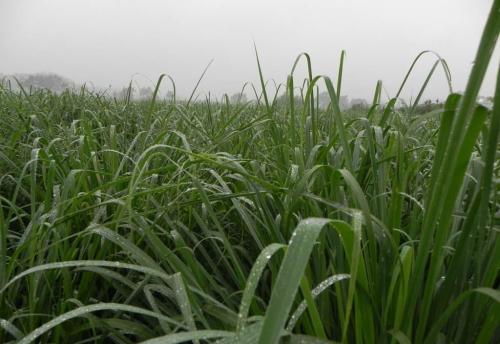
Lemongrass is a perennial herbaceous plant with a lemon aroma. The plant has many tillers and grows in clumps, with each clump reaching a maximum diameter of about 2 m. The leaves are broad and linear, growing with clasping stems, reaching lengths of up to 1 m and widths of about 1.5 cm to 3.0 cm. Leaf color is mostly green, with shade varying according to the cultivation environment, so it is not easily used as a basis for classification. Both leaf surfaces are rough and grayish-white; the leaf sheath is smooth; the ligule is thick and scale-like. The margins are mostly serrated, so care must be taken when touching as cuts occur easily. Lemongrass (C. citrates) stems are mostly light green to medium green. C. flexuosus has two types, one with apple-green to white stems and another with red stems. Stem color is mostly light green to medium green. Wax bloom is commonly seen on the internodes of the stems.
Lemongrass rarely bolts and flowers, so it is mostly propagated by root division or stem tillering. It occasionally flowers in summer and autumn; its inflorescence is a loose panicle composed of paired racemes with multiple nodes, branched, interrupted at the base, with slender branches drooping in an arc. The first-order branches have 1 to 5 nodes, and the second and third-order branches have about 2 to 3 nodes and are simple. The raceme has 4 nodes, with long soft hairs on the rachis internodes; each pair of racemes is subtended by a boat-shaped, sheath-like spathe; spikelets are awnless, the sessile spikelets are bisexual, and the pedicelled spikelets are lead-purple. Because lemongrass rarely flowers, it is difficult to distinguish differences between varieties based on floral structure. Plant appearance also varies with cultivation environment and management methods, making identification difficult. For beginners, it is best to directly seek reliable seedling suppliers for purchase, supplemented by aroma identification. Generally, the main essential oil aroma component of lemongrass and C. flexuosus is citral. Ceylon citronella, however, has dark red leaf sheaths densely covered with fine bristles, and when flowering produces longer loose drooping inflorescences; its essential oil aroma components are mainly citronellal and citronellol.
Cultivation Environment and Key Points
Cultivation Environment: Lemongrass prefers warm, humid, full-sun environments and well-drained sandy soil. In India, the main cultivation areas are distributed in regions with average temperatures between 18 and 29°C, average annual rainfall of 70 to 410 mm, and soil pH between 5.0 and 5.8 (East India) and soil pH between 4.3 and 8.4 (West India). However, the climatic conditions for maximum oil yield per metric ton of fresh grass are a growth temperature between 25 and 30°C and average annual rainfall between 2,500 and 3,000 mm. At the same time, fertilizer conditions include nitrogen at approximately 186 kg per hectare per year, phosphorus at 26 kg/ha, and potassium at 384 kg/ha. Nitrogen fertilizer has a greater effect on above-ground fresh grass yield, while potassium fertilizer has a greater effect on lemongrass oil yield.
Propagation Methods: Because lemongrass rarely flowers and sets seed, propagation is mainly by root division or tiller propagation. A mature lemongrass clump has about 50-200 tillers; cut off the upper leaves, leaving about 10-15 cm of rooted tillers, and plant directly in the field. C. flexuosus, however, can be propagated by seed, with a sowing rate of about 5-10 kg/ha.
Cultivation Key Points: Row and plant spacing is generally 100X45 cm. After planting, the first harvest can be made on average about 6 to 8 months later, and thereafter once every 3 to 4 months on average. Reports indicate that harvesting fresh grass 20 cm above ground yields higher fresh grass and essential oil production. Dry grass yield can reach about 4-6 metric tons/ha, and lemongrass oil yield 30-40 kg/ha (4 to 5 harvests per year); mechanical or manual harvesting can be used.
Chemical Composition
The entire lemongrass plant contains volatile oil (essential oil), extracted by steam distillation to produce lemongrass oil, with an essential oil extraction rate of about 0.2 to 0.5%. After harvest, lemongrass should be wilted before extraction. Lemongrass oil is generally yellow to dark yellow. More than 100 chemical components can be detected in the essential oil, with the main chemical composition being citral at 70-80% and myrcene at about 20%; it also contains citronellal, geraniol, l-borneol, 1,8-p-menthadien-5-ol, and other components. These components are mainly used in perfumes and cosmetics. The market generally considers that the citral content of lemongrass is lower than that of C. flexuosus, but there is no definitive conclusion.
Applications of Lemongrass
Applications of Fresh and Dried Grass: The entire lemongrass plant can be used. Fresh or dried leaves and stems both have a rich lemon fragrance. In Asian countries such as India, Vietnam, and Thailand, it is commonly used as a seasoning in soups and meat dishes, for example adding leaves to curry. In India, lemongrass is directly crushed and placed in clean water for use as shampoo and washing water. It can also add fragrance to non-alcoholic beverages, baked goods and pastries. Lemongrass tea brewing method: take about 3 grams of dried grass or cut an appropriate amount of fresh grass (5-10 grams), brew with 250 cc of hot water, let stand for 5-10 minutes before drinking; it can also be mixed with other herbs. Currently, farmers in central Taiwan also dry and process it into lemongrass pillows for sale.
Applications of Lemongrass Oil: Lemongrass oil can be directly used as a fragrance ingredient in perfumes, cosmetics, soaps, creams and other processed products. Lemongrass essential oil is classified as a semi-dry essential oil, and in aromatherapy it is considered helpful for oily skin. Because citral can be used as a raw material for synthesizing ionones (raw materials for perfume and cosmetic fragrances). Therefore, citral can be fractionated from lemongrass oil for use as a fragrance ingredient in soft drinks, soaps, perfumes, cosmetics and detergents, as well as for masking unpleasant odors in many industrial products.
Medicinal Uses: In traditional or folk medical applications, lemongrass is considered to have wind-dispelling and insect-repelling effects. In the classification of Chinese herbal medicine, its nature and flavor are categorized as pungent and warm. Its effects are to dispel wind and dampness, reduce swelling and relieve pain. In addition, related research reports indicate that lemongrass essential oil has sedative and antimicrobial effects. C. flexuosus essential oil has antifungal effects. The volatile oil has insecticidal and mutagenic effects. Reports indicate that palmarosa has toxic effects on fungi. Currently, some organic cultivation management uses diluted lemongrass oil as an organic insect repellent or plants lemongrass as a repellent plant, but the actual effectiveness still awaits confirmation by experimental data.
Safety and Side Effects: Currently, extracts or essential oils made from lemongrass plants have been assessed as safe and can be used for food or external application, with no reports of side effects. However, lemongrass essential oil is irritating, and excessive use can cause redness and swelling, so it should be used in moderation.
In recent years, people have enjoyed growing some fruits themselves, and consumer interest in the cultivation and application of herbs has grown increasingly lively. Harvested plants can be used for tea, cooking, and bath soaks. Recently, the summer solstice has passed, and Minor Heat and Major Heat will follow one after another. In the sweltering weather, with mosquitoes flying about, when out on outings or at home, try using lemongrass essential oil products or cooking a pot of lemongrass chicken soup or fish soup; perhaps it will eliminate some of those annoying mosquitoes and summer heat for you. Lemongrass has a pleasant lemon fragrance, and also has the advantages of tolerating high-temperature, humid climates and soil environments and growing rapidly; cultivation and management are extremely easy. Growers can plant it at the edges of farms or around herb field plots; as it sways in the wind, the stems and leaves rub together and naturally release the natural fragrance of lemongrass!