A Detailed Guide to Strawberry Cultivation Techniques and Growing Management Methods
(1) Selection of the environment and coordination with related measures. Practice crop rotation. Carry out soil diagnostic analysis. Soil improvement. No soil, air or water source pollution in the surrounding environment. (2) Weed control methods. Use manual or mechanical tillage for weeding; do not use chemical herbicides. Adopt mulching or crop rotation
(1) Selection of the environment and coordination with related measures
Practice crop rotation
Carry out soil diagnostic analysis
Soil improvement
No soil, air or water source pollution in the surrounding environment
(2) Weed control methods
Use manual or mechanical tillage for weeding; do not use chemical herbicides.
Adopt mulching or crop rotation to control weed occurrence.
(3) Fertilizer management methods
Do not use chemical fertilizers; apply only organic fertilizers, preferably compost that has been piled and fermented on site, and the organic fertilizers must not contain additives such as chemical synthetic agents, and organic liquid fertilizer may be used as a top dressing.
During the seedling stage and the growing period of strawberries, beneficial microorganisms such as phosphate-solubilizing bacteria and mycorrhizal fungi may be inoculated and used.
Apply an appropriate amount of compost at the same time as land preparation. Generally, when the soil organic matter content is below 2%, the recommended compost application rate may be up to 20 tonnes; if the content is higher than 2%, the application may be reduced accordingly, but 6-10 metric tonnes is still advisable.
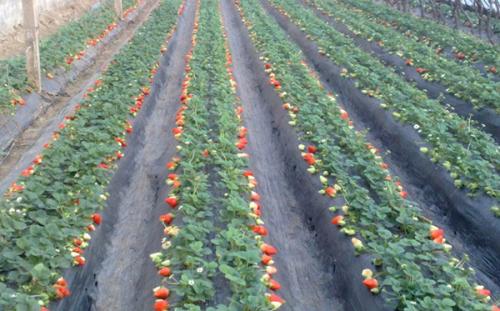
(4) Pest and disease control methods
Recommended methods for pest control
For large areas under long-term cultivation, use sex pheromones to trap and kill adult moths
a. Tobacco cutworm (Spodoptera litura): 4 trap boxes per hectare.
b. Beet armyworm (Spodoptera exigua): 8 trap boxes per hectare.
Spray microbial insecticides — to control larvae of pest insects (Lepidoptera)
a. Bacillus thuringiensis at 1000-3000 times dilution.
b. Beauveria bassiana or Metarhizium anisopliae.
Release green lacewings (Chrysopa spp.) (40,000 eggs per fen of land), which can prey on leafminers, thrips, aphids and lepidopteran larvae and eggs.
Apply non-pesticide substances
a. In combination with the release of green lacewings, spray vinegar at 200 times dilution, which can control leafminers, etc.
b. Apply garlic extract or neem extract, etc., which can control leafminers, thrips and aphids, etc.
c. Sugar-vinegar solution may be applied in an appropriate amount.
Recommended methods for disease control
Gray mold:
a. Remove diseased leaves or diseased fruit.
b. Microbial preparation DCB-1A (Biotechnology Center).
Powdery mildew:
a. Remove diseased leaves or diseased fruit.
b. Microbial preparation DCB3 (Biotechnology Center).
Bacterial wilt:
a. Apply S-H soil additive at 600 kg per fen of land one week before planting.
b. Use healthy seedlings.
Root-knot nematode:
a. Raise seedlings in seedling soil together with mycorrhizal fungi, then transplant, which can increase resistance.
b. Apply chitin (crab shell powder) to the soil during land preparation or basal fertilizer application.
General preventive methods:
a.
Before planting, flood the soil or plant green manure crops, generally mainly sesbania (Sesbania), and after incorporating the sesbania, flood with water for more than 2 weeks.
b.
Before planting, cover the soil with plastic sheeting and use solar disinfection.
c.
Interplant repellent crops such as garlic and scallions.
d.
Apply soil improvement materials such as magnesium lime or silicate slag in an appropriate amount.