What plant is the common bean? Common bean planting and cultivation management methods
Organic common bean cultivation and management techniques
(1) Environmental selection and coordination of related measures
Practice crop rotation
Carry out soil diagnostic analysis
Soil improvement
No soil, air or water source pollution in the surrounding environment
(2) Weed control methods
Use manual or mechanical inter-row cultivation and weeding, and do not use chemical herbicides.
Adopt mulching or crop rotation to control weed occurrence.
(3) Fertilization management methods
Do not use chemical fertilizers; apply only organic fertilizers, preferably compost that has been piled and fermented on site, and the organic fertilizers must not contain additives such as chemically synthesized agents; organic liquid fertilizer may also be used as a top dressing.
(4) Pest and disease control methods
Recommended methods for pest control
Spray microbial insecticides — to control larvae of poisonous insects
a. Bacillus thuringiensis at 1000-3000 times dilution.
b. Beauveria bassiana or Metarhizium anisopliae.
Release Chrysopa sp. lacewings (40,000 eggs per fen of land), which can prey on spider mites, thrips, aphids, and lepidopteran larvae and eggs, etc.
Apply non-pesticide substances
a.
In combination with releasing Chrysopa sp. lacewings, spray Gongyan vinegar at 200 times dilution, which can control spider mites, etc.
b.
Apply garlic infusion or neem extract, etc., which can control thrips and aphids, etc.
Recommended methods for controlling major diseases
Rust: select disease-resistant (tolerant) varieties.
General preventive methods:
a. Flood the soil before planting, or plant green manure and then flood.
b. Cover the soil with plastic sheeting before planting and use solar disinfection.
c. Interplant repellent crops such as garlic.
d. Remove diseased plants (leaves) and burn them.
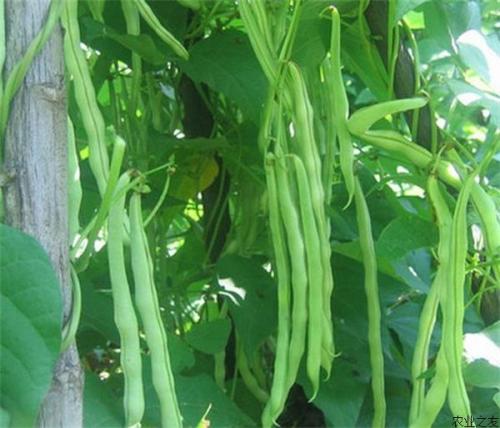
What plant is the common bean
Family Fabaceae, widely distributed in tropical and temperate regions; in China (including cultivated ones) there are about 15 species, produced in all provinces, among which mung bean P. radiatus L., adzuki bean P. angularis Wight, lima bean P. lunatus L. and common bean P. vulgaris L., etc., are all important food crops and are widely planted in all provinces. Twining or erect herbs; pinnately 3-foliolate, rarely reduced to a single leaflet, with small stipels; stipules often persistent, with longitudinal lines; flowers arranged in axillary, sometimes terminal racemes; calyx bell-shaped, with distinct, persistent bracteoles below; corolla white, yellow, red or purple, extending beyond the calyx, the keel petal apex prolonged into a spirally coiled long beak; stamens 10, diadelphous (9+1); ovary sessile, with many ovules, style long, twisted in the same direction as the keel, hairy along one side; pods linear to oblong, flat or swollen, with several seeds.