Practical Techniques for Shiitake Cultivation and New Techniques for Fast-Growing, High-Yield Production
The scientific name of shiitake is Lentinus edodes. It is a low-calorie food; eating 50 grams of shiitake per day provides only 15 calories. Its protein and fiber content are also high, and it is rich in calcium; in addition, shiitake contains two components that have been proven to have medicinal effects, namely shiitake mycelium extract (LEM) and lentinan, both of which are currently sold as commercial products.
In 1969, the Japanese government conducted a survey of two areas with very low cancer rates and found that these two areas were actually shiitake production regions in Japan, where residents consumed relatively more shiitake in their daily diets. Shiitake is now recognized worldwide as a health food.
Shiitake production in Taiwan, China is mostly concentrated in areas such as Nantou and Taichung. According to the "Agricultural Yearbook" of the 89th year of the Republic of China (2000), shiitake production in Taiwan, China was about 3,166 metric tons. At present, there are still no applicable production standards for organic shiitake in the Taiwan, China region, but if shiitake is classified under organic vegetables, then a fully organic production method must be adopted. That is to say, the production process of organic shiitake must not use chemical fertilizers or pesticides at all. Shiitake cultivation generally uses relatively few pesticides, so shiitake is an agricultural product suitable for organic cultivation.
Organic Cultivation of Shiitake
Shiitake is easier to cultivate organically than other mushrooms because it is more resistant to invasion by pests and diseases. In European and American countries, much shiitake cultivation is organic, meaning that log wood or sawdust is used to cultivate shiitake without adding chemical substances such as calcium carbonate or pesticides to the growing medium or spraying pesticides on the shiitake. Organic shiitake cultivation will encounter some of the same contamination problems as traditional shiitake cultivation, as well as pest and disease problems such as slugs and mushroom flies, all of which can lead to reduced yields or affect shiitake quality. Producers must be able to control these pests and diseases or face some degree of crop loss. In order to label the product as "organic," producers must participate in certification.
Traditional shiitake cultivation involves large-scale cultivation at mushroom farms for commercial production. In recent years in the United States, however, there are some organic shiitake production companies that promote organic mushroom growing kits for home cultivation on the Internet. In the United States, there are also examples of small logs being sold for people to grow mushrooms at home. Small logs already inoculated with shiitake mycelium can produce natural organic shiitake indoors or outdoors in shade. It is said that such logs, if cared for well, can be used continuously for 3-4 years and can produce shiitake about every 2 months.
Organic Shiitake Kits
Missoula is a small town in the state of Montana in the United States, also known as the Garden City. In Missoula, the mushroom farm named after the Garden City is Garden City Mushrooms, jointly operated by Glen Babcock and Wendy Garrett. This mushroom farm is famous for specializing in the production of certified organic mushrooms. They also take pride in being able to provide kits for home mushroom production. This allows many laypeople to produce shiitake in their own homes. The shiitake strain they use is suitable for growing at 15-24 degrees Celsius. Using this farm's organic shiitake production kit to grow shiitake at home is as easy as growing potted plants at home; all you have to do is water it. When you receive the kit, it is like receiving a peculiar gift, and it seems like an educational project meant to let you learn and gain insight.
The sawdust kit used for producing shiitake does not take up much space; it is only 15 cm X 15 cm in size and can be placed on a coffee table, cabinet, or ordinary desk. Observing the growth of shiitake every day is extremely exciting.
How to Care for Shiitake at Home
To successfully cultivate shiitake at home, you basically need to let the kit receive indirect light at the appropriate times, supply water and air, and also give it love. Generally, a shiitake kit for home cultivation comes with three other items, namely a humidity tent, four wooden strips to prop up the humidity tent, and a care card (that is, the instruction manual for the kit).
The method of using plastic bags of sawdust to produce shiitake in Taiwan, China was approximately published in 1974. After continuous research and development by industry operators, it developed into a unique production method renowned worldwide (Song Xifu, 1998), which is popularly known as the "space bag." Its main material formula consists of oak sawdust, rice bran, cornmeal, and calcium carbonate. For the sawdust plastic bags used in organic shiitake cultivation, the calcium carbonate added should preferably be made from crushed minerals containing lime, and the amount added should also be properly investigated; excessive amounts will slow mycelial growth or even hinder it. Below, the method for home production of shiitake provided by Garden City Mushrooms is given for domestic reference:
1.
When you receive the mushroom growing kit, the sawdust medium inside has already been prepared and has already been inoculated with shiitake spawn. All you have to do is take out the four wooden strips and insert them at the four corners of the large block (as shown in Figure 3), then cover it with the included plastic bag to serve as a humidity tent (as shown in Figure 4). The kit must be placed in a location at about 16 degrees Celsius to 21 degrees Celsius, and it needs about 10 to 12 hours of indirect light exposure each day.
2.
Sufficient humidity must be maintained inside the humidity tent so that the shiitake can grow well. Usually, spraying with a fine mist 4 times a day is enough. Spray until water droplets cling to the inner wall of the humidity tent, which indicates that the moisture is sufficient.
3.
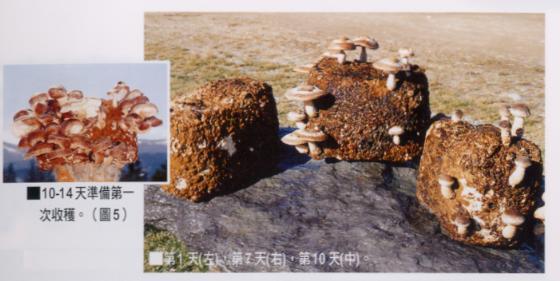
Usually, by repeating the spraying twice a day, after about 7 to 10 days you should be able to see small mushrooms beginning to emerge from the large block.
4.
As the shiitake continue to enlarge, you must keep the humidity inside the tent relatively high so that you can harvest them. Shiitake has no skin, and its moisture evaporates quickly, so sufficient water must be supplied.
5.
When the mushroom caps have become slightly flattened, the shiitake can be harvested. (Figure 5)
6.
After all the shiitake on the block have been harvested, it needs to rest for about 10 days to allow the mycelium to absorb nutrients again so that mushrooms can emerge again next time.
7.
During the period when the block is resting, you must still continue watering.
8.
After the block has finished resting, you must stimulate it to grow mushrooms again. So remove the humidity tent and also take off the 4 wooden strips, then soak the block in a bucket filled with cold water (about 13 - 16 degrees C), letting it be completely submerged underwater for about 18 -24 hours. You can use something to weigh down the block so that it does not float up.
9.
After soaking, place the block back inside the humidity tent again, and then spray and water again. Usually the next batch of mushrooms will emerge again after 7 to 10 days.
10.
Repeat the above steps until it no longer produces mushrooms. Generally speaking, how long the block lasts depends on how well you follow the instructions and manage it. As long as you pay attention to each detail of watering, letting the block rest, soaking it, and letting it grow mushrooms, you will obtain a good shiitake yield.
11.
Usually, when the outer edge of the mushroom has become slightly flattened, the shiitake can be harvested. The size of the mushrooms is generally not very uniform and can range between 5-10 cm. Generally, if shiitake are well managed after harvest, the number of mushrooms produced again will increase, but they will become slightly smaller. In order to maintain humidity inside the tent, you can place a small bowl of water inside the humidity tent; this can increase the humidity inside the tent and is favorable for mushroom production. Usually, after the block has been harvested and treated, it can continue producing shiitake after about 2-3 weeks, and the entire block can produce mushrooms about 2-3 times. The shiitake produced the first time will be larger than those produced the second and third times.