In precision agriculture, Israel has invented the sweet pepper-picking robot Sweeper
Rest assured, robots still cannot take over our world in the short term, because even some of the most basic operational tasks will leave them at a loss. Have you ever thought about how difficult it would be to let a robot pick a ripe sweet pepper on its own?
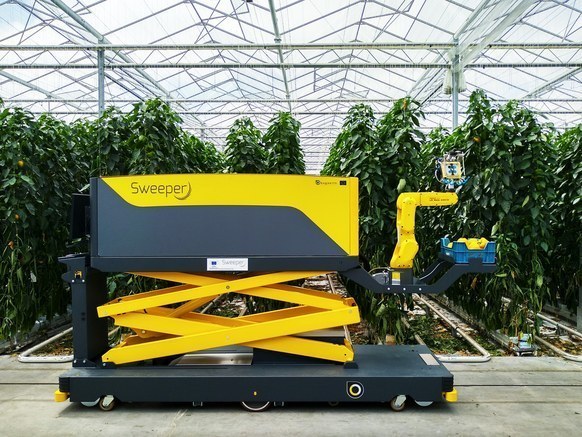
To be honest, I had never thought about this question either, but it is clear that researchers from Israel and Europe have studied it for a long time. They are currently developing a robot named Sweeper, which can autonomously patrol back and forth in greenhouses where sweet peppers are grown, observe whether the sweet peppers are ripe, and pick the ripe sweet peppers and place them into a basket.
In fact, we can think of Sweeper as a self-driving car, except that this “car” is equipped with a sawtooth at the front, and its destinations are all pepper plants. In the greenhouse, Sweeper uses sensors such as lidar (which determines distance by emitting laser beams) to determine its patrol path. As it patrols along the planting paths of the plants, it stops every few feet to capture images of the target.
Polina Kurtser, an industrial engineer from Ben-Gurion University in Israel, said: “When Sweeper finds a target object resembling a pepper, it will try to approach it.” It will then observe this target object more carefully, extending its head (equipped with a camera) back and forth to inspect the target object from multiple angles. During this process, Sweeper itself projects light onto the plants, which means that whether it is day or night, it can work normally in the greenhouse.
Through the light projected onto the target object, Sweeper can observe the color of the sweet pepper in greater detail, thereby confirming its ripeness. This is because if the sweet pepper is in the appropriate state, the color on its surface will show an uneven kind of change, with some areas turning yellow, and in addition there will be green patches. In this state, the sweet pepper has not reached full ripeness, but this is exactly the state Sweeper is looking for, because during the process from being picked to entering the market, the sweet pepper will happen to continue ripening to a state that satisfies consumers.
Next comes the most critical picking process: Sweeper positions its head so that the small sawtooth at the brow position is exactly above the stem of the pepper plant, while the scoop at the robot's chin position is below the sweet pepper fruit. In this way, after the sweet pepper is cut off by the sawtooth, it will fall directly into the scoop, and after rotating, it will finally enter the collection basket.
The entire process takes 24 seconds. Kurtser said: “Right now you might think that 24 seconds is too long, because a human worker might be able to complete this operation in 3 to 4 seconds. But don't forget, a human worker cannot stay in a working state 24 hours a day.” In addition, the researchers are currently running the machine in a slow mode, mainly out of safety considerations, taking into account the safety of people working around the machine, and they believe that the picking time can actually be shortened to 15 seconds.
In this sweet pepper-picking process, the biggest obstacle is precisely the simplest operational step: placing the sweet pepper into the fruit collection basket takes 3 to 4 seconds, because it must turn the sweet pepper away from the direction of the plant and then carefully place it into the basket. To achieve a picking time of 15 seconds, they may use some kind of tube that allows the sweet pepper to reach the basket directly after being cut off, omitting the intermediate scoop transfer step.
In fact, it is already very difficult for Sweeper to achieve its current accomplishments. Because we all know that the greenhouse environment in which plants grow is hot and humid, and this environment is not friendly at all to robot sensors, and engineers must also order special boxes and materials to allow the sensors to operate normally in this environment. Kurtser said: “We humans do not like to work in the high-heat environment of a greenhouse, and sensors likewise do not like such a working environment.”
In addition, Sweeper also faces a challenge: the interior of a greenhouse is not the carefully organized structured environment usually suitable for robots to work in. Although the plants are arranged neatly and orderly, the gaps are very small, and the plants are spread throughout the entire greenhouse space. Kurtser explained: “If you want to run a robot in a BMW production workshop, then you can create an environment that is favorable for its operation. But to run a robot in this kind of agricultural environment, you really cannot design too much, and you must adapt to the environment there.”
Admittedly, different crops require different types of robots, and you cannot casually place Sweeper in an apple orchard and then expect it to bring you back a basket of apples. But this does not mean that the design ideas and approach of this robot cannot be referenced by picking robots for other similar types of crops. The researchers said that after slight adjustments, Sweeper can be used to pick cucumbers.
Kurtser said: “(Sweet pepper and cucumber picking robots) face the same problems in terms of obstacles, density, and planting systems.” One major difference is that the criteria for identifying cucumber ripeness are different from those for sweet peppers. “Therefore, some things you can use directly, but for the algorithm that detects ripeness you need to design it separately.”
Different crops also have different requirements for how robots pick and place them. Iron Ox is currently developing a robot suitable for working in greenhouse environments. Company co-founder and CEO Brandon Alexander said: “Delicate fruits like strawberries need to be placed directly into the final packaging container after being picked to prevent friction damage, while vegetables like sweet peppers can first go through an intermediate step such as a bulk bin.”
Sweeper and other varieties of picking robots are currently only just beginning to take shape. However, judging from the current situation of a 20% labor shortage on California farms, this is also a good time for robots to enter farms.