Detailed Explanation of Chloroplast Photosynthetic Pigments and Their Optical Properties
Chloroplast Photosynthetic Pigments and Optical Properties
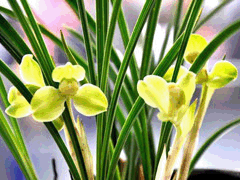 OrchidsLeaves are the main organs for photosynthesis, and chloroplasts are important organelles for photosynthesis, containing multiple pigments to adapt to the function of photosynthesis, and are also the main factor in the emergence of variegated leaf characteristics. ChineseOrchidsare mostly shade-tolerant plants, with numerous and large chloroplasts, allowing them to receive the maximum amount of light under weak light conditions.
Generally, chloroplasts contain four pigments, namely chlorophyll a, chlorophyll b, carotene and xanthophyll. Chlorophyll a (C55H72O5N4Mg) is blue-green, chlorophyll b (C55H70O6N6Mg) is yellow-green, carotene (C40H56) is orange-yellow, and xanthophyll (C40H56O2) is golden yellow. The different proportions of these photosynthetic pigments in leaves form the basis of the different variegation characteristics of variegated orchids.
In addition to the above four pigments, the vacuoles of leaf cells also contain anthocyanins and related pigments. They mainly exist in petals, and anthocyanins are also present in some young or senescent leaves. Because as one of the appreciation trends of Chinese orchids, the color flower art, the different colors of flowers or red buds and yellow buds are all determined by the content of anthocyanins and related pigments.
Among the four pigments in chloroplasts, chlorophyll a is the main one responsible for photosynthesis, as it can convert absorbed light energy into chemical energy. The other three pigments can also absorb light energy, but the light energy they absorb must be transferred to chlorophyll a to be effective.
Among the optical properties of chlorophyll, the most important is its ability to selectively absorb light energy and its fluorescence phenomenon.
Observing the absorption spectra of chlorophyll a and b, it can be seen that they have two maximum absorption regions, one in the red
light region and the other in the blue-violet light region. Chlorophyll does not absorb green light. The light strongly absorbed by chlorophyll is also the most efficient light for photosynthesis. The absorption spectra of carotene and xanthophyll show that they can only absorb blue-violet light, and their absorption range in the blue-violet region is somewhat wider than that of chlorophyll. Therefore, variegated orchids should have increased blue-violet light exposure.
Direct sunlight contains more red light, while scattered light contains more blue-violet light. On cloudy days or in shaded areas, or under shade netting, orchid plants can utilize scattered light for photosynthesis. Carotenoids can absorb more blue-violet light and transfer the energy to chlorophyll a, enabling the plant to still carry out photosynthesis at a certain intensity under weaker light. Since variegated orchids contain more carotenoids,cultivationconditions should be somewhat shadier, firstly to increase and absorb the blue-violet light in scattered light, and secondly to prevent direct red light from scorching the leaves. However, the light energy absorbed by carotenoids must ultimately be transferred to chlorophyll for photosynthesis, so "high-grade variegated" orchids or "ghost buds" gradually decline and die due to lack of chlorophyll to produce nutrients. As for "brocade variegated" or "treasure variegated" orchids, besides their variegation developing to an advanced level, an important point is that they maintain a certain amount of chlorophyll, which both satisfies the appreciation requirements of variegation and meets the physiological needs of the orchid plant. Therefore, these variegation types have always been the goal and mainstream of orchid appreciation.
The formation and destruction of chlorophyll are closely related to conditions such as light, temperature, mineral nutrients, water and oxygen.
Light is a necessary condition for chlorophyll formation. New plants grown in darkness are yellow-white, and turn green quickly after exposure to light. This is because protochlorophyll formed in darkness is converted to chlorophyll under suitable light. Therefore, many "dragon root" new shoots or new shoots of color flowers are initially yellow-pigmented, which is due to insufficient light exposure time, where protochlorophyll has not been converted to chlorophyll, so these new shoots will gradually recover green under light conditions. However, restricted by certain conditions, the protochlorophyll synthesized by the plant cannot be reduced to chlorophyll under light, and the plant cannot grow.
Too strong light can also lead to the destruction of chlorophyll, therefore, orchid plants cultivated under overly sunny shade nettingcultivationhave leaves that are more yellow-brown and lack luster, which is caused by this reason.
The formation of chlorophyll requires some mineral elements. Some are components of chlorophyll, such as magnesium and nitrogen. Applying large amounts of nitrogen fertilizer will make leaf color dark green. Iron plays a catalytic role in chlorophyll formation, and copper and zinc are activators of certain enzymes in the chlorophyll formation process. If plants lack these elements, it will lead to chlorosis symptoms.
The biosynthesis process of chlorophyll mostly involves enzymes. Temperature affects enzyme activity, and thus affects chlorophyll synthesis. For reference, the minimum temperature for chlorophyll formation is 2-4°C, the optimum temperature is 26-30°C, and the maximum temperature is 40°C. New shoots emerging at lower temperatures have less deep green color, with red and yellow being more vivid. As the temperature gradually decreases, when the rate of chlorophyll formation is less than the rate of destruction, chlorophyll gradually disappears, and the colors of xanthophyll and carotene become visible, turning the leaves yellow or orange. New shoots emerging under low temperature conditions or prolonged low temperatures produce color flower types such as "Tao Ji", "Ying Ji" etc., with more vivid colors. Under high temperature conditions, the flower color of "Yu Fei" also tends toward green. This is because at low temperatures, chlorophyll synthesis is less than the decomposition process, carotenoids become visible, and at the same time, more sugars in the body form flower pigments. At high temperatures, the effect is reversed. In places like Japan where temperatures are lower, the cultivated variegated orchids and color flower typecultivationvariegated orchids and color flower typeorchidshave more pronounced variegation colors, which is also due to this effect. The fact that "Huang Fei" produces more attractive flower colors when cultivated in Japan is an obvious example.
Lack of water and oxygen inhibits chlorophyll formation and also promotes the decomposition of existing chlorophyll. Therefore, during severe drought or waterlogging, leaves generally show yellow-brown chlorosis.
Therefore, the environmental conditions for cultivating variegated orchids should be chosen with lower temperatures, slightly greater shading, restricted application of certain mineral elements, and scientific water supplementation, in order to cultivate high-quality Chinese orchid artworks. (Liu Zhongjian)