How to choose a suitable pot for planting Cymbidium tortisepalum
Pot selection for Cymbidium tortisepalum
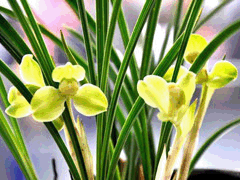 Choose pots with good breathability that readily absorb heat. Pots generally sold on the market come in three materials: porcelain, ceramic and clay. Pots of each material are further divided into large, medium and small sizes. According toCymbidium tortisepalumorchidcultivationpractices accumulated over many years, planting in clay pots is the most suitable and gives very good results. Clay pots have better breathability and heat absorption than ceramic and porcelain pots, and best suit the growth needs ofCymbidium tortisepalumorchids. The fact that clay pots fired in the two places Eryuan and Jianmen are now widely used by orchid growers sufficiently proves this point. But large clay pots do not easily cultivateorchidswith few plants, because a large pot holds much soil and the plants absorb only a limited amount of water; therefore, the dryness and moisture of the pot soil cannot be effectively controlled. The clay pots currently sold on the market already have a history of several hundred years, and the pot shape has changed little, so the dimensions of clay pots are unreasonable: the large ones are inappropriately large, and the small ones are excessively small. In fact, this kind of clay pot was originally fired according to the planting requirements of Xiaoxuesu; Xiaoxuesu has been cultivated for several hundred years and is a fixed variety, so naturally it has changed little, but it is very unsuitable for plantingCymbidium tortisepalumorchids. Especially for rare and precious varieties with few plants, some grasses are of the fine-leaf drooping-leaf type, and there are also miniature grass varieties; large clay pots are very unsuitable forcultivationneeds. A large pot with much soil is not conducive to drainage and instead easily accumulates water; a large pot with much soil is relatively cold around winter, which is not conducive to the growth of orchid plants. In addition, after one or two years of use, clay pots will weather and will deposit alkaline salts, which is very harmful to the growth of orchid plants. Although porcelain flower pots are beautiful and attractive, they are not breathable and cannot be used tocultivateCymbidium tortisepalum; they can be used as decorative outer pots when participating in orchid exhibitions. Ceramic pots combine some advantages of porcelain pots and clay pots: they are beautiful and elegant, small in volume and occupy little space, and are most suitable forbalconyorchid growing. However, ceramic pots also have shortcomings: their breathability is not as good as clay pots, which is the first point; the second point is that the roots of Cymbidium tortisepalum are well developed, thick and long, while most ceramic pots currently sold on the market come in only six-inch and four-inch types. They are still not suited to the length of the roots. When using ceramic pots, the key lies in solving the problem that the cultivation material must be ventilated and breathable, and solving the problem of drainage and water retention, so as to make up for the shortcomings of ceramic pots. When the cultivation material is both ventilated and breathable and also drains water and retains water, cultivation is hygienic and management is convenient. At present, because the breathability problem of cultivation materials has been solved, using ceramic pots to cultivate Chinese orchids is very popular at home and abroad. Cultivation in ceramic pots is both artistic and suitable for cultivating Cymbidium tortisepalum. Practice over several years has proved that if ceramic pots are used to plant Cymbidium tortisepalum and the orchid plants are few and of the fine-leaf type, the pot and the orchid plants are suited to each other, and with appropriately selected cultivation material, the cultivation effect is very ideal. Because a small pot does not easily accumulate water and the temperature is easy to control, it is easy to keep warm in winter, which is conducive to sprouting and flowering. The Dongchuan pots currently popular on the market, apart from their height not being suited to the root length of Cymbidium tortisepalum, have quite acceptable cultivation results. Therefore, pots are highly valued in the orchid-growing world; asorchidplanting material and as an ornamental and practical function, pots are an indispensable component in orchid growing. (Zhao Qin, Wang Zehuai, Li Xinhua)