All fish and crabs in the ten-thousand-mu fish and crab farms of Hongze Lake in Sihong County have died off, with black sewage pouring in continuously
Affected by recent heavy rainfall, a large amount of upstream sewage flowed into Hongze Lake. Since the early morning of the 25th, water quality has severely deteriorated. As of 5 p.m. on the 28th, about 31,000 mu of aquaculture areas in Linhuai Township, Sihong County, have been severely affected, among which the fish and crabs in 12,600 mu of crab ponds belonging to 160 crab farming households in Shengli Village, Linhuai Township, located on a small island in the lake, have almost all died.
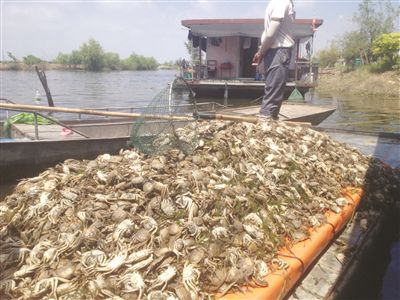
Fishermen watched helplessly as large numbers of crabs died
Shengli Village in Linhuai Township, Sihong County, is a small island in Hongze Lake, with a total of 260 households, of which 160 are crab farming households. A few days ago, the lake water suddenly turned black and foul-smelling, emitting a pungent odor. All the fish and crabs in the village's 12,600 mu of crab ponds died within just a few days.
On the morning of the 29th, a reporter boarded a small fishing boat heading to Shengli Village. The stench of dead fish and crabs could still be smelled in the air. The fisherman steering the boat said: “Over the past few days, quite a few dead fish and crabs have been scooped up. Otherwise, the entire lake would stink, and water quality would deteriorate even further.” Moving along the river channel, piles of dead crabs and fish could be seen stacked on both banks from time to time.
“The water quality is much better now. A few days ago, the water was all black.” Wang Zhiming, Party secretary of Linhuai Township, who was traveling with the reporter, said that this year had good weather, and the crabs were about to go on the market soon. Now that mass deaths have occurred, it is truly a great pity. Wang Zhiming said that at present, only the fishermen's direct input losses can be calculated; the remaining losses simply cannot be calculated at all.
Upon arriving at the small island, more than a dozen small boats were seen moored at the dock, each with large numbers of dead crabs piled in the cabin or at the bow.
Liu Peixi, a 54-year-old fisherman, told the reporter that this year he raised crabs in 80 mu, put in 2,300 jin of crab seedlings, and invested nearly 300,000 yuan. He had planned to sell them around the Mid-Autumn Festival, but unexpectedly, in the early morning of the 25th, a large amount of sewage suddenly flowed into this area of Hongze Lake, giving off a pungent odor. By the morning of the 25th, he saw crabs beginning to die in large numbers. Many crabs climbed onto the enclosure nets, but could not hold on long and fell into the water one after another and died. By the 27th, all the crabs, fish and shrimp in his 80 mu of crab ponds were dead.
Like Liu Peixi, the crabs and fish and shrimp in the 12,600 mu of crab ponds belonging to the 160 farming households on the small island all died within a few days.
Fisherman Zhu Dejun has also been engaged in aquaculture for many years. Because the crab market was good last year, this year he invested more than 500,000 yuan to raise crabs in 9 ponds, totaling more than 230 mu. “Raising crabs is very hard work, and now all that hard work has been wasted!” Zhu Dejun said that when his wife saw that all the crabs had died, she was so anxious that she burst into tears on the spot.
The fishermen said that such large-scale crab deaths had never occurred before. Every year when upstream water levels were high, sewage occasionally passed through, but the duration was very short and the impact on fishermen was not great.
Some residents experienced nausea and headaches
On the afternoon of August 29, Sihong County briefed the public on the relevant situation regarding the “8·25” pollution incident. According to the briefing, recently affected by a typhoon, the northern part of Jiangsu and Anhui experienced continuous sudden heavy rainfall. Upstream areas in Anhui opened sluice gates to release water, and a large amount of floodwater flowed through the county's Lihe Hollow and then into Hongze Lake. The water levels of the rivers entering the lake were all above warning levels and exceeded historical record highs.
In the early morning of August 25, large-scale crab and fish deaths occurred in about 10,000 mu of enclosure aquaculture areas in Shengli Village, Linhuai Township, Sihong County. In response, the Sihong County Party Committee and County Government attached great importance to the matter and quickly arranged for the county Environmental Protection Bureau, together with the fisheries, water conservancy and other departments, to immediately go to the site to investigate and verify, and found that crabs, fish and shrimp in the aquaculture areas had died on a large scale.
According to township staff, some nearby residents experienced nausea and headaches due to the foul odor of the water.
After the disaster occurred, the Sihong County Party Committee and County Government quickly established a command headquarters for the leading group handling the “8·25” incident, dispatched and handled the incident, requested higher-level departments to coordinate the timing and flow of cross-provincial flood discharge, and guided the affected and surrounding fishermen to take emergency measures to reduce losses.
Sewage has not affected the water source area
On the morning of August 29, the Suqian Municipal Environmental Protection Bureau issued a briefing. The briefing stated that on-site investigation found that among the rivers entering Hongze Lake, a large amount of sewage was passing through the Xin Sui River, the current was swift, the water quality was black and had clearly deteriorated, and monitoring results showed it was worse than Class V.
The Jiangsu Provincial Department of Environmental Protection has activated an emergency response. The 5-person working group it dispatched arrived in Sihong on the afternoon of the 28th and immediately participated in investigation and handling work. At present, intensified monitoring measures have been implemented for all rivers entering the lake in the Sihong area of Hongze Lake as well as the Xin Sui River, and the sewage has not affected the water source area.
As of 5 p.m. on the 28th, the polluted area of fish and shrimp aquaculture was about 31,000 mu. Because the upstream inflow had decreased, the momentum of regional expansion and spread had slowed, but water quality had not shown obvious improvement, and dissolved oxygen was extremely low.
The reporter learned that the Jiangsu Provincial Department of Environmental Protection has sent an official letter to the Anhui Provincial Department of Environmental Protection, requesting the activation of the “Yangtze River Delta Regional Cross-Border Sudden Environmental Incident Emergency Linkage Mutual Assistance Procedure” to jointly respond to the cross-border abnormal water quality phenomenon.