How to Fertilize Cymbidium tortisepalum var. lianpan? Detailed Guide to the Correct Methods and Precautions
Fertilizing Cymbidium tortisepalum var. lianpan
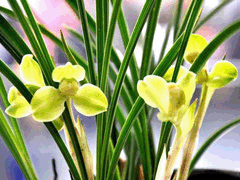 Orchidsneed fertilizer to grow well. They need not only organic fertilizer but also inorganic fertilizer; only when the two kinds of fertilizer are applied together as top dressing do the orchid plants readily grow robust and the flowers open with proper form and bloom well. In the past, people always thought thatorchidsgrow in high mountains and deep valleys, are a kind of holy plant, a flower of simple elegance and noble character, incompatible with anything dirty, and simply could not have any connection with fertilizer. They mistakenly believed that orchids could grow without fertilizer, and that applying top dressing would harm their quality. Today, the idea thatorchidscannot be given top dressing is long out of date. Both the orchid-growing community and orchid lovers recognize the importance of top dressing and fertilizing orchids. In orchid-growing practice in western Yunnan, apart fromGrowing orchidswild-collectedlianpanorchids not being given top dressing, all other established plants must be given various kinds of fertilizer solution as top dressing. How to apply top dressing tolianpanorchids, what fertilizers to apply, and when to apply them all need to be taken seriously.Lianpanorchids are cultivatedin pot soil.The pot is only so big, and the soil's fertilizer content is also limited, especially since the soil is changed only once a year, or at most twice a year. Over time, as the soil's fertilizer is lost, the pot soil can no longer supply the nutrients that lianpan orchids need for growth. A pot ofgrowingmedium starts out with ample fertility, but because of frequent watering, each watering causes fertilizer to leach away with the water, so the fertilizer content in the pot soil gradually becomes deficient. If small pots or ceramic pots are used for growing, then needless to say, the limited fertility contained in thegrowingmedium in the pot is naturally even more insufficient. In order not to change the soil frequently while still promptly supplementing the shortage of fertilizer, the method of top dressing must be adopted. How to fertilize lianpan orchids and what fertilizers to apply are still issues worthy of attention and study. Although lianpan orchids are perennial herbaceous plants, their roots are fleshy roots and cannot directly absorb fertilizer, so the fertilizer applied must be fermented and must be dilute and weak; raw fertilizer and concentrated fertilizer must absolutely not be used. Results from horticultural research both internationally and domestically prove that applying organic fertilizer to orchids at the right time, and also applying appropriate inorganic fertilizer, with the two combined as top dressing, helps the orchid seedlings grow and produces sturdy orchid plants. According to the summary of most people, there are two methods of fertilizing lianpan orchids: one is to mix an appropriate amount of fermented organic fertilizer into the growing soil as a base fertilizer. Fertilizers for use as base fertilizer are also sold on the market today; when using them, simply mix them into the growing soil. Base fertilizer has a long-lasting effect and saves time and effort in management. The second is to apply top dressing during the orchid seedlings' growing period, that is, to dilute fertilizer that has been fermented for a long time and pour it directly into the pot, or to use inorganic fertilizer to water the pot or spray the leaves. For inorganic fertilizer, it is safest to dilute it first and then use it to spray the leaves. Organic fertilizer, whether used as base fertilizer or top dressing, must undergo long-term, thorough fermentation, otherwise it will have the opposite effect or no effect at all. When applying inorganic fertilizer, be sure to pay attention to dilution; concentrated fertilizer must absolutely not be applied, otherwise the consequences will be unimaginable. When fertilizing, note that you should apply weak fertilizer frequently, and apply various fertilizers as top dressing according to the needs of the orchid plants. Fat orchid plants cannot remain thin for long; thin, diseased orchid plants are best not fertilized. Applying too much concentrated top dressing will cause fertilizer burn to the orchid plants; after fertilizer burn, they cannot recover their vigor for several years, and in severe cases the plants die and the stems wither. What fertilizers should be applied as top dressing to lianpan orchids? Inorganic fertilizers of stable quality produced by manufacturers can be used boldly, while organic fertilizers are of many kinds, such as sheep dung, chicken feather water, fish scale rot water, sesame residue water, and so on, which can be prepared singly or in combination. Inorganic fertilizer must be chemical fertilizer containing nitrogen, phosphorus, potassium and other trace elements, such as compound fertilizer, monopotassium phosphate, and so on. For the different growth stages of orchids, use fertilizers of different natures, or mix them in appropriate proportions. According to the introduction in the Japanese publication "Collection of Gardening Secrets," perennial herbaceous flowers are plants grown mainly for their flowers, and applying one part nitrogen, two parts phosphorus, and three parts potassium is most suitable. One point should be noted here: when growing lianpan orchids on balconies and indoors, light is insufficient, the degree of openness is poor, air permeability is insufficient, and the root system is not well developed, so applying a little more potassium fertilizer can help new seedlings grow roots. Potassium fertilizer can be applied with confidence; potassium fertilizer, like phosphorus fertilizer, is a long-acting fertilizer, and applying a little more will not produce side effects. (Zhao Qin, Wang Zehuai, Li Xinhua)