Symptom Identification and Control Methods of Orchid Round Spot Disease
Orchid Round Spot Disease
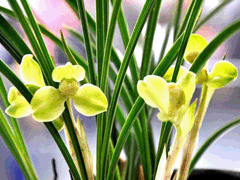 1. Damage: This disease was first discovered in Shenzhen, China, mainly affectingCymbidium sinense(Cymbidium sinense) andCymbidium kanran(C. kanran), with leaf incidence rates of 75% and 64% respectively, and disease indices reaching 64.8 and 43 respectively. In addition,Cymbidium goeringiivarieties are also susceptible to a certain degree.
2. Symptoms: The disease affects the leaves and presents two typical symptoms on the leaves: First, the lesions are circular, appearing semicircular when occurring at the leaf margin, relatively small, 1-3 mm in diameter, black, with no discoloration at the boundary between the lesion and healthy tissue, sunken on both leaf surfaces, occurring from the leaf tip, leaf margin, center and leaf base, with lesions mostly evenly distributed over the entire leaf, and fruiting bodies difficult to see on either the front or back surface. When the disease is severe, the entire leaf is covered with black lesions and dies. Second, this symptom is locally called "iron cannon," presenting a typical satellite-type symptom. Lesions appear on the leaf blade with an obvious infection center, radiating and expanding outward from the central lesion, producing many small lesions. The central lesion is elliptical, semicircular (when occurring from the leaf margin) or irregular, dark brown, relatively large, 10-25 mm in diameter, with a reddish-brown margin, sunken on both leaf surfaces. The surrounding lesions are fewer and decrease in size with increasing distance from the central lesion, circular, dark brown, and wherever they occur, the surrounding leaf tissue becomes yellowed. The central lesion can occur from the leaf tip or base, leaf margin or interior, and has strong radiating expansion ability. Sometimes when the central lesion appears at the leaf base, its surrounding small lesions can extend along the leaf margin all the way to the leaf tip. Fruiting bodies are also difficult to see on both leaf surfaces.
3. Pathogen:Orchidround spot disease pathogen was identified as Stagonospora curtisii. On PDA medium, colonies are circular with entire margins, presenting two morphological forms: one with a reddish-brown reverse and ochre-red front, with colonies spreading flat like velvet; the other with a dark green reverse and fluffy front mycelium, raised in the center, grayish-brown. After 4-5 days of culture, milky-red conidial slime is produced on the colonies. The conidiomata are pycnidia, flattened spherical, embedded in the substrate, with an opening at the top, 120-180 um in diameter. Conidiophores are short, cylindrical or club-shaped, growing from the basal cells of the pycnidium. Conidiogenous cells are phialidic. Conidia are elongated elliptical or cylindrical, colorless, 15-25 um * 5-7 um, with 1-3 septa; septa are indistinct initially but become distinct upon germination, with slight constriction at the septum or without constriction, containing large oil droplets. When conidia germinate, germ tubes can emerge from either end or the middle; upon germination, constriction and septa become distinct. Conidia can germinate in distilled water, but 1% glucose solution promotes germination. They can germinate at temperatures from 15-30 degrees C, with the suitable temperature being 20-28 degrees C and the optimum being 25 degrees C. In 1% glucose solution at 25 degrees C, the germination rate can reach over 90% in just 12 hours. The temperature range for mycelial growth is 10-40 degrees C, with the suitable temperature being 25-35 degrees C and the optimum being 28 degrees C. Above 40 degrees C or below 10 degrees C, mycelia can hardly grow. The pH range for mycelial growth is 4-11, with the suitable pH range being 6-9 and the optimum being 7.
4. Disease characteristics: Survey results indicate that in Shenzhen, China, the disease begins to occur in mid-February, with April to May being the peak period. High temperature, rainy and high-humidity weather conditions favor the occurrence of this disease, with the optimum air temperature being 20-26 degrees C. After June, when the temperature rises above 30 degrees C, the disease stops developing. The pathogen overwinters in diseased leaves.
5. Control methods:
(1) Strengthen quarantine; maintain nursery sanitation, remove diseased leaves, and reduce sources of pathogen infection.
(2) The pathogen of this disease can cross-infect with narcissus, so it should be planted separately from narcissus and other ornamental plants.
(3) Spray with 50% carbendazim, 64% oxadixyl, 58% metalaxyl-mancozeb, 50% benzimidazole, Bordeaux mixture formula B, 80% ethylicin at 1000x dilution. (Liu Zhongjian)