What kind of growing environment suits Four Seasons Orchid?
Four Seasons Orchid Growing Environment
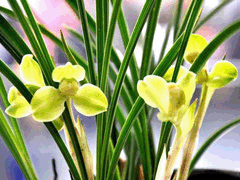 Four SeasonsOrchidIts original growing environment is primary forest on east- or south-facing slopes near mountain summits with a little sunlight; it has not been found growing wild in dark, damp valleys. From this it can be inferred that its light level is roughly between 10,000 and 30,000 LUX; calculated as a shading rate, 80% plastic mesh shade can achieve the same effect. On flatlandcultivationwhere temperatures are higher, the shading rate in summer needs to be increased by another 10%. Avoid excessively strong light, which causes leaf yellowing.
Four SeasonsOrchidThe ideal growing temperature is 15°C to 30°C, with a maximum of 40°C and a minimum of 0°C. In winter, cold damage must be prevented; in areas with frost and snow, the area around the orchid must be enclosed with a double-layer plastic film fence, with electric heating wires or hot-water pipes installed inside for heating, or the plants moved indoors to escape the cold, otherwise there is a risk of freezing injury. Although it can withstand 40°C heat in summer, respiration also becomes more vigorous accordingly. Generally speaking, above 10°C, for every 10°C increase, respiration increases 2 to 3 times, and the higher the respiration, the faster the metabolism and the greater the consumption of water and nutrients. During the high-temperature period in summer, cooling and ventilation are especially important. Apart from increasing the shading rate, using fans to exhaust air and spraying water on the roof, removing the rain shelter to let it ventilate naturally is also among the best methods.
Four SeasonsOrchidVegetative growth requires high temperatures, while reproductive growth depends on the day-night temperature difference. Because the temperature difference affects cell division and nutrient storage, it can influence the next year's sprouting rate and flowering abundance; especially in winter, controlling the temperature difference at 10°C is ideal. In areas where the day-night temperature difference is small, increasing sunlight during the day and providing natural ventilation at night can achieve the effect. Conversely, if the day-night temperature difference is too large, above 15°C, it will also cause new shoots to wither and mature plants to age, and nighttime insulation is also necessary.
Although dark, damp valley bottoms are unfavorable for Four Seasons Orchid growth, this does not mean Four Seasons Orchid likes dryness. In its native habitat, summers have abundant rainfall, and even in the dry winter, morning and evening fog and dew supply what it needs for year-round growth. In other words, during the spring and summer growing season it still needs ample water; even continuous plum rain does not hinder its root development, and all it needs is good drainage and ventilation. At the turn of summer and autumn, which coincides with flower bud differentiation, too much water will affect phosphorus and calcium fertilizer uptake and lower the flowering rate. If flowers are to be forced, the frequency of watering must be moderately controlled. In winter, when temperatures are low, it is even more appropriate to use the drycultivationmethod, because in winter there is little water evaporation, the root water content is high, and exposure to frost and snow makes it prone to freezing to death.
In watering methods, the first priority is "thorough watering": not only must water come out of the bottom of the pot, but the medium also needs to be completely soaked through. Uneven wetting and drying easily leads to mold and root rot. The pot surface and leaves, however, need more dryness than moisture; if normally damp with poor ventilation, disease is likely. The frequency of watering should be adjusted according to pot size, the water-holding capacity of the medium, humidity level, light intensity, temperature, and the quality of ventilation.
Water quality is also a key factor affecting Four Seasons Orchid growth. Water quality is judged by PH value (acidity and alkalinity) and EC value (electrical conductivity). The PH value suitable fororchidgrowth is between 5 and 8; weakly acidic (below 5) or strongly alkaline (above 8) will cause the roots to become hollow or hardened and affect growth. The EC value, commonly known as impurities, is still considered good water quality at 200 PPm; above 300 PPm, the vascular bundles will develop disorders, causing new shoot growth to stall and the leaves of mature plants to yellow and scorch at the tips. Measuring water values requires specialized instruments or asking the water utility for testing.
Protection against acid rain requires even more caution. Acid rain often forms during long droughts without rain, when sudden showers carry polluted air, and residue left on the leaves corrodes the leaf surface and causes black spots. In areas without rain shelter or easily splashed by rainwater, extra care is needed. If this happens, immediately water thoroughly to dilute the acid rain concentration. (Liu Qingyong)