Identification and Control Methods for the Orchid Pest Eucornuaspis machili
Orchid Pest - Eucornuaspis machili
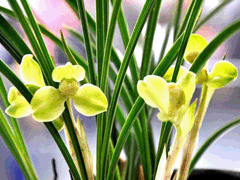 Eucornuaspis (=Lepidosaphes) machili (Masked), also known as the orchid scale, belongs to the order Homoptera, superfamily Coccoidea. It is distributed in Shanghai, Jiangsu, Zhejiang, Taiwan, China, Shanxi and other places. It damages with nymphs and female adultsCymbidium ensifolium、Cymbidium sinenseand cycads, etc. It fixes itself on both the front and back of leaves to suck sap, causing the leaves to lose their luster and affecting growth and ornamental value.
Morphological characteristics:
Adult: The female adult's shell is about 2.1 mm long, long plough-shaped, enlarged at the posterior end, yellowish brown, with the shell point protruding at one end dark brown; the male adult is 1.5-1.6 mm long, spindle-shaped, with 3 glandular tubercles on the ventral side of the mesothorax, 6 on the ventral side of the metathorax, 4 on each side of each abdominal segment, and 3 pairs of anal angles.
Egg: Oval, pale yellow.
Nymph: Oval at hatching, yellowish brown.
Occurrence pattern:
Eucornuaspis machili occurs 2-3 generations a year, overwintering as fertilized female adults. In mid-to-late May of the following spring, eggs are laid inside the scale, with each mother scale laying 20-30 eggs. Newly hatched nymphs crawl slowly and mostly settle on both sides of the main vein, with a few fixing themselves at the leaf margins to pierce and suck, causing damage. They secrete wax and gradually form a scale.
Control methods:
1. If a small number of scales appear on the leaves, they can be brushed off with a writing brush or soft-bristled brush. Old leaves with more scale insects should be cut off and burned.
2. During the nymph hatching period, spray 50% fenitrothion 1000-fold solution. Combined with disease prevention, fenitrothion can be mixed with carbendazim at the corresponding dilution.
Liu Zhongjian