Organic Is Everywhere in Yingde's Organic Black Tea Gardens
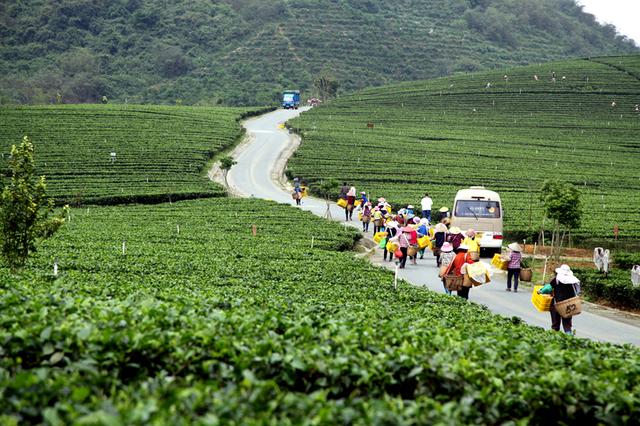
A Tea Town That Truly Lives Up to Its Name
Tea culture is an important representative of Chinese culture. Through the ages, many men of letters have written a great number of poems about tea.
There are also ancient poems that depict the history of tea cultivation in Yingde. As early as more than 1200 years ago in the Tang Dynasty, Lu Yu, the “Sage of Tea”, wrote in The Classic of Tea, Chapter Eight: Where Tea Is Produced: “Lingnan produces tea in Fuzhou, Quanzhou, Shaozhou, Xiangzhou…… often when one obtains it, its flavor is excellent.” Shaozhou here refers to Yingde in Guangdong.
Yingde, known as Yingzhou in ancient times and long called an ancient town of Lingnan, is a place of beautiful mountains and waters that nurtures Yingde black tea, one of the three great black teas renowned worldwide, and enjoys the reputation of “Hometown of Chinese Black Tea”.
100 Years of the World Tea Industry, edited by researchers Cheng Qikun and Zhuang Xuelan of the China Tea Research Institute, also states that “in the Tang Dynasty and the Five Dynasties, the counties of Qujiang, Renhua, Yingde and others in Shaozhou all produced tea”, and that “before the Ming Dynasty, Yingde had already become one of the 11 tea-producing counties in Guangdong Province at that time”. This shows that Yingde has a long history of tea planting and tea production.
Starting in 2008, Yingde City granted certain rewards and subsidies for high-standard tea garden planting, promoting the scale of tea garden cultivation. Since 2010, it has also held national vocational qualification certification, and more than 500 person-times have obtained national vocational qualification certification.
Since 2012, Yingde has seen its second peak period of tea planting development, adding an average of 10,000 mu of scale each year. At present, the total tea garden area in Yingde has reached nearly 90,000 mu, accounting for about 13% of the province's tea garden area. The dominant variety is mainly “Yinghong No. 9”, which has “astounded the world at one stroke and won fame far and wide”.
“Yinghong No. 9” excels in color, aroma and taste. Color: the liquor of premium-quality Yinghong No. 9 is as noble as fine brandy. Aroma: the tea liquor is full of an earthy fragrance, and some vividly describe the tea's aroma as resembling the taste of sweet potato. Taste: it never grows tiresome no matter how much you drink, has no side effects, and can be drunk from morning to night without harming the body, unlike other types of tea, which, if drunk too much, either make you excitable, or make you drunk, or harm the stomach.
Ecological or Not? Go Take a Look at the Tea Garden
Is Yingde's tea ecological? This is a question of great concern and worry to tourists and people around the world. Some tea drinkers worry even more about whether some tea enterprises, in order to increase output value, secretly engage in the practice of using chemical fertilizers and pesticides.
“Such worry is normal, but also unnecessary.” The person in charge of Yingde Shangmingxuan told reporters that although the tea produced in Yingde is of premium quality, competition is also fierce. Local relevant departments are also extremely strict about green certification for tea. Therefore, whoever uses chemical fertilizers and pesticides to grow tea is destined to have only a handful of days left in the development of that tea enterprise, or may even suffer a “sudden death”.
“Growing ecological tea must involve refusing to use chemical fertilizers and pesticides.” The person in charge of Yingde Shangmingxuan Company told reporters that, however, using fermented cow dung and other organic fertilizers to grow tea brings with it an infestation of insect pests. Relevant experts then conducted repeated research and developed this thing similar to a “fly glue trap”.
For the sake of ecology and environmental protection, tea enterprises in Yingde have each come up with new tricks. Some tea enterprises plant bean seedlings under the tea trees to prevent insect pests in an ecological way, while more tea enterprises “plant” “insect-catching boards” in a staggered, well-arranged manner throughout their contiguous tea gardens.
“Insect-catching boards”, also called “sticky insect boards”, are about the size of A4 paper, goose-yellow, with a layer of sticky liquid on the front, and this sticky liquid carries something that insect pests love to eat. Once insect pests are “caught”, they cannot free themselves and are stuck to death.
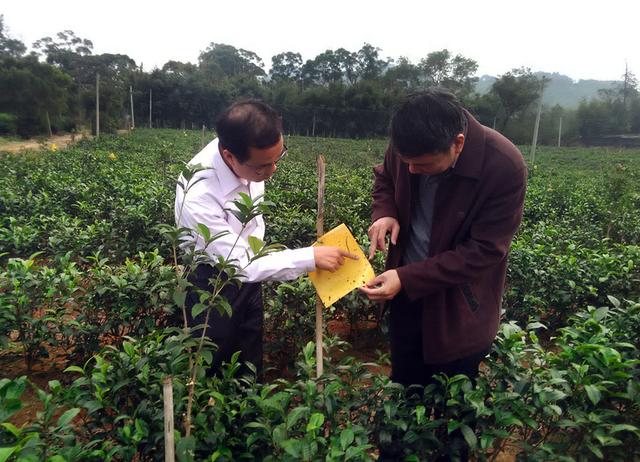
The person in charge of Shangmingxuan introduces the function of the sticky insect boards and the pest elimination situation to visitors
In the Jiqingli tea garden, the reporter saw that in the rolling tea gardens, “sticky insect boards” were hung in horizontal rows and vertical lines, just like the flags of all nations hung at a large world conference, a truly spectacular scene.
In a newly planted tea garden by the Shakoujing Reservoir in Yingde, the reporter saw that because the land was fertile, the weeds grew especially fast, almost taller than the tea seedlings, shading them. The reporter blurted out: “How come? There are so many weeds and they're so tall, yet you don't use pesticide to kill them?” The accompanying owner said without thinking: “No! Using pesticide to kill weeds first affects the ecology, and second affects the growth of the tea trees. Besides, the cost of manual weeding is not much different from the cost of killing weeds with pesticide, so why bother?”
What's more, professionals say that the most intuitive and effective way is to go and take a look at that tea enterprise's tea garden. If you see that the tea enterprise's tea garden has “insect-catching boards” planted everywhere, then you can make your decision - there's no harm in buying later. The tea you buy is sure to be ecological and environmentally friendly, pollution-free and free of public hazards.