The case of how Zespri Kiwifruit became a billion-dollar brand through stable production
To build a fruit brand, stable, large-scale production of consistent quality is an essential prerequisite.
Next, we try to use the case of the New Zealand kiwifruit producer Zespri® to explain how technological upgrading and organizational change reduce the impact of natural environmental variability on the production side, thereby giving rise to a brand.
Zespri produces an average of more than 3 billion kiwifruits a year, sold in 53 countries worldwide. In 2015, annual sales reached 10 billion yuan, accounting for 33% of the global kiwifruit market. Today, the company has undoubtedly become the world's leading kiwifruit brand.

By contrast, China's kiwifruit industry today lags far behind, still dominated by spontaneous planting by fruit growers and scattered small brands, and has yet to form a brand advantage.
In fact, when Zespri was founded, the state of New Zealand's kiwifruit industry was similar to that of China today. So we wondered: under conditions where the kiwifruit industry was non-standardized, had no brand value and faced heavy market pressure, how did Zespri break through and grow into a fruit industry giant?

As early as the 1960s-1980s, the number of fruit growers in New Zealand who made their living from growing kiwifruit was already very large, and the industry developed rapidly. But at the time the industry was still in a primitive state of natural competition: producers were numerous yet scattered, the quality of the kiwifruit produced was unstable, and yields fluctuated greatly, which also led to fragmented brands and very limited overall influence.
The above reasons gave New Zealand kiwifruit low bargaining power in the global market. Turmoil soon arrived. In 1988, its largest overseas market, the United States, implemented an anti-dumping policy, sharply reducing kiwifruit import volumes, and New Zealand fruit growers suffered heavy losses.
The New Zealand government decided to improve the stability of kiwifruit production through organizational change, thereby shaping a strong kiwifruit brand. The New Zealand Kiwifruit Marketing Board (NZKMB) was thus born.
This body, jointly initiated and established by numerous fruit growers, was responsible for purchasing kiwifruit from growers in a unified way and selling it to the market in a unified way. Other institutions and individuals had no right to interfere in the kiwifruit procurement and sales process, and growers could not sell privately to international markets.
In 1997, the marketing board decided to launch "Zespri" as the sole brand of New Zealand kiwifruit and continued to advance organizational change along the following 2 dimensions:
First, standardization of the production process
" Upstream": unified breeding research and development, unified planting standards, unified fertilizer and pesticide use, minimizing interference from uncontrollable factors.
Zespri mainly promotes 2 kinds of kiwifruit: the Hayward green kiwifruit, cultivated by the New Zealander Hayward in the 1920s, and the golden kiwifruit, successfully bred in 1991. Both kinds of kiwifruit have the characteristic of stable production.
Hayward has a stable shape, good taste and good storability; the golden kiwifruit blends the flavors of several fruits such as cantaloupe, peach and citrus, and is the most stable variety developed through years of planting and grafting selection.
At the same time, Zespri manages in a unified way the nutrients and pest-control pesticides needed during the growing process. For example, in 2014-2015, the company provided growers with treatments against the PSA (bacterial canker) pathogen to reduce damage.
" Downstream": standardization of sorting, storage and logistics, with full control of sales channels.
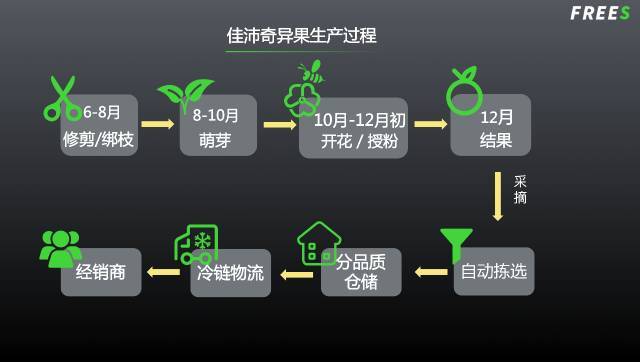 Zespri's kiwifruit production achieves full-process standardization.
The sorting of Zespri kiwifruit is done automatically by machines. Kiwifruit is automatically sorted by quality and size into different warehouses. Within the same warehouse, the kiwifruit is basically uniform in quality and size.
In the storage stage, to reduce the impact of storage time on kiwifruit quality, Zespri uses controlled-atmosphere storage to ensure the kiwifruit does not deteriorate within 8 months; in the logistics stage, it uses cold-chain logistics, bringing the loss rate down to 5%. This is far below the 10%-15% transport loss rate of Chinese kiwifruit.
On the sales side, Zespri strictly controls its distributor channels. Distributors must first pay a high deposit before they can obtain Zespri supply. At the beginning of each year, distributors also need to pay a fee to Zespri, 30% of which Zespri uses for growers' production costs.
Second, establish a grower management system with a virtuous cycle
" Supervision mechanism": growers are highly controllable
Zespri uses the following 3 methods to monitor growers' production stages and thereby keep the supply chain controllable:
A traceability mechanism. Growers are managed in a unified way using production tracking and traceability information cards. When a quality problem arises in a certain batch of fruit, Zespri can quickly pinpoint the place of origin and the grower responsible for that batch.
Geographically intensive supervision. 80% of kiwifruit is produced in New Zealand's Bay of Plenty region. The region covers an area of 12,000 sq km, equivalent to the size of Tianjin. Concentrated production can greatly reduce supervision costs. Besides Zespri, Wens (for details see: "Fengrui Report 11: On the eve of the explosion of the trillion-yuan pig farming industry, pigs really are standing in the trough"), the U.S. strawberry brand Driscoll's and others have also adopted the same approach.
Procurement at standard-based pricing. Starting 3 months before harvesting the fruit, growers are prohibited from using any chemical compounds. Zespri then commissions a third-party testing agency to enter the orchards and take samples. Only when the fruit's sweetness, ripeness and dry matter content all meet the standards may it be hand-picked. Finally, professional inspectors screen the fruit layer by layer according to its appearance, and only high-quality fruit is allowed to bear the Zespri label.
" Incentive mechanism": moderately incentivize growers
Zespri uses the following 3 methods to establish a healthy grower incentive mechanism, thereby further stabilizing the supply chain:
A 30% advance deposit, with guaranteed minimum purchase. Before commissioning growers to plant, Zespri pays growers a 30% deposit in advance, while the remaining 70% is treated as profit income and determined by market sales conditions. If the fruit provided by a grower is of superior quality, the grower can receive a bonus reward from the company. At the same time, Zespri also adopts measures such as guaranteed minimum purchase and equity dividends.
Brand building brings higher bargaining power, and grower incomes rise accordingly. In 2001, the selling price of Zespri kiwifruit in the Asian market was 5.22 USD per box; by 2003 it had risen to 6.42 USD per box; today, the price per box has exceeded 10 USD. By building the brand, Zespri's influence in the market keeps expanding; with superior fruit quality, prices rise accordingly, grower incomes increase accordingly, and production enthusiasm keeps being stimulated.
Control the scale of individual growers to ensure the fruit can receive careful tending. Zespri manages more than 2,700 growers, with a total planting area of about 10,580 hectares. Among these, orchards of 2-5 hectares account for 45%, and orchards of 5-10 hectares account for 15%, with small-scale growers being the main production force.
Many stages of kiwifruit cultivation cannot be mechanized; for example, removing underdeveloped young fruit and regularly pruning excess branches. If an individual grower's scale is too large, management will inevitably be extensive; if the scale is too small, income will inevitably be low.

According to estimates, 3.33 hectares (about 50 mu) is the area an individual grower can carefully tend. At this scale, the average annual net income of an individual grower is about 30,000 New Zealand dollars (assuming a net profit margin of 10%-15%), equivalent to 150,000 yuan.
In short, through continuous technological upgrading and organizational change, Zespri has established a high-quality, high-yield kiwifruit supply chain, which has become the moat of its brand value.