Identification and Control of Aulacaspis pseudospinosa Infestation on Orchids
Orchid Pests: Aulacaspis pseudospinosa
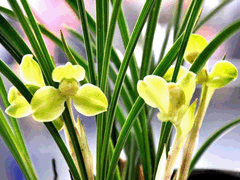 Aulacaspis pseudospinosa Chen belongs to the order Homoptera, family Diaspididae. It is distributed in Guangdong, Sichuan, Jiangsu and other places. It harmsorchidsleaves, and also harms Smilax, palms and Machilus.
Morphological characteristics: The female scale is nearly circular, white, quite thick, slightly protruding. The exuviae are located at the margin, submargin and near the center, mostly at the margin. The exuviae are grayish yellow or pale yellow, with a total length of 1.6-2.0 mm. The female adult body is elongated, with a large head and thorax, width greater than length, anterior lateral angles usually absent, and if present, obtuse and rounded. The posterior line is much wider than the metathorax, and the metathorax is similar in width to the first abdominal segment. The second abdominal segment is relatively wide, and the third abdominal segment sharply narrows, with a triangular tail end. The antennae have one flagellum. There are about 25 disc pores at the anterior spiracles, and 2 at the posterior spiracles. On the lateral ends of abdominal segments 2-3 there is one group of medium-sized tubular glands each. Near the posterior lateral angles of the first abdominal segment there are circular sclerotized scars. The anal plate tail notch is narrow and obvious, with the median lobes sunken within it, not very large, the basal connection relatively slender, and the parts bending and separating to both sides relatively broad, with rounded ends and inconspicuous inner marginal teeth. The second pair of lobes is well developed, divided into 2 lobules, and protrudes backward, with rounded ends. The male scale is flat and elongated, white, with 3 dorsal longitudinal ridges equally prominent, the exuviae at the anterior end, grayish yellow, with a total length of 1.2-1.4 mm and a width of 0.4 mm.
Occurrence pattern: This pest causes serious damage in Guangzhou, occurring almost throughout the year, especially severe in hot, stuffy and dry weather.
Control methods:
1. When the pest occurrence is low, use coarse cloth dipped in kerosene to wipe and kill them.
2. Spray pesticides regularly; spraying 40% omethoate emulsifiable concentrate at 1000 times dilution when nymphs hatch gives good results.
3. Use 20% methidathion emulsifiable concentrate at 500-1300 times dilution to control all stages, especially effective against crawling nymphs and early adults. (Liu Zhongjian)