Identification and Control Methods for Thrips tabaci Infestation in Orchids
Orchid Pests: Thrips tabaci
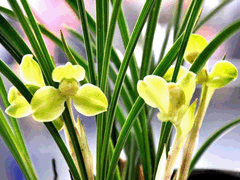 Thrips tabaci L., also known as the onion thrips, belongs to the order Thysanoptera, family Thripidae. It is distributed throughout the country except in Tibet, where its status is unknown. It damages plants in the adult and older stagesorchids, chrysanthemums, Gerbera, carnations, hyacinths, cyclamen, and others. The direct damage caused by Thrips tabaci results in chlorotic or yellow-brown streaks appearing on both the upper and lower surfaces of orchid leaves, making the moisture-rich leaf tissue of other flowers thicker and more brittle, curling upward or splitting, leading to leaf drop and affecting growth. The petals also develop chlorotic streaks, affecting quality.
Morphological characteristics:
Female adult: body length 1.1-1.3 mm, body color highly variable, from brownish-yellow to light brown, compound eyes purplish-red, coarsely granular and slightly protruding, 3 ocelli arranged in a triangle, each with an interocellar bristle on the outer line of the triangle formed by the front two lateral ocelli, antennae 7-segmented, segments 3 and 4 each with a "U"-shaped sense cone at the tip, segment 5 with one short sense cone on each side at the tip, segment 6 with one slender sense cone. Forewing upper vein bristles 4-6 in number; if 4, evenly arranged; if 5-6, mostly in groups of 2-3; lower vein bristles 14-17, evenly and continuously arranged.
Egg: about 0.2 mm long, kidney-shaped.
Nymph: first instar about 0.37 mm long, second instar body length about 0.9 mm, color light yellow to deep yellow.
Prepupa and pupa: the prepupa (third-instar nymph) and pupa (fourth-instar nymph) resemble the two nymphal instars but have wing pads, with antennae positioned in front of the head.
Occurrence pattern: The number of generations per year varies by region, generally 6-10 generations. It overwinters as adults, nymphs, or pupae in potting soil, dead branches and fallen leaves, bulbs, or within the leaf sheaths of some plants, primarily overwintering as adults. It becomes active from March to April the following year. Eggs are scattered on the surface of tender leaves. Adults and nymphs mostly damage areas near petioles and leaf veins. Because they are photophobic, they often crawl onto the leaf surface in the early morning and evening or on cloudy days, while on sunny days they mostly damage areas in front of the leaves or at the veins during the day. Adults are very active, able to fly and jump well, and spread and disperse very quickly. Drought without rain favors them; high temperature and high humidity or heavy rain inhibit their activity.
Generation duration: In a greenhouse with an average temperature of 19°C and relative humidity of about 85%, the egg stage lasts 8 days, the 1st-2nd instar nymphs 10-14 days, the prepupal stage 4-7 days, and completing one generation takes about 20-plus days; in summer only about 15 days. In summer all are females; males begin to appear in autumn. They generally reproduce by parthenogenesis, with each female laying 20-200 eggs.
Control methods:
1. Adopt effective horticultural measures, such as clearing weeds around the flower garden and repotting and changing soil after autumn.
2. For chemical control, refer to flower thrips.
Liu Zhongjian