Exploring the watering patterns of orchids and mastering the methods of water use in orchid growing
Exploring the patterns of water use in orchid growing
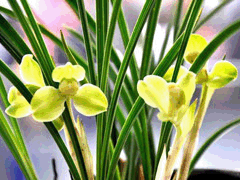 Orchid growing's success or failure depends to a very important extent on water use. The older generation oforchid growingexperts said, "To grow orchids, first learn to water for three years," and this makes a lot of sense. I have been growing commonCymbidium goeringii、Cymbidium ensifoliumfor more than twenty years, and it has been four or five years since I expanded into growing traditional famous flowers and selecting and breeding precious new varieties, yet I still cannot say I have already mastered the patterns of water use. But I have also accumulated some experience and lessons, which I offer here for orchid friends to discuss together.
Orchid growingThe first problem encountered in water use is what kind of water is best. Generally speaking, natural rainwater is best, as it is slightly acidic and does not contain bleaching powder. Snow water in particular also contains various elements, which is beneficial toorchidgrowth, but it is relatively difficult to store, and it is very hard to use it all year round. Next, river water and pond water can also be used, but with the development of industry today, pollution is relatively serious, so they should be used with caution. Next is well water, which has a relatively large temperature difference from the surface, but it is also subject to pollution and is not suitable for use. Like most orchid growers, I use tap water, which is abundant in supply and convenient to use. But note two points: first, tap water has been disinfected with bleaching powder, so it should not be used to water flowers immediately; it must be stored for more than a day and a night, so that the bleaching powder settles and the chlorine dissipates before use. Second, pay attention to the pH of the water.Orchidslove slightly acidic water quality, with the PH value kept between five and six. Test paper can be used to test it. Above seven it is alkaline, and an appropriate amount of hydrochloric acid, oxalic acid or edible vinegar should be added to neutralize it. If it is below five, the acidity is too strong, and caustic soda or an infusion of plant ash should be used to adjust it.
The most difficult thing to master in water use for orchid growing is the moisture of the potting medium in the orchid pot. The ancients' experience in growing orchids was that "orchids like moisture but fear wetness, like dryness but fear parching." The problem is how to master the degree of this "moisture" and "dryness." When I first started growing orchids I used mountain soil, which has poor aeration and water permeability, and I did not understand the characteristic that orchid roots fear wetness. Afraid that theorchidswould die of dryness, I watered every day, which as a result affected aeration, blocked root respiration, and caused poor growth of the orchid plants, and even root rot and death. Later I used Emei Xian soil plus brick granules or pond foundation stone. These hard potting materials have good aeration, do not accumulate water, and are beneficial to the development of orchid roots. But they dry out very easily, and once dry they are extremely difficult to reabsorb water; over time this causes shrinkage of the leaf surface and pseudobulbs, affecting theorchid'sgrowth. Later, based on the experience of orchid friends, I first soaked the Xian soil in water, two or three days for small granules and four or five days for large granules, and used it only after the water had penetrated. The surplus soil was sealed and stored in plastic bags to avoid water evaporation. Xian soil has good water permeability, so watering should be more frequent than with other soils. Of course, watering should also be based on different seasons and weather conditions. In summer, temperatures are high, evaporation is great, and orchids grow vigorously, so they need more water and should be watered frequently, once or twice a day. In winter, temperatures are low, evaporation is small, and orchids are in a dormant state, so water should be given sparingly, once every four or five days. In spring and autumn, the climate changes greatly, so it must be handled flexibly, generally once every two or three days. On cloudy and rainy days, humidity is high, so watering can be reduced. In windy and dry weather, water evaporates quickly, so more watering is needed.
The patterns of watering must be flexibly mastered not only according to differences in potting medium and changes in weather, but also according to differences in orchid pots and the growth conditions of the orchid seedlings. I use three kinds of orchid pots to grow orchids, and by comparative observation, with the same watering, clay pots dry out fastest, plastic pots with holes in the body are next, and purple clay pots dry out more slowly. Therefore, watering must be treated differently. Now I water once every other day. For orchids in clay pots, I use a watering can to water thoroughly each time. If the interval is too long and I find the Xian soil dry, I use the method of soaking the pot, so that the potting medium absorbs water evenly and thoroughly, and then return to normal management. For orchids grown in plastic pots and purple clay pots, I use a watering can to water thoroughly one day and a sprayer to mist the next day, determining different amounts of misting according to different orchid pots and different degrees of moisture retention. In addition, the amount of watering should also be determined according to theorchid'svariety and growth vigor. The general pattern is thatCymbidium sinenseshould be watered more,Cymbidium goeringii、and Cymbidium faberican be watered less; those with strong growth vigor should be watered more, and those with poor growth vigor should be watered less; those with dense clusters of orchid seedlings should be watered more, and those with sparse orchid seedlings should be watered less; during the orchid growth period they should be watered more, and during the dormant period they should be watered less. In short, they must be treated differently according to specific conditions such as different environments, climates, conditions, varieties and utensils, and one cannot apply a single uniform rule or copy things mechanically.
Watering also requires mastering timing and water temperature. According to my experience, the best time to water is when the potting soil appears dry but not parched, that is, when the surface soil is already dry and the lower soil is still slightly moist. The time of watering should be controlled so that the water temperature and the temperature of the potting soil are basically the same, and cannot differ too greatly. In summer, daytime temperatures are high and nighttime temperatures are low, and the temperature of the potting soil changes through a process, so watering is best done in the morning, when both the air temperature and the soil temperature are cool. In winter, watering is best done at noon, because at this time the air temperature is highest and the potting soil has also warmed up, which is more suitable. Generally, watering should not be done in the evening, otherwise water accumulates on the leaves, which easily causes black spot disease and rot of young shoots and flower buds.
The methods of watering can adopt a combination of three approaches: watering, misting and pot soaking. Ordinarily, use a watering can to water; if not watering, then do not water, but when watering, water thoroughly, until water flows out from the bottom of the pot. Do not give half-hearted watering, that is, where the upper layer of potting soil has water but the lower layer has none; over time, this will cause the orchid roots to dry up and the orchid plants to slowly die. Another method is to use a sprayer to mist, which can increase the air humidity of the orchid room and the humidity of the potting medium in the orchid pot, and can also wash away dust and clean the leaf surface. If a small amount of chemical fertilizer is added to the water, it can also play a role in foliar feeding. Generally, this method can be used often during the orchid growth period and in dry seasons. Yet another method is pot soaking: place the orchid pot into water so that the water slowly penetrates from bottom to top. This method can be used when the potting soil is excessively dry or the potting medium is difficult to reabsorb water. These three methods each have their own characteristics, and can be implemented in alternation and combined according to theorchid'sdifferent needs, which is beneficial to the vigorous growth of orchids. (Shou Jicheng)
Address: Room 232, No. 4 Shengli Road, Chengguan Town, Xinchang County, Zhejiang
Telephone: 0575-6024196 Postcode: 312500