What is the natural environment of the native habitat of the Lianban Orchid?
The natural environment of the native habitat of the Lianban Orchid
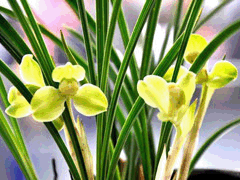 LianbanOrchid belongs to the ChineseCymbidium goeringiifamily and is found exclusively in the western part of Yunnan Province in China, growing in a few locations in Dali, Nujiang, Diqing, Lijiang and Baoshan. It generally grows in high-altitude mountains and deep valleys, which gives rise to theLianbanOrchid's particular plant characteristics. Tocultivatestrong, beautifulLianbanOrchids, in addition to fully understanding and mastering its general plant properties, one must also know its growth habits, especially its requirements for the geographical environment and climate for growth under natural conditions. This is the primary condition forcultivatingLianban Orchids well.
The Lianban Orchid grows in the mountain ranges of the Yunnan-Guizhou Plateau, distributed in the Northern Hemisphere of the globe, near the Tropic of Cancer, with a longitude of 98°-100° and a latitude between 24°-28°. This area is located in the Three Rivers and Six Banks region centered on the Lancang River, namely the upper reaches of the Jinsha River, and the high mountains and deep valleys on both banks of the Nujiang and Lancang Rivers. The great mountains and canyons of the Three Rivers and Six Banks have a valley-type climate (see the Lianban Orchid growth map). This area is located in the southwestern part of the Yunnan-Guizhou Plateau, with an average annual temperature of around 16°C, a small temperature difference between day and night, and a long frost-free period. The climate of the Lianban Orchid's growing area is one where thefour seasonsare indistinct, the dry and wet seasons are clearly distinguished, rainfall is abundant, sunshine duration is long, and sunlight is plentiful. The Hengduan Mountains of western Yunnan have high mountains and abundant water, and the climate is three-dimensional, with certain differences from the climate of the flat basin areas. OrdinaryCymbidium goeringiimostly grow in mountainous areas at an altitude of 600-800 m, but in various places in Yunnan the altitude rises greatly, reaching 2000 m. The Lianban Orchid is different; they grow in high mountain areas at an altitude of 2600-2800 m. Most of these high-altitude mountain ranges have snow accumulation after entering winter, and an altitude of 2800 m happens to be just below the snow line, so the climate is naturally cold, with the lowest temperature at around 0°C. The Lianban Orchid's formation of cold resistance and its many-leaved, many-floweredplant characteristics are entirely determined by the natural environment.
The Hengduan Mountain region of western Yunnan is composed entirely of high mountains and great rivers, with interlacing rivers and lakes, a mild climate along with high air humidity, good soil, and moderate moisture and nutrients, making it very suitable for the growth and reproduction of variousorchids. On the nineteen peaks of Diancang Mountain in Dali alone, more than twenty species such as various Lianban Orchids, Duoduo Xiang, and Green Orchids have been found, and historically there were even more. According to Yang Shen'an's "Nanzhao Yeshi Beikao" of the Ming Dynasty, in the Dali region, "orchids number more than seventy species. The Snow Orchid is foremost." The places where Lianban Orchids grow are truly lofty mountains and steep ridges, with high mountains and deep valleys overlapping and interlacing, and mountain ranges winding and towering into the clouds, one after another, one layer of mountains and water to one layer of forest. Among the mountain groups are Diancang Mountain, Biluo Snow Mountain, Gongshan, and so on.
Western Yunnan not only has a complex mountain structure of landforms, but also, accompanied by the overlapping mountain ranges running north-south, forms a complex water system structure. Between the Hengduan Mountains in the western Yunnan-Guizhou Plateau, rivers crisscross and lakes are scattered like stars, with water flowing from north to south and pouring from west to east, forming a special water system structure that is tight upstream and sparse downstream. In addition to the Lancang River, Jinsha River, Heihui River, Erhai Lake and other small plateau lakes, there are mountain streams and clear springs between mountains and within a single mountain, so water resources are extremely abundant. Because of the abundant water resources, together with suitable temperatures, it is very suitable for the growth of various plants, and the forest vegetation is very thick. The forests here include semi-humid evergreen broad-leaved forests and subtropical evergreen shrub forests, and more of the mountains grow broad-leaved shrub jungles of the oak type. The forest coverage is large and can fully maintain air humidity, and the humidity in general valley areas is around 60-70%. Such an ecological environment exactly meets the growth needs of the Lianban Orchid.
The places where Lianban Orchids grow are mainly evergreen shrub jungles, especially places where oak trees grow. Evergreen shrub jungles carry out metabolism year after year, dropping branches and leaves, which pile up and rot; in addition, the soil of the highland mountain ranges of western Yunnan is mostly red soil, and the fallen residual branches and withered leaves of trees, especially oak trees, mix with the red soil to form humus. After the two mix, through rain and sun over a long period, they become a dark brown, very loose humus soil. This humus soil is acidic, with a pH value between 5-7, and its fertility is also moderate.
The Hengduan Mountains of western Yunnan have complex rock properties, weathered layers of varying thickness, and relatively steep slopes, so it is not easy for water to accumulate during heavy rain or when there is a lot of water; on clear days the temperature rises quickly, evaporation is high, and air humidity increases. Therefore, the uniquely favorable geographical environment and climatic conditions have created superior growing conditions for the Lianban Orchid. The Lianban Orchid is a unique orchidaceous plant that nature has bestowed upon western Yunnan.
The geographical location, climate and soil characteristics of the high mountains and great rivers of western Yunnan, summed up, are precisely all the conditions required to adapt to the growth laws of the Lianban Orchid. The Lianban Orchid is a neutral plant: it likes sunlight but fears direct strong light, likes moisture but fears waterlogging, likes rainwater but fears accumulated water turning into flooding, likes slight acidity but fears alkalinity, and likes fertility but fears excessive fertility. Therefore, it can be concluded that by grasping well the growing environment and natural conditions of the Lianban Orchid, and artificially striving during thecultivationprocess to provide an environment similar to nature, choosing suitable cultivation materials, and managing carefully, one will certainly cultivate robust and beautiful Lianban Orchids. (Zhao Qin, Wang Zehuai, Li Xinhua)