How to choose a place for growing orchids? Discussion of key points for the orchid-growing environment
Discussion of orchid-growing locations
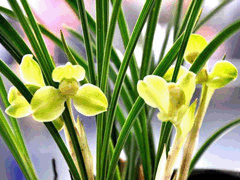 The original living environment of orchids (Cymbidium) is usually in secluded mountain forests and valleys, on high, airy terrain with forest shade above, forming a small living environment with small temperature differences, high atmospheric humidity and clean air. Therefore, for artificialcultivationof Chinese orchids, the first consideration is that there must be no direct sunlight, yet there must be an appropriate amount of daylight; the second consideration is a suitable growing temperature, cool in summer and warm in winter; the third consideration is relatively high humidity in the location and fresh air (good ventilation conditions).
The first rule oforchid growingsummarized in ancient orchid books is that they like sunlight but hate heat, and like shade but hate dense shade. More sunlight gives better flowers, more shade gives finer leaves. Therefore,orchid growinglocations are best chosen on high, airy ground facing southeast with the northwest at the back, with a stream or pond to increase humidity. For shading, 50%-70% shade netting is mostly used nowadays.Cymbidium goeringii、Cymbidium faberineed stronger light,Cymbidium ensifoliumcomes next,Cymbidium sinensecomes after that. Because the sun's angle changes throughout the year, in spring, with gentle wind and warm sun, there is little direct sunlight and little shading is needed, so as to favor the sprouting of new shoots, which become warm and gradually strong. In summer and early autumn, shading is increased appropriately according to the growth needs of the orchid species. Movable shading equipment is ideal, as it makes the amount of sunlight easy to control. Even in spring and summer, on rainy or cloudy days, simply remove the shading equipment to increase light transmission; on sunny days, move the shading equipment to reduce light transmission, so as to favor orchid growth.
The ancient books describe: "In cold weather it should be exposed, in fierce sun it should be hidden" (Qing dynasty, Zhu Kerou); "Do not take it out in winter, do not bring it back in summer, do not let it dry in autumn, do not let it stay wet in winter" (Ming dynasty, Li Kui); "It likes sunlight but hates heat, likes rain but hates wetness, likes [sunlight] but hates dense shade, likes wind but hates stagnation" (Qing dynasty, Ou Jin
ce) and so on. All of these explain the coordination between light and ventilation inorchid growinglocations and have a certain dialectical logic.
Rare orchid species are usually managed in glass greenhouses or plastic film greenhouses under shade.Orchidsgrow best at a temperature of 20-30 degrees. When the winter temperature drops, the orchid room should be sealed to keep it warm, and at the same time the shade netting should be opened so that sunlight falls directly on the greenhouse to raise the room temperature. When these measures still cannot raise the indoor temperature to 20 degrees, heating equipment should be provided so that orchids continue to grow in winter. At present, some foreign countries produce a kind of environmental humidifier with very small mist droplets. Under suitable temperature conditions, increasing the relative humidity of the orchid-growing environment is very important. If there is no humidifier, an ordinary sprayer nozzle can be installed on a high-pressure water pipe, and when the environment is dry, spray frequently to increase humidity, so as to favor the growth of orchid plants.