Understanding and Controlling Orchid Pests: Orchid Mealybugs
At the turn of spring and summer, it is preciselyorchidsthe season when pests occur frequently, especially orchid mealybugs. Below, drawing on book knowledge, I will share some views.
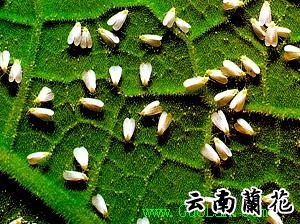
Orchid mealybugs are also known as whiteflies (TRIALEURODES VAPORARIORUM). Adults and nymphs gather on host leaves, suck sap, form yellow spots at the feeding sites, and can secrete honeydew, inducing sooty mold.
Morphological characteristics:
Adults are about 1.1 mm long, light yellow, with semi-transparent wings covered in white waxy powder. Eggs are yellow. Nymphs are small and flat, oval, pale yellow, covered with a semi-transparent waxy substance. Pupae are oval and flat, yellow-green before emergence and with a white transparent pupal case after emergence. The dorsal surface of both nymphs and pupae bears waxy spines of varying lengths.
Life habits:
It can occur 11~13 generations per year, overwintering as mature nymphs or pupae. Eggs are mostly laid on the underside of young host leaves. Newly hatched nymphs do not crawl far and mostly settle and parasitize near the eggshell, sucking sap and causing damage. Population density increases fastest from July to August, and damage is most severe from August to September. Adults are poor fliers and spread slowly, with obvious centers of infestation. Adults have a strong attraction to yellow.
Control methods:
For orchids grown in greenhouses, in winter spray at a dosage of 1 ml of 80% dichlorvos stock solution per cubic meter, then fumigate in a sealed environment, keep closed for 8 hours, then open windows for ventilation. Adults can be trapped and killed with orange-yellow sticky insect cards.
Control agents:
Choose 25% buprofezin wettable powder at 2000 times dilution, 25% acetamiprid emulsifiable concentrate at 2500~3000 times dilution, or 2.5% cyhalothrin emulsifiable concentrate at 3500 times dilution.