The mechanism by which water control, sun exposure and potassium dihydrogen phosphate promote flowering and multiple shoots in orchids
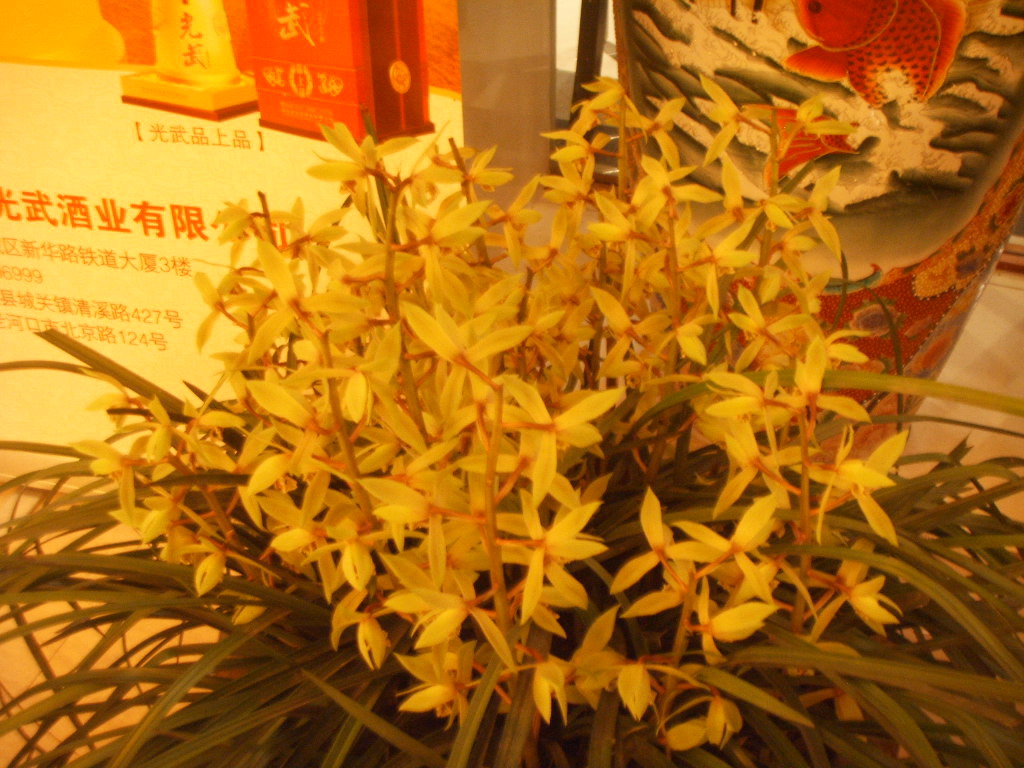
Water control, sun exposure, potassium dihydrogen phosphate and multiple shoots - I have encountered this situation before too. Last year, onCymbidium ensifoliumright when it was in bloom, I controlled water, exposed it to the sun, and applied potassium dihydrogen phosphate. Very quickly, 6 buds grew out, but the result was not what I had hoped for: of the 6 buds, only two were flower buds, while the other four were leaf buds.
At the time I posted a thread hoping to get an answer, and the moderators and orchid friends gave me enthusiastic replies. But I kept thinking, why were leaf buds in the majority? Then on October 2, 2004, I divided the Cymbidium ensifolium from Peiji Garden and Ji Garden into separate pots, and after repotting the Cymbidium ensifolium I carried out a similar experiment again. Very soon, I was surprised again——on October 27, 7 buds came out all at once. So I became fascinated with this pot of Cymbidium ensifolium, and within a few days I found another bud. However, as they continued to grow, the result was once again uniform——all eight were leaf buds.
At this point I still did not understand, but soon I did not pay much attention to it anymore. Because I had started buying Song Mei and Xiao Da Mei, and my interest shifted more toCymbidium goeringii. In particular, the three shoots of Da Fu Gui bought at the end of September achieved, by November 12, one new shoot producing three. The total was three producing three. It was not until March of this year that I mail-ordered a book, "Flowering Period Control of Ornamental Plants"——my ideal was to makeCymbidium goeringiibloom in the city where I live. First I read through the table of contents, skimmed over the theory section, and went straight to look for practical guidance, but the result was a great disappointment. Although the vast majority of the book's length introduces flowering control for various ornamental plants, it surprisingly does not separately discuss flowering period control fororchids. With no other choice, I had to start reading from the theory section. Flowering period control is divided into two parts:
The first part is the basic theory of flowering period control, in which there is a carbon-to-nitrogen ratio theory, saying that the factors that promotefloweringare not the absolute contents of the two substances carbon and nitrogen, but the ratio of their total contents. When the carbon-to-nitrogen ratio is high, the plant can flower smoothly. The other part discusses flower bud differentiation. It mentions that the supply of water can obviously affect the differentiation of floral organs, and that the vast majority of ornamental plants can differentiate flower buds more rapidly only after going through a period of water deficit, so as to reproduce offspring as quickly as possible. This part also mentions that when phosphate fertilizer is applied in excess, it can promote flower bud differentiation in many plants, while potassium plays a very important role in the formation of carbohydrates. When applied in relatively large amounts, it can raise the carbon-to-nitrogen ratio. Nitrogen fertilizer, on the other hand, obviously promotes vegetative growth.
Up to this point it still seems to have nothing to do with sending out shoots. But immediately I had my own idea.
I think: for a plant like the orchid, when it is not in its flowering period, if flowering-promoting methods are forcibly used to treat it, the result will likewise surprise us! You get leaf buds!!!
I was thinking to myself why this is so, and whether it can be explained this way: what makes orchids different from other plants is that orchids have two ways of continuing the line. One is flowering to continue the line. The other is sprouting pseudobulbs to continue the line.
We cannot regard an orchid sprouting a new pseudobulb as typical vegetative growth; it should also be regarded as a kind of reproductive growth. Because this way a completely new living body is formed. Unlike ordinary plants, where growing one more branch fork does not at the same time produce another set of roots.
——This can also explain why twisting the pseudobulbs loose can force out new shoots——the orchid is threatened with its life, immediately produces a stress response, but does not send out flower buds and instead sends out leaf buds.
With sufficient potassium and sufficient sunlight, a large amount of carbohydrates will inevitably accumulate. At this time, let it be placed under harsh water-deficient conditions. The result is that it enters another kind of reproductive growth——sending out shoots.
One point I want to add is that water deficiency without high temperature gives the best effect. Because if it is high temperature plus water deficiency, the orchid will enter dormancy rather than sprout.
My Da Fu Gui was treated with this kind of suitable-temperature sun exposure, not high-temperature sun exposure. Temperature 25 degrees, sufficient sunlight, water deficiency, but no special potassium supplementation (when bought, the new shoot's pseudobulb was already very strong, and what I used was a self-prepared MS medium, which was not short of potassium). In addition, I think that when using this method to provide high-potassium conditions, one should not use potassium dihydrogen phosphate, but should use potassium nitrate——providing potassium and nitrogen, without providing phosphorus. Excessive spraying of potassium dihydrogen phosphate, although it produces many shoots, makes the old shoots age quickly. Because too much phosphorus strengthens plant respiration, consumes more carbohydrates, and hinders the synthesis and accumulation of carbohydrates. This is exactly the opposite of the effect of potassium——this is the reason the mother shoot ages rapidly. Returning to the two examples I mentioned at the beginning, the first occurred in August, when Cymbidium ensifolium was right in its main flowering period. Treated this way, it was impossible for there to be no flower buds, but at the same time leaf buds were also obtained.
This October case illustrates the point even better. In October, after repotting and letting the shoots recover a little, when treated by this method, the Cymbidium ensifolium flowering period had already passed. The result of treatment at this time was a large number of shoots——leaf buds. Coincidentally, an orchid friend using this method onCymbidium faberiduring its non-flowering period also got the result of a large number of leaf buds.