Orchid potting media: the emphasis on clean versus rich and turbid, with dry growing and wet growing each having their own methods
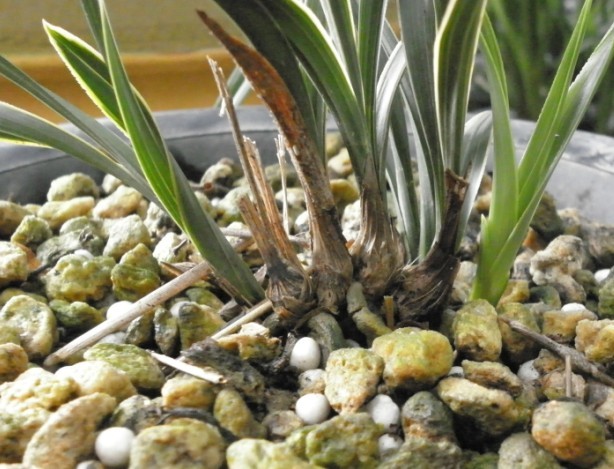
CultivationOrchidpotting media are many. Hard media include Zhijinshi (orchid stone), Tangji orchid stone, expanded clay pebbles, perlite, weathered stone, sand and gravel, crushed stone, and various other broken bricks and tiles; soft media include Send soil, snake wood (tree fern fiber), rotten wood, bark, leaves, and other fruit shells, spent mushroom substrate, and so on; humus media include the surface humus layer of forests and humus soil from composted and fermented garden dead branches and fallen leaves; soil media include mountain forest topsoil, loess, and so on.
We often mix various potting media in fashionable combinations to grow orchids. Media, environment, and management, the three are in a relationship of opposition, unity, and change.
Clear The singleness and inorganic nature of a potting medium is customarily called clear medium, and growing orchids with it is called clear growing. For example, pure Zhijinshi, Tangji orchid stone, sand and gravel, and so on. They are non-fertile, neutral media, often used to coax old rhizomes (old heads), or to grow old and weak seedlings and tissue-cultured plantlets just out of the flask; in management they are also often grown without fertilizer, or only foliar fertilizer is applied, and after the plantlets mature they are transplanted into organic media.
(Photo below: Luyun Zhao, tissue-cultured plantlet, medium is pure Zhijinshi, has been clear-grown for 3 years, and can now be transplanted into organic medium)
Clean No matter what kind of medium, and no matter the combination, cleanliness is foremost. Unused hard media such as Zhijinshi, Send soil, and so on are fine, but humus media must come from a reliable source, otherwise they must be disinfected before use.
(Photo below: Damo Zhao, pine bark 50% + Tangji orchid stone 40% + Send soil 10%)
(Photo below:Cymbidiumweak seedling, grown in the surface humus layer of Dicranopteris dichotoma (fern); after 10 days it clearly puts out new roots. It is a fine medium that is rich but not turbid, but it is not suitable for coaxing old heads or growing orchids without roots)
(Charcoal + pine bark, 50% each, there are almost no unhealthy roots)
Rich The fertility of a potting medium is of two kinds. One is the fertility the medium itself possesses, such as the surface humus layer of forests, composted humus soil, Send soil, and so on; the other is the artificial addition of various nutrients needed by plants, such as mixing phosphorus and potassium fertilizers into hard media with strong adsorption capacity, and so on.
(Photo below: Songmei, pine bark + Tangji orchid stone, 50% each)
(Xueshan old seedling 1 + 2 heads, pine bark 10% + Dicranopteris dichotoma)
(Photo below: Songmei pine bark 50% + Tangji orchid stone 40% + Send soil 10%) Good fertility, humidity is easy to control.
(Photo below: wild-collected orchid, charcoal + pine bark 50% each, good rooting, safe medium, good moisture retention)
(Photo below: two pots of Songmei, left is pine bark 50% + Tangji orchid stone 40% + Send soil 10%. Right is Dicranopteris dichotoma + pine bark 10%; the plant grown in Dicranopteris dichotoma has a darker color, showing the complete-nutrient nature of its fertility)
(Photo below: Songmei, medium Tangji orchid stone 40% + pine bark 50% + Send soil 10%, roots are very good)
Photo below: wild-collected orchid, medium Dicranopteris dichotoma, the original roots were deliberately cut short, and every new root it sends out is healthy, and it grows fast)
Turbid Overly mixed, fertility unclear, granules and powder not separated, bacteria and insects breeding, this kind of medium is not suitable forgrowing orchids
The main medium in my garden is pine bark 50% + 40% Tangji orchid stone + 10% Send soil, or without Send soil.
2. Dicranopteris dichotoma Easy to root, good fertility, it is a fine medium for all kinds of seedling conditions, but by no means use it to coax old heads or grow rootless old seedlings. When completely dry it is not easy to water thoroughly; it may be more useful in a rain-sheltered orchid shed.
3. Pine bark + charcoal Good rooting, humidity is easy to control, and the cost is lower than Tangji orchid stone; there are plans to use it as the main medium.