Orchid Anthracnose Knowledge Explained (Part 1)
Anthracnose of Orchids (Part 1)
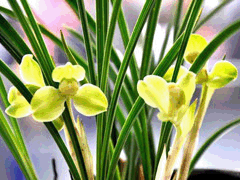 Orchids[Cymbidium spp., Orchidaceae]
[Symptoms]Leaf spots are semicircular, circular, oval, spindle-shaped, and irregular in shape, varying in size; some merge with one another into large patches or form dead streaks extending downward from the leaf tip. The spots are brown, or grayish-brown or grayish-white in the center, and some spots have a yellow-green halo around them. In the later stage, tiny black dots the size of pinheads (the fungus's acervuli) are scattered over the spots, and eventually the diseased leaves turn yellow and wither.
[Pathogen and disease characteristics]The pathogen is Colletotrichum gloeosporioides Penz. of the subphylum Deuteromycotina [= C. orchidearum Allesch = C. orchidearum Allesch f. cymbidii Allesch]. The fungus overwinters as mycelium and acervuli on diseased leaves or on diseased plant debris left in the soil. In the Guangzhou area, the overwintering period is not obvious; infection can begin in early spring when temperature and humidity are suitable, but the disease is most severe in May and June during the plum rain season, or in years with heavy autumn rain or typhoon rain in September and October. High humidity and muggy heat, especially weather that alternates between sunny and rainy, poor ventilation in the garden or nursery, poor fertilizer and water management, pots placed too close together so that leaves cross and become bruised, or frost damage to plants can all worsen the disease. Resistance differs among species and cultivars.Cymbidium sinense、Cymbidium ensifoliumthe cultivar Tiegengsu is relatively resistant to the disease,Cymbidium goeringii、Cymbidium faberi、Cymbidium kanran、Cymbidium ensifoliumthe cultivar Datousu is relatively susceptible to the disease.
[Control methods]① In winter and spring, cut off diseased leaf sections (in an "A" shape), collect the diseased debris and burn it, then immediately spray the ground and the whole plant thoroughly with 0.5%-1% Bordeaux mixture 1-2 times. ② Spray regularly to protect newly emerging leaves [in addition to the treatments for chrysanthemum anthracnose, you may also spray 1% Bordeaux mixture, 75% chlorothalonil + 70% thiophanate-methyl (1:1) 800-fold solution, 80% carbendazim-ziram 600-fold solution, 50% benomyl wettable powder 800-fold solution, or try 20% tricyclazole 800-fold solution]. ③ Strengthen fertilizer and water management, and improve ventilation and light penetration in the garden or nursery.